
THE SPELL IS BREAKING
Canadians Are Beginning to Question the War, the Money and the Man They Were Told Not to Doubt

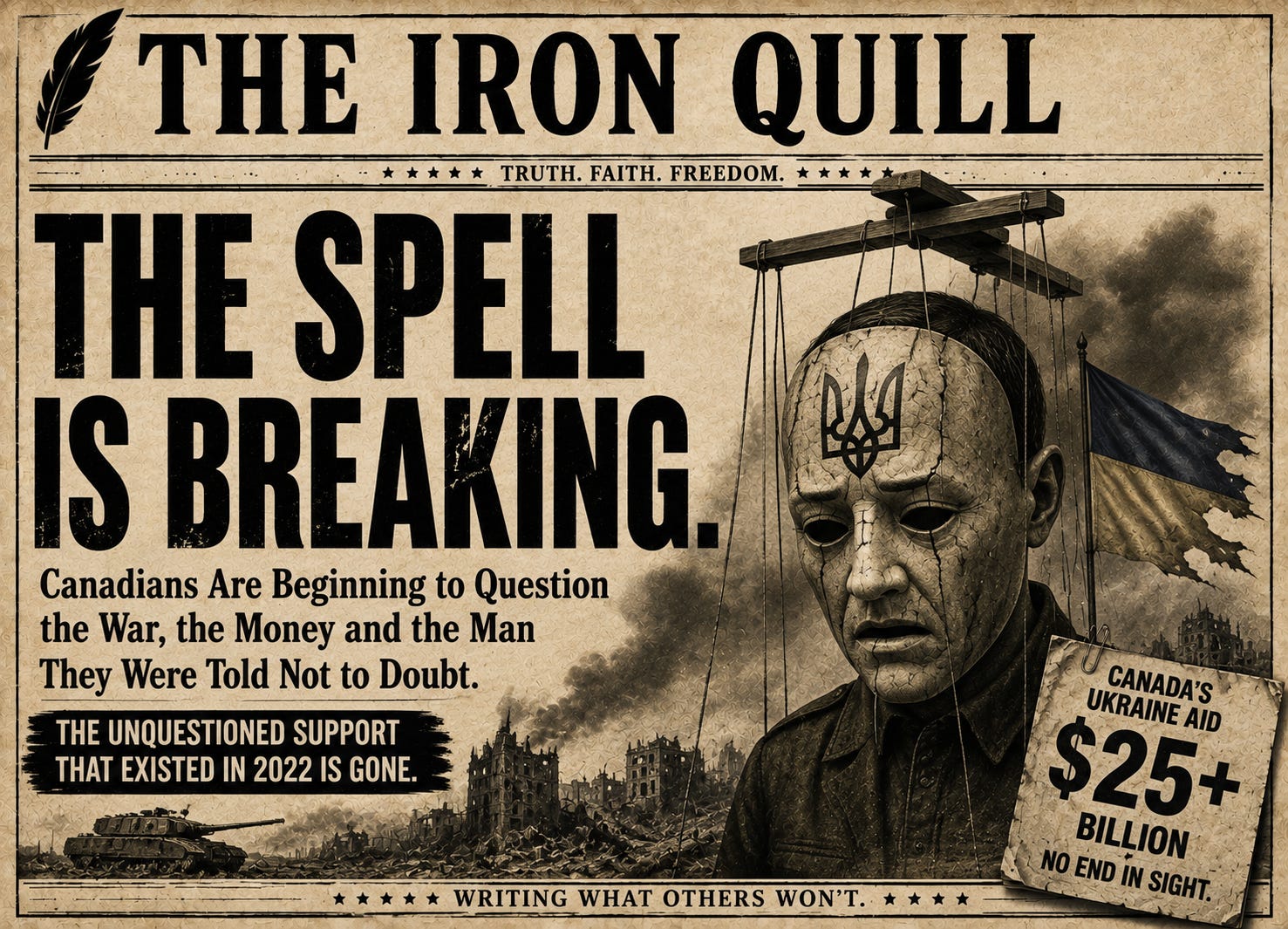
There comes a moment when every spell begins to fail.
Not because the magician suddenly loses his touch. Not because the stage lights go dark or the curtain falls. The spell breaks because someone in the audience finally notices the wires.
Then someone else sees them.
Soon the entire room begins looking past the performance.
That is what is happening with the war in Ukraine.
For years, Canadians were told exactly how they were expected to think. Wave the blue-and-yellow flag. Send the money. Ship the weapons. Applaud Volodymyr Zelenskyy. Do not ask what came before the invasion, where the billions were going, whether NATO helped build the road toward war or how any of it was supposed to end.
Questions were not answered.
They were punished.
Anyone who challenged the official story was shoved into a familiar box and dismissed as a Russian apologist, a Putin supporter or an enemy of democracy. It was easier than defending the narrative.
But narratives become fragile when they depend upon silence.
The silence is cracking.
The Iron Quill does not celebrate what is happening in Ukraine. It does not want the country destroyed, its people displaced or another generation fed into a war with no visible end. It wants peace. It also refuses to pretend that Zelenskyy is beyond scrutiny, NATO is beyond examination or the West has told the whole truth about how this war began.
The spell is not breaking because Canadians stopped caring.
It is breaking because they started looking behind the curtain.
WHEN THE STORY WAS SIMPLE
In the beginning, the public was handed a clean story. Russia invaded. Ukraine resisted. The West answered. That was all anyone was supposed to need.
History was reduced to a headline.
Years of tension between Russia and NATO were pushed aside. Russia’s objections to NATO’s movement eastward were treated as meaningless. Ukraine’s position between two rival power blocs was discussed only when it strengthened the approved narrative.
Canadians were not invited to understand the conflict.
They were invited to choose a jersey.
The emotional response was powerful because the suffering was real. Families fled their homes. Cities were battered. Lives were torn apart. Compassion was natural.
But compassion is not a substitute for foreign policy, and no country can build a lasting strategy on emotion, slogans and moral blackmail.
Sooner or later, people ask what they are supporting.
That moment has come.
THE CHEQUES KEPT COMING
Canada did not offer only kind words. It opened the treasury.
By early 2026, Ottawa said Canada had committed more than $25 billion in overall assistance to Ukraine, including billions in military aid.
That is not a ceremonial contribution.
It is an enormous national commitment made while Canadian families watch food prices climb, young people wonder whether home ownership has disappeared beyond the horizon, small communities lose services, veterans fight for support and hospitals strain beneath problems Ottawa never seems able to solve.
Yet when Ukraine asks, the government finds another announcement, another package and another promise.
The issue is not whether Canada should care about suffering beyond its borders. It should. The issue is whether Canadians are entitled to ask what their government is purchasing with their money.
What is the objective? What would victory actually look like? How much more will be required? How long is Canada committed? What happens when the weapons run short again?
These are not cruel questions. They are the questions responsible governments should answer before committing a country to years of open-ended involvement.
Instead, Canadians received a slogan:
As long as it takes.
That phrase sounds noble until someone asks what it means. As long as Ukraine needs to recover every inch of territory? As long as Russia refuses Western terms? As long as foreign governments remain willing to finance the battlefield? As long as Ukrainian families continue burying their sons?
A promise without a destination is not a plan.
It is a blank cheque.
THE MAN THE WEST CREATED
No one became more important to the public story than Volodymyr Zelenskyy.
He was presented as the face of courage, the reluctant warrior and the former comedian transformed into a statesman beneath the bombs. He appeared before Western parliaments dressed in military green, speaking in the language of sacrifice while elected officials rose to applaud him. Magazine covers, celebrity praise, money and weapons followed.
The image was not merely favourable.
It was protected.
Criticism of Zelenskyy was often treated as criticism of Ukraine itself. Questions about his government, his leadership and decisions made under martial law were brushed aside as though leading a country at war granted permanent immunity from examination.
But a nation is not its president.
The Ukrainian people are not Zelenskyy, and their suffering does not make him infallible.
That should never have needed saying.
THE VIEW FROM INSIDE THE ROOM
The interview with Zelenskyy’s former press secretary, Iuliia Mendel, caused many people to look again.
Mendel served inside his administration before Russia’s full-scale invasion in February 2022. She did not describe the polished figure presented to Western audiences. She offered a far more troubling account of Zelenskyy, his government and the political culture surrounding his administration.
Her allegations touched on corruption, leadership, missed opportunities for peace and the treatment of Ukrainians living through a prolonged war.
Her account should not be accepted blindly.
Political interviews are not courtrooms, and former insiders can bring their own grievances, loyalties and interpretations. The Iron Quill will not replace one form of propaganda with another.
But Mendel was not a casual observer guessing from a television studio. She worked inside Zelenskyy’s office. She saw the machinery behind the speeches.
That does not prove every accusation she made.
It makes her testimony worthy of examination rather than automatic dismissal.
For years, Western audiences were shown the front of the stage: the green shirt, the defiant speech and the carefully chosen backdrop. Mendel offered a glimpse behind the curtain.
Once people see the wires, the performance changes.
The question is no longer whether Zelenskyy has enemies. Every leader has enemies. The question is why so much of the Western press spent years treating serious scrutiny of him as something dangerous.
FROM SYMBOL TO SALESMAN
Zelenskyy has become more than Ukraine’s president. He has become the war’s chief salesman.
He travels abroad seeking air-defence systems, ammunition, funding, advanced weapons and long-term security guarantees. His defenders will say that this is his duty, and they are partly right. A wartime leader seeks assistance wherever it can be found.
But after years of appeals, Canadians are no longer hearing every request as an isolated emergency.
They are hearing a pattern.
Every setback brings another shipment. Every shortage produces another announcement. Victory remains close enough to justify the next package, but never close enough to end the war.
The battlefield moves while the rhetoric remains frozen.
Western governments insist that one more delivery may shift the balance. Zelenskyy insists that one more commitment may secure the future.
Meanwhile, the graves multiply.
Politicians measure war in territory.
Parents measure it in empty bedrooms.
That is the part missing from the speeches.
THE NATO QUESTION NEVER DISAPPEARED
The Iron Quill does not accept the fairy tale that this war appeared from nowhere.
NATO expanded eastward after the Cold War. At its 2008 summit in Bucharest, the alliance formally declared that Ukraine and Georgia would eventually become members. It gave Ukraine the promise of membership without the protection that membership would have provided.
Russia objected repeatedly.
Those objections were not invented after the invasion. In December 2021, Moscow demanded security guarantees that included an end to further NATO expansion and a commitment that Ukraine would not be admitted to the alliance. Western governments rejected the central demand, maintaining that Russia could not dictate the security choices of another sovereign country.
The talks failed.
War followed.
People can argue over whether Russia’s demands were legitimate, exaggerated or designed to secure ambitions of its own. What cannot honestly be claimed is that the conflict had no history before February 2022.
Acknowledging that record does not require admiration for Vladimir Putin.
It requires honesty.
Great powers react when rival military alliances move toward territory they consider essential to their security. Western governments understand this principle when their own interests are involved, yet treated it as meaningless when Russia invoked it.
Ukraine was caught between those powers. It was encouraged to move toward NATO without receiving the full protection of NATO membership. It was armed sufficiently to fight, but never sheltered enough to avoid becoming the battlefield.
When war came, Western capitals praised Ukraine’s courage and poured more weapons into the fire.
That is not the clean story Canadians were told.
It is the uglier one.
Ukraine was not merely defended.
It was used.
WHEN PEACE BECAME SURRENDER
The most dangerous part of the official narrative was not the worship of Zelenskyy.
It was the treatment of peace as betrayal.
Those calling for negotiations were accused of giving Putin what he wanted. Those questioning the likelihood of total Ukrainian victory were branded weak. Those examining NATO’s role were accused of repeating Kremlin propaganda.
The word peace itself became suspicious.
That should terrify people.
Every war eventually ends through victory, collapse or negotiation. When decisive victory cannot be delivered, refusing to negotiate does not preserve honour.
It prolongs death.
The Iron Quill does not want Russia marching across Europe. It does not want Ukraine erased from the map, nor does it believe Ukrainians should simply be abandoned. It believes the purpose of leadership is to find a road away from the graveyard.
Weapons may prevent defeat.
They do not automatically create peace.
There must eventually be a political settlement, security guarantees and an admission from all sides that this conflict was built over years, not born in a single morning. Until then, weapons will continue arriving and funerals will continue following.
WHAT CANADIANS ARE REALLY QUESTIONING
The unquestioned support that existed in 2022 is gone.
That does not mean Canadians have stopped caring about Ukrainian civilians. It does not mean the entire country has turned against Ukraine. It means the debate politicians and much of the media tried to close has reopened.
Canadians are asking where the money is going, how long the war will continue and what victory is supposed to look like. They are questioning Zelenskyy without condemning the Ukrainian people. They are examining NATO’s role without pledging loyalty to Moscow. They are looking at four years of weapons, promises and funerals and wondering whether any leader involved still has a credible road toward peace.
Those are not the questions of a country without compassion.
They are the questions of a country whose trust is wearing thin.
Canadians can welcome Ukrainian families while rejecting endless military escalation. They can oppose Ukraine’s destruction while recognizing that this conflict has a deeper history than the one presented in 2022. They can want the killing stopped without cheering for either side.
What is fading is not necessarily compassion for Ukraine. It is blind support for a policy that demands sacrifice without defining success. It is trust in a leader whose carefully constructed public image no longer satisfies everyone watching. It is confidence in a narrative that demanded obedience instead of earning it.
The support may not be gone.
The blank cheque is.
THE APPLAUSE WILL END
One day, this war will stop.
The speeches will end. The cameras will move somewhere else. Politicians will write memoirs explaining why every decision they made was unavoidable. Weapons manufacturers will find another customer, and news networks will discover another flag to place behind their anchors.
The stage will be cleared.
But the dead will remain.
The cities will remain scarred. The families who lost sons, fathers and brothers will not be repaired by a diplomatic statement or a carefully written chapter in someone else’s memoir.
History will ask the questions today’s leaders spent years avoiding. Could this war have been prevented? Could it have ended sooner? Were possible roads to peace neglected because too many powerful interests preferred continuation? Was Zelenskyy the heroic figure presented to the West, or a far more complicated leader shielded by a carefully managed wartime image? Did NATO protect Ukraine, or help turn it into the ground where a larger confrontation was fought?
Those questions are no longer confined to the margins.
They are entering Canadian homes.
The audience has begun to notice the wires.
The Iron Quill does not stand with Moscow, NATO or Zelenskyy’s public-relations machine. It stands with the people forced to pay for decisions made above their heads: the Ukrainian mother waiting for a son who may never return, the Russian mother carrying the same fear and the Canadian taxpayer being told that asking where the money goes is an act of disloyalty.
Wanting peace is not weakness. Questioning Zelenskyy is not hatred. Examining NATO is not treason. Refusing to applaud endless war is not abandoning Ukraine.
Every spell eventually breaks.
Not because the magician runs out of tricks.
Because the audience finally sees the illusion.
And behind every illusion of endless war lies the same brutal truth:
Wars begin with speeches.
They end with cemeteries.
—The Iron Quill
Hate to say it but I’ve been questioning this ever since the war began. Trudeau was too quick to defend Ukraine and instantly made Canada a war monger. Canada had a history of diplomacy in foreign conflicts since the end of WW2. It seemed too convenient to hastily send money as Ukraine is well known for dry cleaning foreign funds. I’ve written letters to my mla to question all the money sent asking for an audit but I’ve never received a reply. I truly question Chrystia Freeland’s role in Ukraine especially with her close ties to Mark carney. There is a putrid smell coming from that war. Zelensky, carney and all the European leaders are thriving whilst Ukrainians and Russians are paying with their lives! Ukraine has gold reserves Canada has zero, why are we sending them taxpayer money that our children, and grandchildren will have to pay back?
Anybody who thinks Russia is the problem is an absolute Neocon Marxist puppet!
How many hospitals,Water bombers etc thus could have built !