
Conviction Without Contempt
The Email I Knew Was Coming

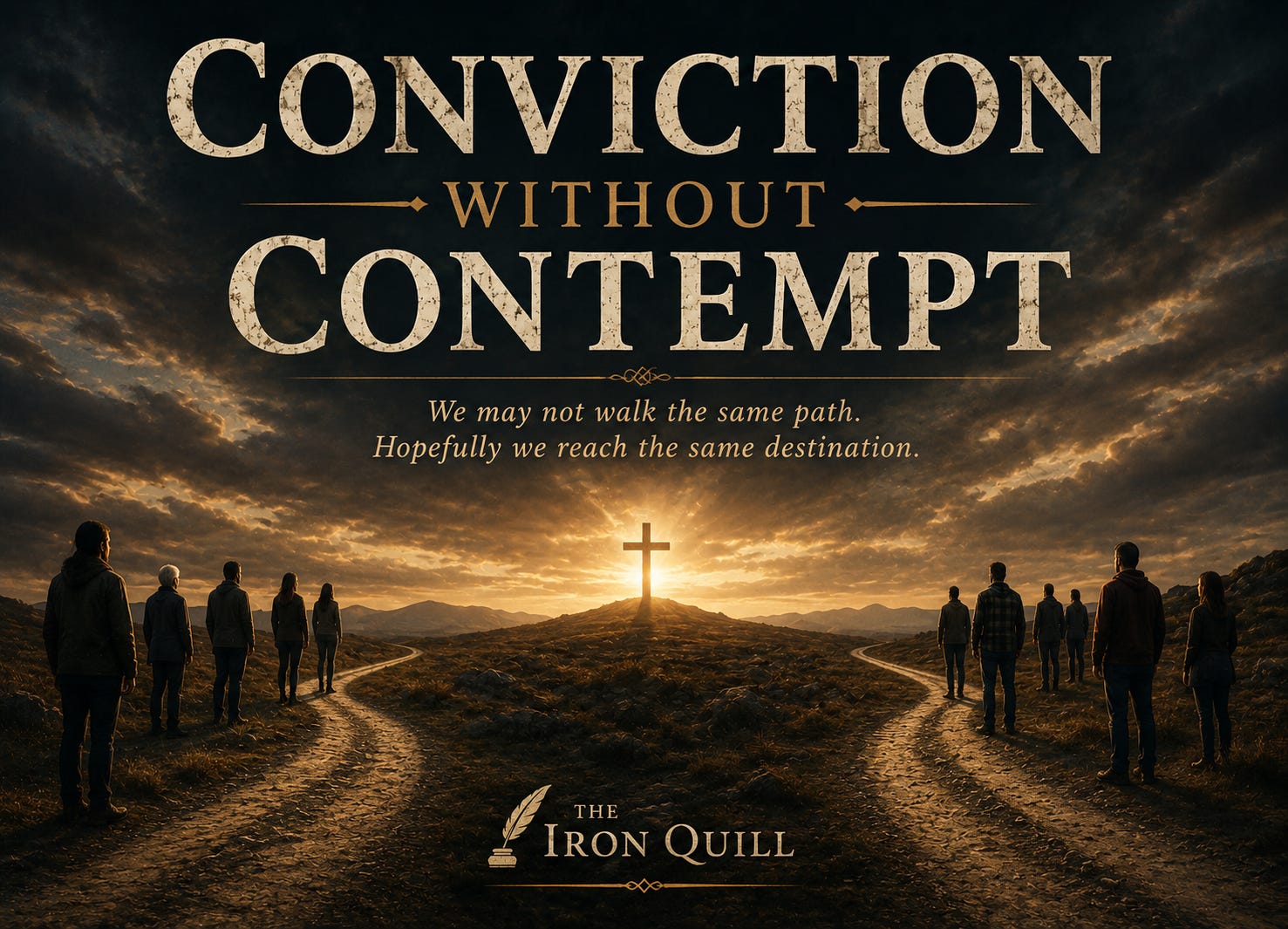
Over the past year, I have written my fair share of controversial biblical articles.
The Armstrong Files.
The Covenant Code.
The Sabbath.
The Feasts.
The New Covenant.
The law.
Prophecy.
The modern church.
The old paths.
The narrow gate.
Subjects that do not simply invite disagreement.
They almost guarantee it.
Some readers have agreed with every word. Others have disagreed with entire sections. Some have sent thoughtful replies. Some have pushed back hard. Some have probably closed the article halfway through and wondered how I got there.
That is fine.
I mean that.
It is fine.
Because the purpose of writing biblical articles is not to create a room full of people who nod at the same time, repeat the same phrases, and never wrestle with Scripture for themselves.
The purpose is to open the Bible.
To ask hard questions.
To test what we have been told.
To weigh tradition against the Word.
To look at what God actually said, not just what someone told us He meant.
That kind of writing will always stir disagreement.
It should.
Truth is not weak. Scripture is not shallow. Faith is not supposed to be a decorative item sitting untouched on a shelf.
But here is where the line must be drawn.
We do not have to accept every belief another person holds.
But we do have to respect the person holding it.
That is where many people have lost the plot.
The World Has Taught Us to Hate Disagreement
We live in an age where disagreement has become a declaration of war.
If someone disagrees with you, they must be dangerous.
If someone questions your view, they must be attacking you.
If someone reads Scripture differently, they must be blind, deceived, arrogant, legalistic, compromised, worldly, or lost.
The labels come fast.
Legalist.
Liberal.
Pharisee.
Heretic.
False teacher.
Compromiser.
Cultist.
Backslider.
And once the label is attached, the conversation is over.
That is not discernment.
That is laziness dressed up as righteousness.
The world does this constantly. Politics has trained people to treat disagreement as treason. Social media has trained people to react before they think. Algorithms reward outrage, not understanding. The loudest voice gets the most attention, and the harshest judgment is often mistaken for strength.
But Christians should know better.
We are not called to be soft on truth.
We are not called to pretend doctrine does not matter.
We are not called to shrug at error.
But we are also not called to tear one another apart every time we find a difference in understanding.
There is a difference between testing a belief and condemning a person.
There is a difference between correcting an idea and destroying a brother.
There is a difference between standing firm and standing proud.
That difference matters.
Conviction Is Not the Enemy
Strong conviction is not the problem.
A Christian should have convictions.
A Christian should believe something.
A Christian should be willing to say, “This is what I see in Scripture. This is what I believe God’s Word says. This is where I stand.”
There is nothing noble about being endlessly vague.
There is nothing faithful about refusing to take a position because someone might be offended.
If the Word of God speaks clearly, we should not mumble.
But conviction without humility becomes dangerous.
Knowledge without love becomes noise.
Zeal without patience becomes a weapon.
That is where the trouble begins.
A person can be right in doctrine and wrong in spirit.
A person can quote the verse and miss the heart.
A person can defend truth in a way that makes truth look ugly.
That should sober us.
Because the goal is not simply to win the argument.
The goal is to honour God.
God Does Not Teach Every Lesson at the Same Time
One of the things we forget is that God does not work on every person in the exact same order.
One believer may be deep in prophecy.
Another may be learning grace.
One may be wrestling through the covenants.
Another may be learning forgiveness.
One may be studying the Sabbath.
Another may be learning how to pray again after years of silence.
One may be digging through the law.
Another may be learning how to trust God with a broken family, a lost job, a sick parent, or a heavy burden nobody else can see.
We look at one another and assume everyone should be learning the same lesson at the same time.
But the Christian walk is not a factory line.
Peter’s road did not look like John’s.
Paul’s calling did not look like Timothy’s.
Moses did not walk the same path as David.
Elijah did not walk the same path as Jeremiah.
Yet God was working.
Different roads.
Different seasons.
Different wounds.
Different corrections.
Same God.
That does not mean all beliefs are equal. It does not mean every interpretation is true. It does not mean doctrine no longer matters.
It means we should be careful before we assume someone is rebellious simply because they have not arrived where we have arrived.
And we should be just as careful before assuming we have arrived at all.
Romans 14 Still Matters
Romans 14 is one of those chapters the modern church likes to quote but struggles to live.
Paul was dealing with believers who had different convictions. Some ate certain foods. Some did not. Some regarded certain days. Some did not. These were not people outside the faith. These were believers trying to honour God, but doing so with different consciences and different levels of understanding.
Paul did not tell them to despise one another.
He did not tell them to mock one another.
He did not tell them to form tribes and start throwing stones across the aisle.
He asked a simple question.
“Why do you pass judgment on your brother?” — Romans 14:10
That lands harder than most people want to admit.
Because sometimes we act as if every believer answers to us.
They do not.
They answer to God.
That does not erase truth.
That does not silence correction.
That does not mean we stop testing doctrine.
But it should change the way we carry ourselves.
There should be humility in our certainty.
There should be patience in our correction.
There should be restraint in our disagreement.
Because we are not dealing with opinions floating in the air.
We are dealing with souls.
What Writing Has Taught Me
Writing The Iron Quill has taught me something.
People can disagree and still be sincere.
People can challenge you and still respect you.
People can push back and still be seeking truth.
Not every disagreement is an attack.
Not every question is rebellion.
Not every correction is hostility.
I have had readers disagree with me on the Sabbath.
I have had readers disagree with me on the covenants.
I have had readers disagree with me on prophecy.
I have had readers disagree with me on Armstrong, church history, law, grace, and the direction of modern Christianity.
Some of those disagreements sharpened me.
Some forced me to explain myself better.
Some made me go back to the text.
Some reminded me that I still have more to learn.
And that is not a weakness.
That is part of the work.
If we are truly seeking truth, we should not be terrified of questions.
The Bible can handle scrutiny.
God does not need fragile defenders.
He needs faithful servants.
The Danger of Knowing Too Much
There is a strange danger that comes when a person studies deeply.
You begin to see things others do not see.
You begin to connect passages others have overlooked.
You begin to notice where tradition has covered over the plain reading of Scripture.
You begin to understand why certain teachings do not hold up under pressure.
And if you are not careful, knowledge starts to puff up.
You begin to mistake understanding for superiority.
You begin to think patience is compromise.
You begin to think anyone who disagrees must be less serious, less faithful, or less awake.
That is a dangerous place to stand.
Because none of us knows everything.
None of us sees perfectly.
None of us has mastered the fullness of God.
We are still students.
We are still servants.
We are still dust held together by mercy.
The longer we walk with God, the more humility should appear.
Not less.
Hopefully, the Same Destination
Here is the truth.
God’s Word may strike you in a place it has not struck me yet.
It may correct you in a season where I am being corrected somewhere else.
You may see something I missed.
I may see something you have not considered yet.
We may emphasize different passages.
We may carry different burdens.
We may be convicted in different ways.
We may not walk the exact same path.
But hopefully, we end up at the same destination.
At the feet of Christ.
Not at the feet of a denomination.
Not at the feet of a movement.
Not at the feet of a teacher.
Not at the feet of a tradition.
Not at the feet of our own pride.
At the feet of Christ.
That is the destination.
And if that is truly where we are going, then we should be able to walk with more grace than we often do.
Keep the Bible Open
So yes, I will keep writing hard articles.
I will keep asking uncomfortable questions.
I will keep challenging traditions when I believe Scripture demands it.
I will keep opening the subjects many would rather leave untouched.
But I also want to keep the conversation open.
Because this was never about building an echo chamber.
The goal is to pursue truth.
Open the Bible.
Test everything.
Hold fast to what is good.
Reject what is false.
Stay humble.
Stay teachable.
Stand firm.
Show respect.
That does not mean weaker conviction.
It does not mean softer truth.
It does not mean a watered down faith that refuses to speak clearly.
It means conviction without contempt.
Truth without pride.
Correction without cruelty.
Disagreement without division.
You do not have to believe everything I write.
I do not have to believe everything you believe.
But if we can still open the Scriptures together with humility, respect, and a sincere desire to know God, then the conversation is still worth having.
Because the goal was never to prove that we were right about everything.
The goal was always to follow Him.
—The Iron Quill
The Iron Quill is reader-supported.
Most of this work remains free because truth should travel.
If you believe in the mission, become a paid supporter and help keep the signal alive.
Very good article again. Your articles are to make a person think which we all should be doing. Thank-you
Excellent article, again, Iron Quill. On reading this I am reminded of the scripture, 2 Tim 2:15 "Study to show yourself approved by God."
In over 50 years of following Christ I have reevaluated my understanding in several areas humbled myself before the Lord, and learned there are different trails to the top of the mountain as long as we all arrive at the proper and designated pinnacle, Jesus Christ, Lord of all.