
WHY ARE WE HERE?

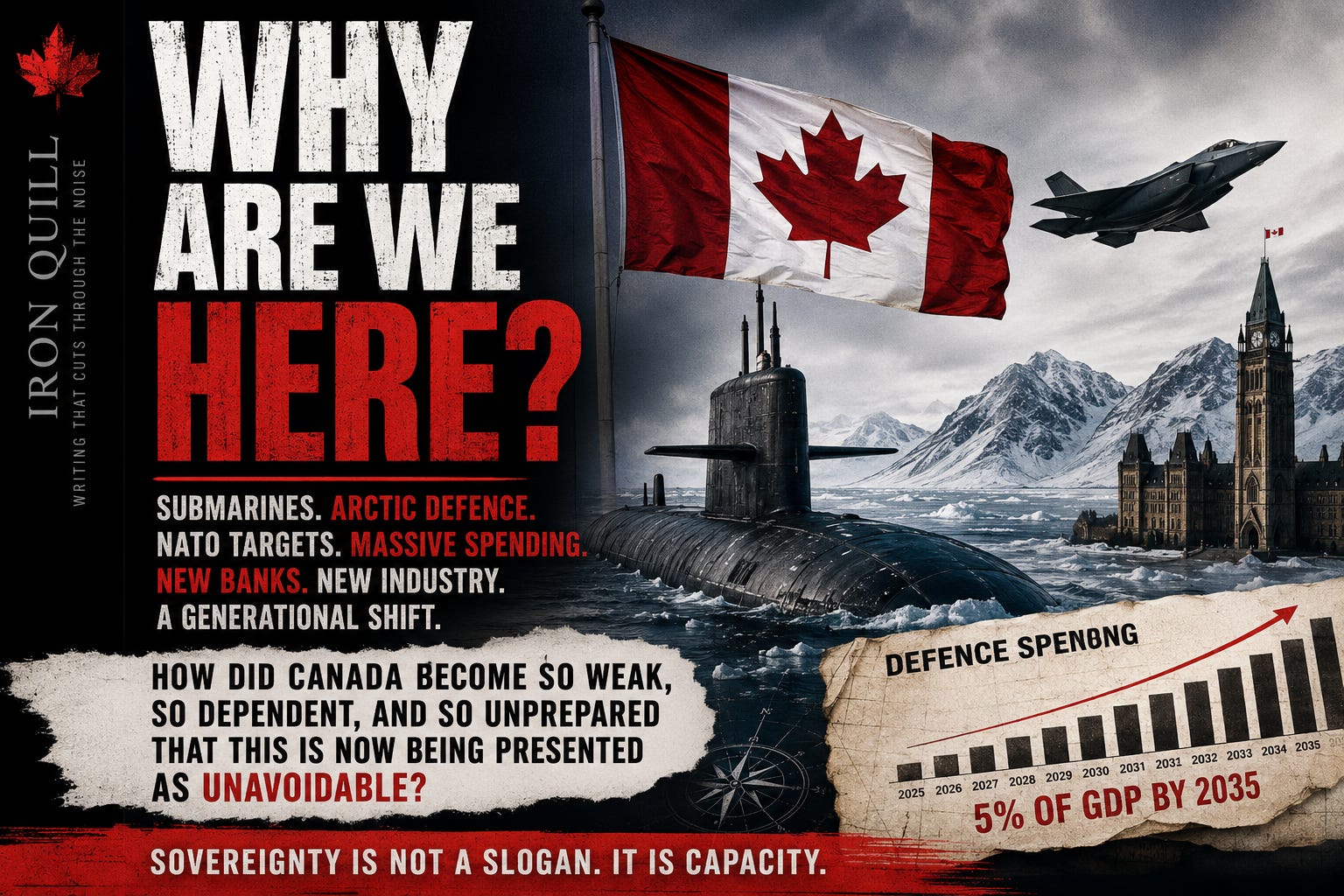
Submarines. Arctic infrastructure. NATO spending targets. Defence manufacturing. Military readiness. New financing structures. New language about sovereignty, security, resilience, and preparedness.
Canada is preparing for the largest defence buildup in generations.
Ottawa wants Canadians to look at all of this and accept the bill as necessary.
Maybe parts of it are.
A serious country needs to defend itself. It needs a functioning military. It needs to take the Arctic seriously. It needs to stop pretending geography alone is a defence strategy.
But before Canadians are asked to write the cheque, they deserve to ask a harder question.
How did we get here?
For years, Canadians were told there was not enough money.
Not enough to make life affordable.
Not enough to fix housing.
Not enough to meaningfully reduce taxes.
Not enough to stop families from being crushed by groceries, fuel, rent, mortgages, and debt.
Then, almost overnight, defence became the priority.
And suddenly, the money appeared.
Canada has claimed it reached NATO’s 2 percent defence spending benchmark and has committed to a much larger NATO pledge of 5 percent of GDP by 2035, with 3.5 percent for defence and 1.5 percent for defence and security-related investments. (pm.gc.ca)
That is not pocket change.
That is not a small adjustment.
That is a generational shift.
So the question is not simply whether Canada needs a stronger military.
The question is why the country was allowed to become so weak, so dependent, and so unprepared that this level of spending is now being presented as unavoidable.
This Did Not Happen Overnight
Canada did not wake up one morning and discover the world had changed.
The signs were already there.
Russia invaded Ukraine.
China expanded its reach.
The Arctic became more important.
Supply chains cracked.
Energy security returned to the centre of global politics.
Manufacturing capacity became strategic again.
The comfortable world was already cracking.
But Ottawa kept acting like history had ended.
For decades, governments delayed hard decisions. Procurement dragged. Equipment aged. Recruitment struggled. Readiness declined. Problems were studied, announced, re-announced, reviewed, delayed, and passed along.
Now the bill has arrived.
And like most bills government ignores for too long, it is bigger than it needed to be.
This is not just about one prime minister.
It is not just about one party.
It is about a political class that enjoyed the benefits of security without maintaining the foundations that made security possible.
Canada got comfortable.
Then it got cheap.
Then it got dependent.
Now Canadians are being asked to pay for the consequences.
We Outsourced Our Security Assumptions
For generations, this country lived beside the most powerful military force on earth.
That shaped everything.
The United States defended the continent.
NORAD guarded the skies.
NATO anchored the alliance.
Canada benefited from the protection, geography, intelligence, technology, and military strength of its southern neighbour.
That arrangement allowed Canadian governments to spend less, delay more, and pretend defence was someone else’s burden.
But that was never a real strategy.
It was an assumption.
And assumptions are dangerous when the world starts changing.
Today, that relationship is under greater strain than it has been in years, while Canada is also facing renewed pressure from NATO allies to carry more of its own defence burden.
Whether one blames Ottawa, Washington, or both, the result is the same.
Canada can no longer assume someone else will always carry the load.
You cannot neglect your own military and then act shocked when allies ask whether you are serious.
You cannot build a national security plan on the hope that someone else will always show up.
That is not sovereignty.
That is dependency with a flag on it.
The Arctic Is No Longer A Symbol
For years, politicians talked about the North like it was a map-room slogan.
True North.
Strong and free.
Arctic sovereignty.
Canadian territory.
Nice words.
But sovereignty is not a slogan.
Sovereignty is capacity.
Can you patrol it? Can you see it? Can you reach it? Can you defend it? Can you operate there when conditions are brutal and the stakes are high?
Canada is now moving toward major Arctic defence investments, including plans tied to military airfields, support hubs, and reduced reliance on the United States for Arctic defence. (reuters.com)
Canada has selected Germany’s Thyssenkrupp Marine Systems as the preferred supplier to begin negotiations for delivering up to 12 submarines for the Royal Canadian Navy. This is expected to become the largest defence procurement in Canadian history. The submarines are intended to strengthen Canada’s Arctic capabilities and improve interoperability with NATO allies. (pm.gc.ca)
That tells us something.
The Arctic is no longer being treated as empty space.
It is being treated as strategic ground.
Shipping routes matter.
Resources matter.
Surveillance matters.
Submarines matter.
Military access matters.
Continental defence matters.
The question is not whether Canada owns the North on paper.
The question is whether Canada has the strength to act like it.
And if the answer is no, Ottawa should have to explain why it took this long to notice.
Defence Is Becoming Economic Policy
Canada is not only talking about soldiers, ships, and planes.
It is talking about industry.
The government has launched Canada’s first Defence Industrial Strategy, promising to build up the domestic defence industrial base and increase Canadian defence capacity. (reuters.com)
That means defence is no longer just defence.
It is shipbuilding, steel, critical minerals, artificial intelligence, cybersecurity, manufacturing, ports, energy, supply chains, and industrial planning.
Ottawa is tying economic policy to national security.
That should get every Canadian’s attention.
Once government starts using security as the justification for reshaping the economy, the public has a right to know exactly what is being built, who controls it, who profits from it, and what freedoms are being traded along the way.
Defence can be necessary.
Sovereignty can be necessary.
Preparedness can be necessary.
But national security can also become a very convenient phrase.
It can justify spending, central planning, corporate handouts, and billions of dollars moving with less public resistance because nobody wants to sound unserious about safety.
That is why this moment needs scrutiny.
Not because Canada should be weak.
Because Canada has already been weak for too long.
And weakness should not become the excuse for an open-ended spending machine.
Who Gets Paid?
Whenever government spending explodes, Canadians should ask one simple question.
Who gets paid?
That does not mean every contractor is corrupt or every procurement is unnecessary. It means public money should never be moved on this scale without hard questions attached.
Canada is talking about massive defence investment.
Submarines. Arctic projects. Industrial strategy. Procurement reform. New financing tools.
Canada is also involved in a proposed Defence, Security and Resilience Bank, with nine countries committing to the initiative. Reuters reported the bank aims to raise up to £100 billion to finance allied defence capacity. (reuters.com)
That is not ordinary budgeting.
That is a new machine.
So Canadians should ask who benefits, how much work stays in Canada, how much money leaves Canada, which foreign partners are involved, which banks profit, and whether we are building real Canadian capacity or simply buying expensive systems from somewhere else and calling it sovereignty.
That question matters.
A country can spend billions on defence and still remain dependent.
A country can announce sovereignty and still outsource the machinery.
A country can claim strength while building a system where citizens pay, contractors profit, and Canada still lacks the ability to stand on its own.
Canada Does Not Have Unlimited Money
This is the part Ottawa does not want to discuss honestly.
Canada does not have unlimited money.
Families know this. Small businesses know this. Farmers know this. Workers know this.
Every ordinary Canadian lives with tradeoffs.
If the truck breaks down, something else waits.
If groceries go up, something else gets cut.
If the mortgage renews higher, the family budget changes.
Government pretends it lives by different rules.
It does not.
Debt is not magic.
Deficits are not courage.
Borrowed money is not free just because politicians spend it with serious faces and patriotic language.
Maybe Canada needs to invest more in defence.
But Canadians still need to know what gets sacrificed.
Will taxes rise?
Will services be squeezed?
Will debt grow?
Will affordability get worse?
Will this become another excuse to transfer public money into private hands while ordinary people are told to tighten their belts?
These questions are not anti-military.
They are pro-accountability.
A serious country can defend itself and still demand honesty from its government.
In fact, a serious country must do both.
The Real Failure Was Waiting This Long
The central issue is not whether Canada should defend itself.
Of course it should.
The issue is why Canada allowed itself to drift into a position where catching up now requires such dramatic action.
Why was readiness allowed to decline?
Why did recruitment problems persist?
Why did procurement become a national embarrassment?
Why did governments pretend Arctic sovereignty could be maintained with speeches?
Why did Canada assume the United States would always carry the burden?
Why did politicians spend years lecturing the world while neglecting the hard foundations of national strength?
This is the problem with political comfort.
It always sends the bill to someone else.
The leaders who delayed the hard decisions are often gone by the time the invoice arrives.
The speeches are forgotten.
The promises are archived.
The photo ops disappear.
Then ordinary people are told there is no choice.
Pay up. The world has changed. Security costs money. Be responsible.
But responsibility should have started years ago.
How Did We Get Here?
Canadians do not need another slogan.
They do not need another polished announcement.
They do not need another press conference about resilience, sovereignty, and global leadership.
They need the truth.
If Canada is preparing for a different world, say so plainly.
If the Arctic threat is serious, explain it clearly.
If our military has been neglected to the point of crisis, admit it.
If our dependence on the United States has become dangerous, own it.
And if defence spending is going to reshape the economy, then Canadians need a real debate before the machinery is built around them.
A nation does not become unprepared in a day.
It happens slowly.
One delayed procurement at a time. One neglected base at a time. One recruitment failure at a time. One broken promise at a time. One assumption at a time.
Someone else will defend us.
The world will stay stable.
The Arctic can wait.
The Americans will handle it.
The military can manage.
The money can be found later.
Well, later has arrived.
Now Canada is building submarines. It is talking about Arctic defence. It is tying industry to national security. It is pledging enormous defence spending. It is trying to rebuild capacity it should never have allowed to decay.
That does not make every new investment wrong.
But it does make the moment worthy of serious scrutiny.
History rarely presents the bill immediately.
It waits.
It waits until governments have changed.
Until speeches have been forgotten.
Until promises have disappeared.
Then it hands the invoice to ordinary people.
That is where Canada finds itself today.
Before we spend hundreds of billions preparing for tomorrow, Canadians deserve an honest answer about yesterday.
How did we get here?

If today’s article challenged, informed, or encouraged you, I would ask you to consider standing with this work.
In the coming weeks, I have an opportunity to represent the concerns of everyday Canadians in an important conversation. Your support helps make that possible.
If you believe independent, faith-driven journalism still matters, please consider clicking the Stand With The Quill button below.
Thank you to everyone who has already stood behind this mission. Your support is making a difference.
Members of the CAF called the Chretien/Martin years "the decade of darkness" for how badly they were funded. I wonder what they'll call the Trudeau/Blarney years?
"Then, almost overnight, defence became the priority.
And suddenly, the money appeared."
TRANSLATION .."This makes it sooo much easier to send the $$$ to Chrystia Sniffle-Twitch's Laundromat in Kiev"