
When Work No Longer Works

How are people supposed to live?
Not as a slogan.
Not as a complaint.
As a calculation.
A young tradesman working fifty hours a week wiring new luxury condos cannot qualify for a mortgage in the building he helped construct.
Two incomes barely cover rent.
Debt bridges the space between paycheque and survival.
Families are delayed. Ownership is delayed. Stability is postponed.
This is not cultural decline.
It is arithmetic.
And the arithmetic has shifted.
⸻
The Contract That Built a Country
For decades the contract was simple.
Work. Advance. Own.
You might not be wealthy. But you would have a stake. A modest home. A piece of ground. Something that tethered effort to reward.
That belief built the Canadian middle class.
It built neighborhoods of mechanics, nurses, clerks, farmers, small business owners and tradesmen who believed tomorrow would expand if they applied themselves today.
Ownership was not guaranteed.
It was attainable.
Today, full-time employment does not reliably produce independence.
That is not a minor adjustment.
That is a structural break.
⸻
The Detachment
In 1980, the average Canadian home cost roughly three to four times annual income.
Today, in many regions, that multiple has doubled.
In some, it has tripled.
A modest home now regularly costs eight to twelve times the income of the worker expected to service the debt.
Wages rose over time.
Asset prices accelerated far faster.
That divergence is the fulcrum.
When shelter detaches from wages, every other cost tightens around it. Mobility narrows. Risk tolerance disappears. Independence becomes conditional.
A society cannot remain stable when the entry point to adulthood requires permanent leverage.
⸻
How It Happened
No dramatic vote.
No single villain.
Incentives compounded.
Monetary expansion inflated assets.
Housing supply slowed under restriction and delay.
Energy costs layered into production and transport.
Tax burdens accumulated quietly.
Debt filled the widening space between income and cost.
Those who already owned assets benefited from appreciation.
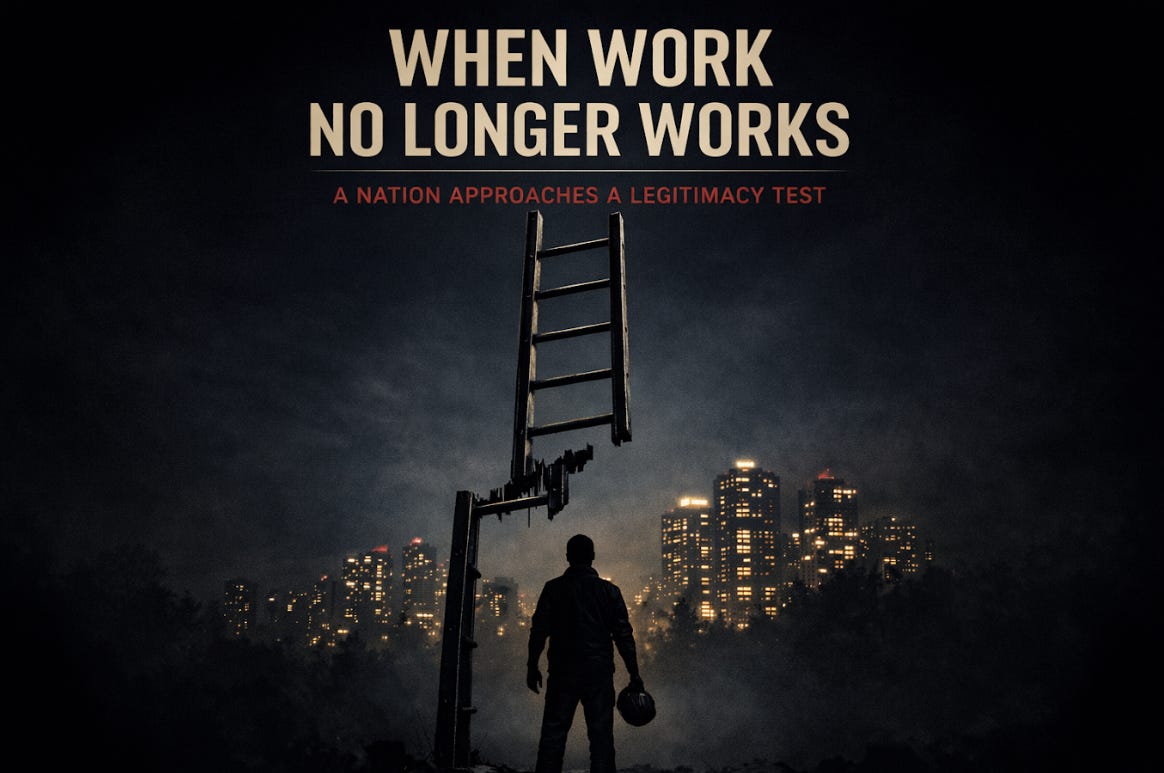
Those entering later encountered a ladder raised higher than expected.
This is not resentment.
It is structure.
And structure determines outcomes.
⸻
Why the Easy Answer Fails
We are told the solution is simple: raise wages.
But if shelter remains distorted, if regulation remains layered, if energy and tax costs remain embedded in everything, wages will chase prices upward.
That is escalation, not repair.
A higher minimum wage does not build supply.
It does not compress cost layers.
It does not realign effort with ownership.
The problem is not that workers want luxury.
The problem is that work no longer reliably produces independence.
That distinction matters.
⸻
The Behavioral Shift
When a generation runs the numbers and concludes ownership is unrealistic, it does not riot.
It recalibrates.
It avoids risk. It postpones entrepreneurship. It delays family formation. It chooses caution over expansion.
The apprentice electrician does not start a company.
The nurse does not invest in a clinic.
The young couple does not put down roots.
They wait.
Waiting becomes the culture.
And a culture of waiting does not build.
It preserves.
History shows that societies endure inequality.
They do not endure hopelessness.
⸻
The Legitimacy Test
A nation can absorb inflation cycles.
It can survive recessions.
It can weather political turnover.
What it cannot absorb indefinitely is the collapse of effort-to-reward alignment.
When full-time work cannot realistically move a person toward ownership, belief weakens.
Not in dramatic rebellion.
In quiet withdrawal.
People disengage before they revolt.
They stop believing the system will expand for them.
And when belief erodes, stability does not collapse overnight.
It thins.
Gradually. Then suddenly.
A country that cannot answer the question,
“How are people supposed to live?”
is not facing a temporary affordability squeeze.
It is approaching a legitimacy threshold.
A nation can survive rising prices.
It cannot survive the quiet collapse of upward mobility.
When work no longer works, belief erodes.
And when belief erodes, pressure does not disappear.
It accumulates.
The Iron Quill
I love this because its the sum of what of happening today:
When a generation runs the numbers and concludes ownership is unrealistic, it does not riot. They recalibrate and avoid risk.
Today hard working couples are being taxed heavily despite the increase in living cost. I had a discussion someone yesterday, he mentioned the system doesnt actively rewards the risk taker, but grants benefits to others who are playing it safe, who choose deliberately not to work, but rely on benefits. While those working are taxed to fund those not working. Hence you have low productivity, because if the majority chooses to wait on benefits from the govt, you already running a communist society.
I’m impressed by you information gathering and your presentation!