
When the Referee Disappears
Most political battles are not fought over ideology.

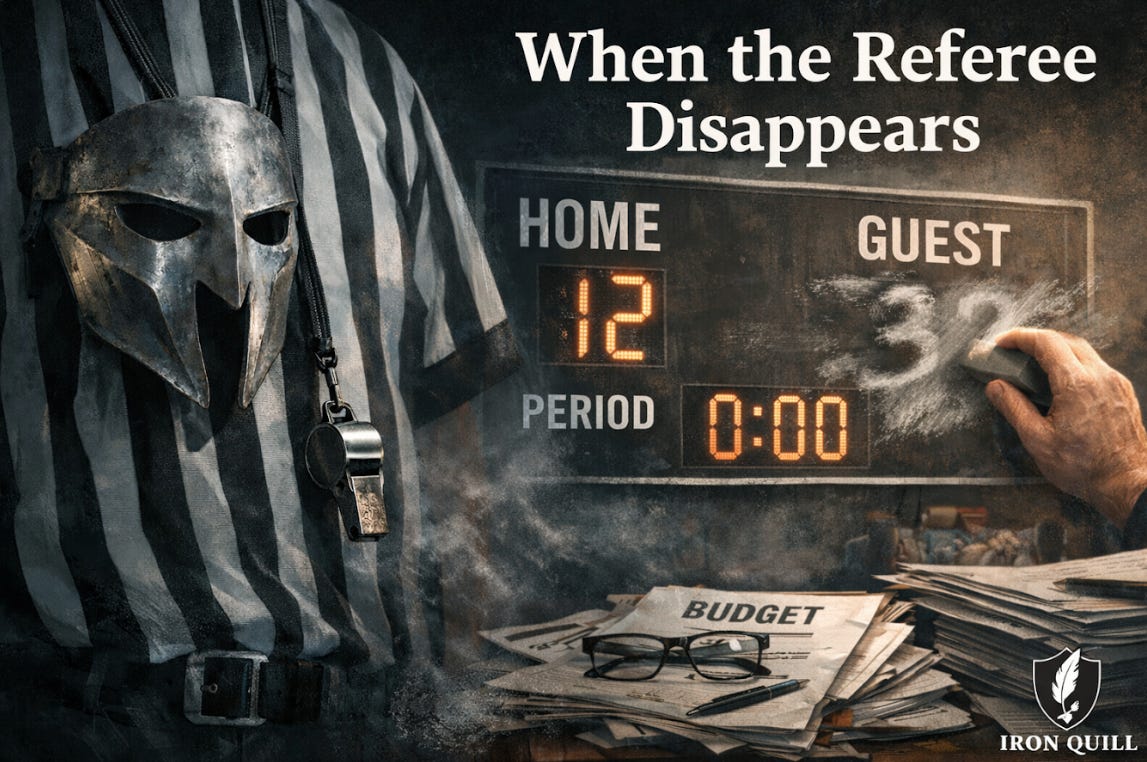
The War for the Numbers
Most political battles are not fought over ideology.
They are fought over numbers.
Deficits.
Budgets.
Program costs.
Debt projections.
Those numbers shape how a nation understands its own reality. If the numbers look manageable, government policy appears responsible. If the numbers look dangerous, pressure begins to build.
Every modern democracy understands this. That is why serious governments create institutions designed to verify the math behind their promises.
In Canada, that referee is the Parliamentary Budget Officer.
And right now, that referee is standing on uncertain ground.
This is not the kind of story that dominates headlines because it lives in the procedural shadows of government. It does not involve dramatic speeches or viral moments. It is technical, administrative, and easy for the public to overlook.
But in politics, the quiet procedural changes are often the ones that matter most.
Because when the referee disappears, the scoreboard becomes whatever the government says it is.
Why the Parliamentary Budget Officer Exists
The Parliamentary Budget Officer was created in 2006 for a simple reason.
Parliament needed an independent source of fiscal truth.
Before the office existed, Members of Parliament debating federal budgets were largely forced to rely on the government’s own financial projections. The government would present its numbers, and the country would be asked to accept them.
That arrangement was never particularly healthy.
The creation of the PBO introduced something new into the system. Independent fiscal scrutiny.
The office analyzes federal spending. It estimates the cost of government policies. It reviews economic assumptions buried inside federal budgets. It produces independent projections about deficits and debt.
Governments produce budgets.
The PBO checks the math.
The tension between those two roles is not a flaw in the system.
It is the design.
Democratic oversight works precisely because someone outside the political machinery has the authority to challenge the numbers being presented to the public.
Why Governments Dislike Independent Numbers
No government enjoys having its math challenged.
Optimistic projections are politically convenient. Independent verification often is not.
When fiscal watchdogs do their jobs properly they sometimes expose underestimated program costs. They reveal deficits larger than expected. They question growth assumptions that budgets quietly depend upon.
Those moments can be uncomfortable for the government holding power.
The current Parliamentary Budget Officer, Yves Giroux, has issued analyses in recent years that were less optimistic than federal budget projections. His office has warned that federal deficits could remain larger for longer than the government’s own fiscal plans suggest.
That does not make the office partisan.
It means the office is functioning as intended.
But inconvenient numbers create pressure. Governments prefer stability. Watchdogs prefer scrutiny. Those two instincts do not always coexist peacefully.
What the Carney Government Has Done
The current dispute surrounding the Parliamentary Budget Officer is procedural, but procedure is where power often hides.
The government has allowed the appointment process surrounding the position to stall while advancing a preferred replacement candidate that opposition parties say raises serious concerns about independence.
What should be a straightforward process designed to protect fiscal oversight has instead become a point of political dispute.
That matters because credibility is the currency of institutions like the PBO.
The moment the office becomes associated with political maneuvering, its authority begins to weaken. If the referee is seen as chosen for convenience rather than independence, the integrity of the scoreboard itself comes into question.
This is not about personalities. It is about the structure of oversight.
When governments influence the appointment of the person responsible for judging their own numbers, skepticism becomes inevitable.
The Deficit Incentive
There is another reason fiscal watchdogs create tension inside government.
Budgets are built on assumptions.
Growth forecasts.
Revenue projections.
Cost assumptions.
A small adjustment to those assumptions can change the appearance of a deficit by billions of dollars over time.
When an independent office examines those assumptions, the comfortable narrative inside a budget can suddenly look far less stable.
That is why the Parliamentary Budget Officer matters so much.
Without an independent referee testing the assumptions inside federal budgets, fiscal projections become political storytelling rather than financial analysis.
And when budgets become stories instead of measurements, deficits can grow quietly while the public is told everything remains under control.
The Timing Problem
If this were happening during a period of stable federal finances, the issue would still matter.
But Canada is not operating in a period of fiscal calm.
The federal government is running persistent deficits. Debt servicing costs are rising rapidly as interest rates climb. Large spending commitments continue to expand the fiscal footprint of the state.
These are the moments when independent oversight becomes most important.
In times of easy money and balanced budgets, fiscal watchdogs are useful.
In times of debt expansion and economic uncertainty, they become essential.
Yet at the precise moment when scrutiny should be strongest, the office designed to provide that scrutiny finds itself surrounded by political debate.
What Happens When Oversight Weakens
The consequences of weakening fiscal oversight rarely appear overnight.
They unfold slowly.
First, Parliament begins debating federal budgets without the full confidence that the numbers being presented have been independently tested.
Second, fiscal projections gradually become more political than analytical. Governments present assumptions that support policy objectives rather than challenge them.
Third, public trust in the integrity of national finances begins to erode.
Most citizens will never read a federal budget. But they can sense when institutions stop behaving independently.
Once the perception spreads that government numbers are shaped by political needs rather than objective analysis, restoring credibility becomes extremely difficult.
And credibility, once lost, is expensive to rebuild.
The Quiet Battle Most Canadians Never See
The loud political fights happen in press conferences and question period.
Those are the visible battles.
The real struggle often takes place somewhere far quieter.
Inside spreadsheets.
Inside economic models.
Inside the assumptions embedded deep inside federal budgets.
Control those assumptions and you control the narrative about a country’s financial health.
Which is why governments throughout history have always been tempted to manage the referees who evaluate their numbers.
The Scoreboard Problem
A functioning democracy requires more than elections.
It requires institutions capable of measuring reality honestly.
Canada does not need perfect governments. No country has them.
But it does need honest books.
Because once the numbers themselves become political instruments, the public is no longer debating policy choices.
They are debating illusions.
And illusions are easy to maintain when the referee is missing from the field.
When the referee disappears, the scoreboard always looks good for the team holding the pen.
And once a country stops trusting the scoreboard, it eventually stops trusting the game itself.
—The Iron Quill
Bottom line? Governments do not like truth. This is why they want Jacques gone. It is why the PMO assigns the ethics commissioner, the senate, the courts, now the police and media. Canada is in trouble and no one wants to accept the truth today, much easier to sit in the corner playing video games and eating junk food and drinking beer. Ya!! That’s the life! We have become a mollycoddled, sick society and it happened slowly over time. Here we are now…a country very divided. All by design.
I like that wording : political storytelling. You are very astute in your post. Thank you very much Iron Quill.