
WHEN THE CROWD IS WRONG
Why Following Christ Has Never Been a Popular Decision

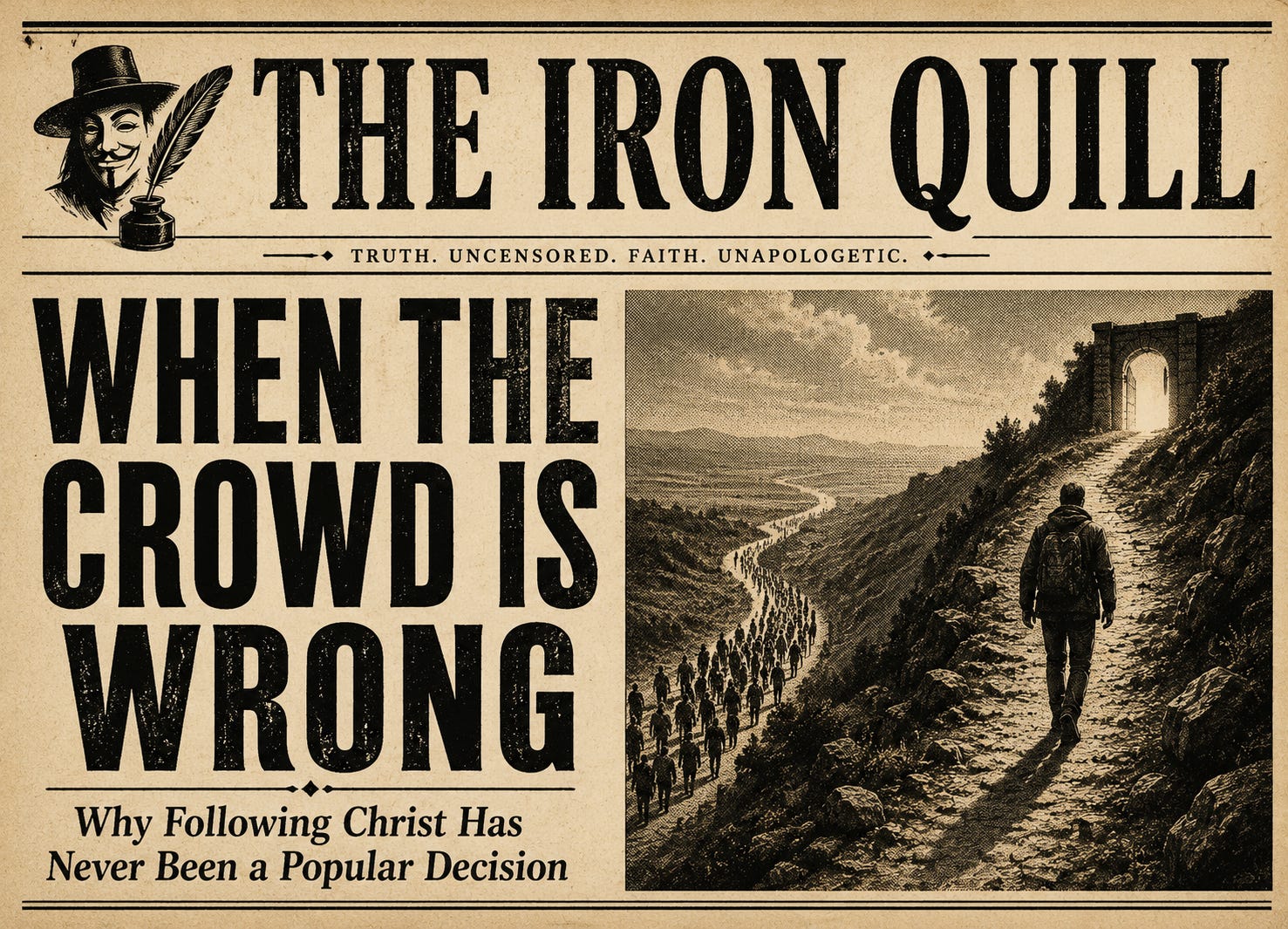
“Enter by the narrow gate. For the gate is wide and the way is easy that leads to destruction, and those who enter by it are many. For the gate is narrow and the way is hard that leads to life, and those who find it are few.”
Matthew 7:13–14 (ESV)
If popularity determined truth, Noah would have been the fool.
If the majority decided righteousness, Elijah would have surrendered on Mount Carmel.
If public opinion established justice, Barabbas would have walked away as the innocent man while Jesus remained the criminal.
Scripture tells a very different story.
Again and again, God shows us something the world does not want to accept.
The crowd is often wrong.
That should not surprise Christians.
Jesus told us it would be this way. He never promised that the road leading to life would become the busiest highway on earth. He said it would be narrow and that few would find it.
That single word—few—stands in direct opposition to nearly everything our culture believes.
Today we are told that if enough people agree on something, it must be true.
Polls become moral authority, popularity becomes evidence, and consensus is treated as wisdom. Before long, the crowd becomes our judge.
But God has never asked the crowd to decide what is true. Truth belongs to the One who created heaven and earth, not to whichever side can gather the most votes.
The Broad Road Is Always Busy
There is a reason Jesus described the broad road as crowded.
It is easy because it asks little and rarely demands sacrifice. It allows people to disappear into the crowd, choosing comfort over conviction without attracting notice.
No one attracts attention by moving with the crowd.
The narrow road is different.
It can feel lonely because it demands obedience when compromise would be easier and faith when sight would be more comfortable.
It asks believers to stand when everyone else is sitting down.
Christ never hid that reality.
He prepared His followers for it.
The Christian should never measure faithfulness by the size of the crowd.
Noah Built While the World Refused to Listen
Imagine standing in Noah’s place.
For decades, he built an ark in a world that refused to believe the warning he carried. Everything around him appeared to confirm that he was wrong.
Had Noah measured truth by public opinion, he would have laid down his hammer.
Instead, he trusted the voice of God over the voices surrounding him.
The rain eventually settled the argument.
The crowd did not become wrong when it began to fall.
They had been wrong all along.
The majority has never possessed the authority to rewrite God’s reality.
Elijah Stood Against the Majority
Centuries later, another servant of God found himself standing against overwhelming numbers.
Four hundred and fifty prophets of Baal stood on one side.
Elijah stood on the other.
By every human measure, he appeared hopelessly outnumbered.
But God has never counted heads before revealing truth.
When fire fell, it did not make Elijah right; it revealed that he had been right all along.
The living God had never been outnumbered.
Neither had His truth.
The crowd was simply standing on the wrong side of it.
The Crowd Chose Barabbas
Perhaps nowhere is this lesson clearer than outside the governor’s palace.
Pontius Pilate asked the people a simple question.
Whom should I release?
The crowd answered.
Barabbas.
Then they shouted for Christ to be crucified.
Think carefully about what happened.
The majority looked directly at the sinless Son of God and rejected Him.
If popularity determines truth, then Barabbas was righteous, Jesus was guilty, and the crowd’s demand was just.
Yet the world continues making the same mistake.
It assumes numbers determine morality.
Calvary proves they do not.
Why We Fear Standing Alone
Most believers do not compromise because they suddenly stop believing Scripture.
They compromise because they fear standing apart from everyone else.
We fear mockery, rejection, lost friendships, and closed doors. We fear becoming the only voice in the room saying what everyone else refuses to hear.
The fear of man has silenced Christians in every generation, often long before persecution was required.
That is why Proverbs warns:
“The fear of man lays a snare, but whoever trusts in the Lord is safe.”
Proverbs 29:25 (ESV)
The greatest danger is not that the crowd disagrees with you.
The greatest danger is allowing the crowd to become louder than God.
The Church Was Never Called to Follow Culture
The Church has faced this temptation in every generation.
The pressure, the rulers, and the language change, but the temptation remains the same.
It is the temptation to soften what God has spoken so that the world will find it easier to accept.
The first Christians understood this well.
They lived in an empire that celebrated pagan worship, demanded loyalty to Caesar, and viewed the exclusive claims of Christ as intolerable.
The apostles could have made life much easier for themselves. A little compromise, a little silence, and a few carefully chosen words could have spared them considerable trouble.
Instead, when they were commanded to stop preaching in the name of Jesus, they answered with remarkable simplicity:
“We must obey God rather than men.”
Acts 5:29 (ESV)
That answer still marks the dividing line for believers today.
Who will we obey?
The crowd or Christ?
The Church does not exist to discover where society is moving.
It exists to proclaim where Christ stands.
When the Church begins asking culture for permission to preach the truth, it has already surrendered the authority Christ gave it.
History shows where compromise leads.
Churches become quieter, truth becomes softer, sin receives new names, and repentance slowly disappears.
The gospel is reshaped until it becomes harmless.
And once it becomes harmless, it no longer confronts anyone.
The cross has always offended the world because it tells every one of us the same uncomfortable truth:
We are sinners who cannot save ourselves.
That message has never become popular.
It has only remained true.
Faithfulness has never required Christians to ask, “What is everyone saying?”
It has always required them to ask, “What has God said?”
God’s Word Does Not Change
Cultures, governments, churches, and public opinion can all change.
God does not.
“The grass withers, the flower fades, but the word of our God will stand forever.”
Isaiah 40:8 (ESV)
Truth does not become false because a generation rejects it.
Neither does error become righteous because millions celebrate it.
God’s standards have never depended upon human approval.
The Bible has outlived every empire that mocked it.
It will outlive ours as well.
The Narrow Road Is Never Empty
Standing apart does not mean standing alone.
Elijah learned that lesson after one of the greatest victories in Scripture.
Fresh from Mount Carmel, he fled into the wilderness convinced he was the last faithful servant left in Israel.
But God answered him with words every discouraged believer should remember:
“I have kept for myself seven thousand men who have not bowed the knee to Baal.”
Romans 11:4 (ESV, quoting 1 Kings 19)
Elijah thought he was alone, but God had preserved a faithful remnant all along.
He always has.
God did not abandon Noah, Daniel, or the apostles, and He will not abandon those who remain faithful today.
The crowd may be larger, but the remnant has never been forgotten.
God has never measured faithfulness by attendance.
He measures it by obedience.
Christ never promised His followers popularity.
He promised His presence.
And that has always been enough.
The Question Every Christian Must Answer
Every generation eventually faces the same choice.
Will we follow the crowd, or will we follow Christ?
The broad road offers acceptance now.
The narrow road leads to life.
The crowd has been wrong before.
It will be wrong again.
The Christian’s calling has never been to walk where the crowd feels comfortable.
It has always been to walk where Christ is leading.
The narrow gate was never meant to attract the crowd.
It was meant to lead the faithful home.

If today’s article challenged, informed, or encouraged you, I would ask you to consider standing with this work.
In the coming weeks, I have an opportunity to represent the concerns of everyday Canadians in an important conversation. Your support helps make that possible.
If you believe independent, faith-driven journalism still matters, please consider clicking the Stand With The Quill button below.
Thank you to everyone who has already stood behind this mission. Your support is making a difference.