
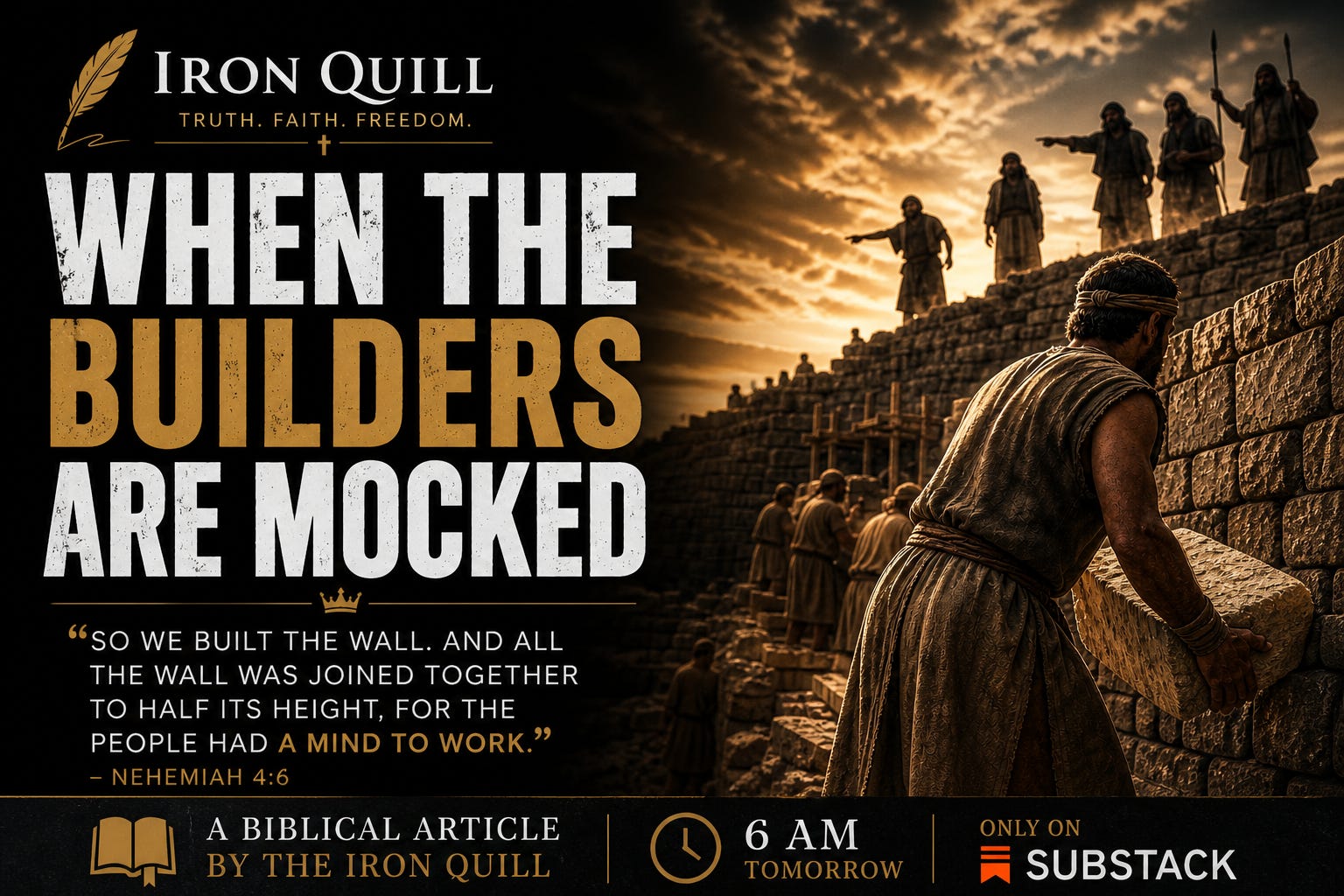
When the Builders Are Mocked

Broken walls always attract two kinds of people.
Builders and mockers.
One sees the ruin and reaches for a stone. The other sees the same ruin and reaches for an insult.
The enemy does not waste much time mocking people who are asleep. He does not need to ridicule the man who has already surrendered. He does not need to distract a house that has already gone cold. He does not need to discourage the people who have made peace with rubble.
Mockery usually begins when obedience begins.
That is what happened in the days of Nehemiah.
Jerusalem was broken. The wall was torn down. The gates had been burned. The city of God’s people sat exposed, vulnerable, and ashamed. Nehemiah did not create that condition. He saw it. He grieved it. He prayed over it. Then he rose to answer it.
And when the rebuilding began, the scoffers arrived.
Nehemiah 4:1–3 says:
Now when Sanballat heard that we were building the wall, he was angry and greatly enraged, and he jeered at the Jews. And he said in the presence of his brothers and of the army of Samaria, “What are these feeble Jews doing? Will they restore it for themselves? Will they sacrifice? Will they finish up in a day? Will they revive the stones out of the heaps of rubbish, and burned ones at that?” Tobiah the Ammonite was beside him, and he said, “Yes, what they are building—if a fox goes up on it he will break down their stone wall!”
There it is.
The voice of contempt.
The laughter of men who prefer ruin to restoration.
The hiss of those who can tolerate brokenness as long as no one has the courage to repair it.
The Wall Was Broken Before the Mockers Arrived
Nehemiah did not create the crisis.
He answered it.
The wall was already down. The gates were already burned. The shame was already public. The danger was already real.
That matters.
The enemies were not angry when Jerusalem lay in ruins. They had no righteous concern when the people were exposed. They did not weep over the broken gates. They did not labour over the fallen stones. They did not come with tools, timber, courage, or prayer.
They were comfortable with collapse.
Their anger began when someone started to rebuild.
That is often how it works.
Decay rarely offends the world.
Rebuilding does.
The broken wall may not be made of stone in our day, but the breach is still real.
A broken home can be tolerated. A compromised church can be ignored. A passive man can be left alone. A silent parent can be praised as reasonable. A fearful generation can be managed.
But when someone finally says, “This is not how it has to remain,” the voices of contempt begin to stir.
When a father decides to lead his home again, someone will call it pride.
When a mother decides to guard her children again, someone will call it fear.
When a church decides to preach truth again, someone will call it extremism.
When a man decides to repent, work, speak, build, and obey, someone will call it foolishness.
The mockers can live with rubble.
What they cannot tolerate is a man with a trowel in his hand and faith in his bones.
Mockery Is Aimed at the Will
Sanballat and Tobiah did not begin with swords.
They began with ridicule.
“What are these feeble Jews doing?”
“Will they restore it for themselves?”
“Will they finish up in a day?”
“If a fox goes up on it he will break down their stone wall!”
They questioned their strength.
They mocked their faith.
They laughed at their pace.
They attacked the quality of the work before the work was even finished.
This was not honest criticism.
This was spiritual warfare wearing the mask of sarcasm.
Mockery is often a weapon aimed at the will before it ever reaches the wall.
The enemy does not always need to stop your hands if he can poison your spirit first. If he can make you ashamed of the assignment, he may not need to fight the assignment. If he can make you embarrassed to obey, he may not need to stop your obedience. If he can convince you that the stones are too burned, the task too late, the people too weak, and the wall too far gone, he can make you quit before the breach is closed.
That is why ridicule is so effective.
It makes obedience feel small.
It makes rebuilding feel foolish.
It makes faith look naïve.
It whispers, “Who do you think you are?”
That question has stopped many men.
It has stopped many women.
It has stopped many families.
It has silenced many churches.
But the better question is not, “Who do you think you are?”
The better question is, “What has God put in front of you?”
Nehemiah did not need Sanballat’s permission to obey.
He did not need Tobiah’s approval to build.
He had a ruined wall, a burden from God, and work to do.
That was enough.
Nehemiah Prayed and Kept Building
Nehemiah did not spend the chapter chasing every insult.
He did not call a meeting to explain himself to Sanballat.
He did not pause the work to manage Tobiah’s feelings.
He did not reshape the assignment to make the critics more comfortable.
He prayed.
Then he kept building.
Nehemiah 4:4–6 says:
Hear, O our God, for we are despised. Turn back their taunt on their own heads and give them up to be plundered in a land where they are captives. Do not cover their guilt, and let not their sin be blotted out from your sight, for they have provoked you to anger in the presence of the builders. So we built the wall. And all the wall was joined together to half its height, for the people had a mind to work.
That is the order.
He brought the insult before God.
Then the wall kept rising.
Some battles are not won by winning the argument. They are won by refusing to leave the assignment.
This is a hard lesson for our age because we live in a world built on reaction. Every insult demands a response. Every accusation demands a statement. Every critic demands access to your attention. Every scoffer wants to pull the builder off the wall and drag him into the mud.
But Nehemiah shows another way.
Pray first.
Keep building.
That does not mean every critic is wrong. It does not mean correction should be ignored. It does not mean pride should be dressed up as courage. A faithful man must remain teachable before God.
But there is a difference between correction and contempt.
Correction wants the work strengthened.
Contempt wants the work stopped.
Nehemiah understood the difference.
He did not let mockery become his master.
He did not let the enemy choose his schedule.
He did not abandon the wall to win a shouting match with men who had no intention of helping.
He prayed.
Then the builders built.
The People Had a Mind to Work
This is the line that cuts through the fog.
“So we built the wall. And all the wall was joined together to half its height, for the people had a mind to work.”
They had a mind to work.
Not a mood to work.
Not a wish to work.
Not a passing burst of religious emotion.
A mind to work.
That is discipline. That is obedience. That is faith that has learned how to carry weight.
They were not waiting for ideal conditions. They were not waiting for the mockers to approve. They were not waiting for the task to feel safe, easy, or respected.
They had a wall to rebuild.
So they built.
Prayer did not replace the work. Prayer strengthened the hands that carried it.
That is a word many people need to hear.
Faith is not laziness dressed in religious language.
Faith moves.
It carries stones.
It repairs breaches.
It guards the home.
It tells the truth.
It repents.
It forgives.
It disciplines the flesh.
It returns to the Word.
It stands where God has placed it, even when the laughter begins.
There is a kind of religion that wants the comfort of God without the call of obedience. It wants the language of faith without the labour of rebuilding. It wants the blessing without the burden, the promise without the plow, the restoration without the stones.
But Nehemiah gives us no such picture.
The people prayed.
Then they worked.
They trusted God.
Then they lifted stones.
They knew the wall would not rebuild itself.
Every Family Had a Section of Wall
One of the most powerful truths in Nehemiah is that the work was shared.
Not everyone rebuilt the entire wall.
Each had a section.
That matters.
God does not usually ask one faithful person to repair the whole ruin alone. He calls His people to take responsibility for the section in front of them.
Your section may be your home.
Your marriage.
Your children.
Your speech.
Your church.
Your work.
Your habits.
Your courage.
Your obedience.
Your section may not look impressive to anyone else. It may not draw applause. It may not trend. It may not be noticed by the people who measure importance by noise.
But God sees the wall.
He sees the breach.
He sees the hands that return to the work when no one is clapping.
The remnant does not rebuild by applause.
It rebuilds by assignment.
That is where many people get lost. They look at the size of the ruin and despair. They see the brokenness in the country, the church, the culture, the school, the family, and the soul, and they decide the work is too large to begin.
But God often begins with the section in front of you.
Do not despise that.
Repair what is yours to repair.
Strengthen what is yours to strengthen.
Confess what is yours to confess.
Build what is yours to build.
The wall rises when ordinary people stop waiting for someone else to fix the breach.
The Mockers Were Loud, But the Wall Still Rose
Sanballat spoke.
Tobiah laughed.
The enemies sneered.
But the wall still rose.
That is the hope in this passage.
The sound of mockery does not mean the work is failing. Sometimes it means the work is finally threatening the darkness.
The enemy mocks rebuilding because rebuilding is a testimony against ruin. Every stone returned to its place declares that collapse does not get the final word. Every gate repaired declares that shame does not get to reign forever. Every family restored, every destructive habit broken, every truth spoken, every prayer prayed, every act of obedience carried out in the face of contempt becomes a witness.
The mockers may be loud.
But they are not sovereign.
God is.
And when God strengthens the hands of His people, burned stones can be lifted again.
That is the part Tobiah could not understand.
He saw rubble.
God saw a wall.
He saw weakness.
God saw builders.
He saw burned stones.
God saw restoration.
Let them mock.
The sound of stones being set back into place is louder in heaven than the laughter of men.
Pick Up the Stones
The faithful do not need perfect conditions.
They do not need applause.
They do not need permission from those who are comfortable with ruins.
They need repentance.
They need prayer.
They need courage.
They need a mind to work.
The wall will not rebuild itself.
The home will not strengthen itself.
The church will not reform itself.
The soul will not discipline itself.
The next generation will not guard itself.
Someone has to pick up the stones.
Someone has to stop making peace with rubble.
Someone has to pray while despised and work while mocked.
Nehemiah did not answer ruin with despair.
He answered it with faith.
He answered it with obedience.
He answered it with builders who had a mind to work.
That is the warning.
That is the invitation.
When the wall is broken, the faithful do not spend their lives cursing the rubble.
They repent where they must.
They pray.
They pick up the stones.
Let the mockers speak.
The builders have work to do.
And by the grace of God, they build.
—The Iron Quill
The Iron Quill is reader-supported.
Most of this work remains free because truth should travel.
If you believe in the mission, become a paid supporter and help keep the signal alive.
Tell me one time when negativity fixed something. Just one.