
WHEN SUPPORT BECOMES CONDITIONAL
What Happens When the Help You Rely On Changes

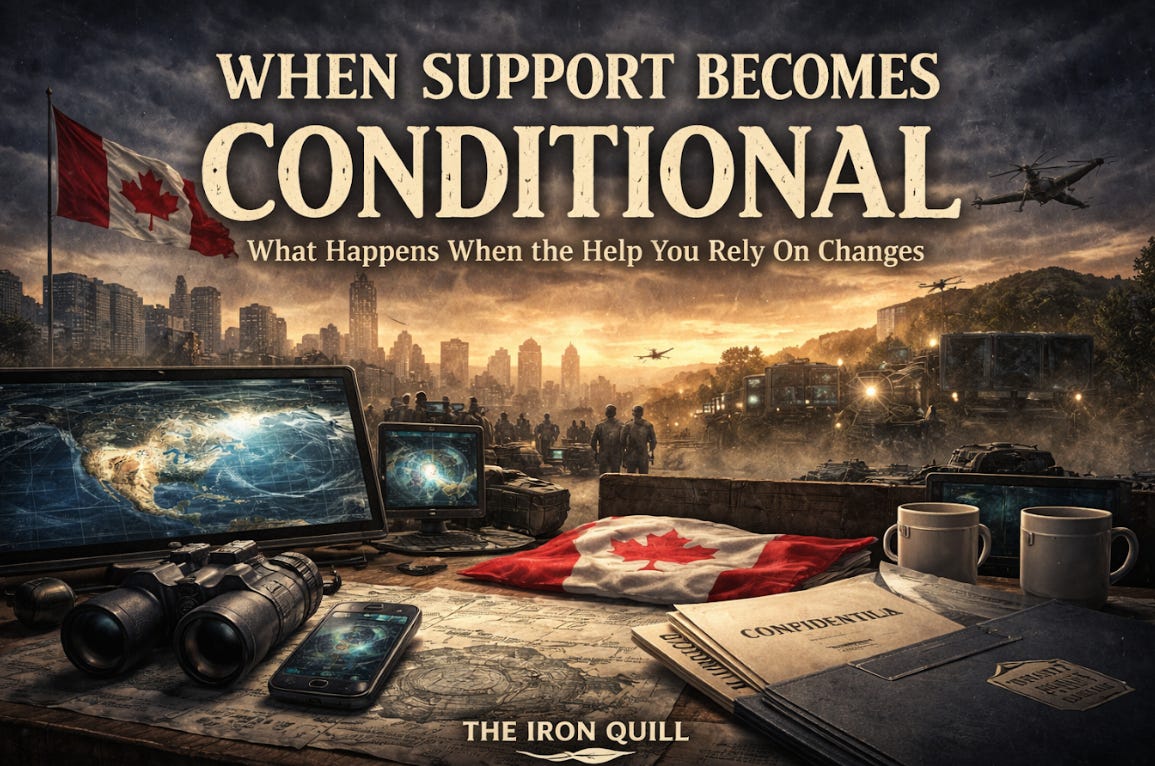
THE COMFORT OF ASSUMPTION
Canadians believe they are protected.
They believe threats are being watched, intercepted, stopped before they ever reach them.
What they rarely ask is a simpler question.
Who is doing the protecting?
That assumption sits quietly in the background. It is never tested. It is never challenged. It simply exists.
And like all assumptions, it holds right up until the moment it doesn’t.
⸻
PROTECTED FROM BEYOND OUR BORDERS
In just the past week, multiple threats inside Canada were disrupted with assistance from outside our borders.
That is not unusual.
It is the system working as designed.
Threats do not respect borders, and neither does intelligence. Information flows across lines on a map through coordination, through shared systems, through alliances.
Structures like NORAD and Five Eyes are not symbolic. They are operational.
They prevent harm. They close gaps. They keep systems running.
This is not an exception. It is routine.
And routine dependence is the kind no one notices until it changes.
Because when something works consistently, it becomes invisible. It becomes expected. It becomes assumed.
And that is where risk begins.
⸻
PARTNERSHIP OR RELIANCE
Cooperation is not the problem.
Dependence is.
Every nation works with others. Intelligence is shared. Systems are linked. That is the reality of a connected world.
But there is a line.
Partnership means you stand together.
Reliance means you cannot stand alone.
And those are not the same thing.
A nation that cannot stand alone does not negotiate from strength.
It negotiates from need.
That difference may not matter in times of stability.
But it matters the moment conditions change.
⸻
WHAT HAPPENS WHEN SUPPORT CHANGES
This is the question no one asks when things are working.
Because when systems function smoothly, assumptions take their place.
But history does not move in straight lines.
Relationships shift. Priorities change. Governments turn inward. Pressure builds.
And when that happens, support is no longer automatic.
It becomes conditional.
Conditional on politics.
Conditional on interest.
Conditional on cost.
A shift in leadership. A domestic crisis. A change in priorities.
Support does not disappear overnight.
It narrows.
It slows.
It becomes selective.
What was once assumed becomes negotiated.
What felt permanent becomes uncertain.
And uncertainty is where systems begin to fail.
⸻
THE RISK NO ONE PREPARES FOR
If support changes, even slightly, the consequences are immediate.
Gaps form. Response times slow. Blind spots appear.
Systems that once operated seamlessly begin to strain.
Because they were never designed to function alone.
They were designed to function together.
And when one side pulls back, even partially, the entire structure feels it.
Not dramatically at first.
Quietly.
A delay that wasn’t there before. A signal missed. A response that comes just a little too late.
That is how systems break.
Not all at once.
But piece by piece.
⸻
THE ILLUSION OF STABILITY
The most dangerous moment is not failure.
It is the moment before it.
When everything still appears stable. When threats are still being stopped. When the public still believes the system is fully intact.
That is when the risk is highest.
Because by the time the shift becomes visible, the window to prepare has already closed.
Stability, in that moment, is not strength.
It is momentum.
And momentum eventually runs out.
⸻
A COUNTRY THAT MUST ASK HARD QUESTIONS
Canada is not a weak country.
But strength is not defined by what works when everything is aligned.
It is defined by what holds when it is not.
Can we detect threats independently?
Can we respond without external systems?
Can we operate if support becomes slower, smaller, or selective?
These are the questions that matter.
These are the questions leaders should already be answering.
Not after pressure rises.
Before it does.
Because waiting for failure to reveal weakness is not strategy.
It is exposure.
⸻
THE QUILL’S FINAL WORD
All support feels permanent until it is tested.
All systems feel strong until they are strained.
And all alliances feel certain until conditions change.
The world is shifting.
Priorities are tightening.
And the assumption that someone else will always be there is not a strategy.
It is a risk.
Because when support becomes conditional, there is no warning.
Only realization.
And by then, it is not a question.
It is a reality you cannot undo.
—The Iron Quill
Having worked in that world for more than three decades, I've been telling anyone who will listen that Canada could not exist without the USA carrying most of our load.
The wonderful (not) healthcare Canadians love to boast about (or used to) would not be affordable if we properly funded our military and police. So now we don't have either healthcare OR military. But hey, we have tampons in the men's bathroom so hurray??
Imagine the gall of many Canadians looking down their noses at Americans for not having universal healthcare while allowing our military to rust in pieces. And then getting indignant when Trump said "Meet your NATO obligations!!"
I spent most of my adult life in service of Canada but nowadays, I wonder why I bothered.
It almost makes one think... Wow, what a powerful and self-reliant country this would be if there were no border between Canada and the USA...