
When Steady Becomes Stationary

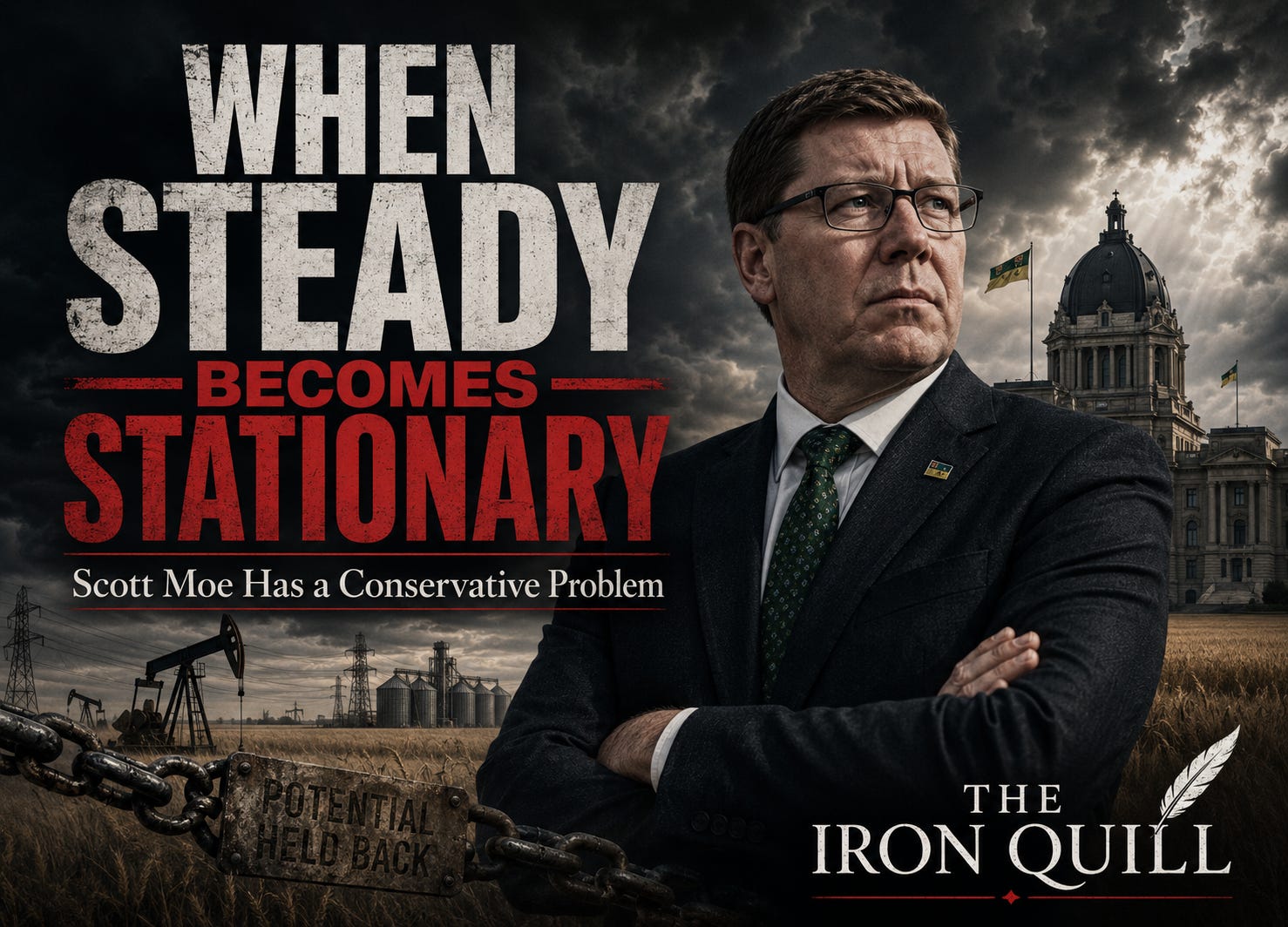
This is not about left versus right.
It is about power versus posture.
Saskatchewan is not weak. It is not poor. It is not without leverage, resources, land, energy, food, fuel, or strategic value. This province has potash under the ground, uranium in the rock, oil in the patch, grain in the bins, cattle on the land, and people who still understand that civilization does not run on slogans.
And yet too often, Saskatchewan is governed like a province waiting for permission.
That is the problem now facing Scott Moe.
Not because conservatives have suddenly become New Democrats. They have not. Not because rural Saskatchewan has discovered the wisdom of Ottawa’s climate class. It has not. Not because the people who built, drilled, planted, hauled, welded, taught, raised, repaired, and endured have decided to surrender the province to the same forces that would gladly manage it into decline.
The unrest is coming from the right.
It is coming from people who voted Saskatchewan Party because they believed it was the wall between this province and federal control. It is coming from farmers, oilfield workers, business owners, parents, rural ratepayers, and ordinary citizens who defended the government for years because the alternative looked worse.
But a survival argument is not the same thing as leadership.
That is where the old bargain is beginning to crack.
The Old Bargain
For years, the deal was simple.
The Saskatchewan Party did not have to be perfect. It only had to be better than the NDP.
For many conservatives, that was enough. They understood the stakes. They knew what the provincial left would do with power. They knew what would happen to resource development, rural priorities, property rights, parental authority, and the working economy if Saskatchewan were handed over to people more comfortable with bureaucracy than backbone.
So they held the line.
They defended the party. They gave it patience. They accepted imperfect victories because the alternative looked like open surrender.
But the country has changed.
Ottawa has grown more aggressive. Federal climate policy has become more invasive. The resource economy has been treated like a guilty industry instead of the backbone of national prosperity. Agriculture has been lectured by people who have never risked a crop under an open sky. Energy workers have watched politicians talk about transition while families wonder what future they are supposed to transition into.
The old question was simple.
Who can keep the NDP out?
The new question is harder.
Who will make Ottawa feel consequence?
That is the question Scott Moe cannot dodge forever.
Alberta Forces the Table
Saskatchewan conservatives are looking west.
They are watching Alberta force itself back into the national conversation. They are watching Danielle Smith put pipelines, carbon pricing, market access, and provincial leverage at the centre of federal politics. They are watching Alberta behave like a province with weight.
The latest Alberta-Ottawa energy deal is not clean. It comes with strings. Carbon pricing pressure. Indigenous consultation requirements. Private-sector uncertainty. Opposition from British Columbia. No serious person should look at it and pretend Alberta has won some final victory.
But that is not the point.
The point is that Alberta forced the table.
Pipeline access is back in the national discussion. Industrial carbon pricing is being negotiated instead of simply swallowed as gospel. Ottawa is being made to answer questions it would rather bury under soft language about transition, partnership, and clean growth.
That is leverage made visible.
It is not always pure. It is not always pretty. It does not always end in victory. But it changes the room.
Alberta has made itself difficult to ignore.
Saskatchewan, too often, still sounds like a province filing objections from the hallway.
Saskatchewan Waits for Permission
This is the charge.
Saskatchewan talks resistance, but too often practices restraint.
It objects without escalating, complains without leveraging, defends its industries in speeches, and still waits inside Ottawa’s framework as if using power would be rude.
That is not the posture of a province under pressure. That is the posture of a province hoping the referee will finally call the game fairly.
But Ottawa is not a referee. Ottawa is a player. Ottawa has an agenda. Ottawa has been building a new economic order around carbon control, managed resource access, and federal leverage over provincial economies.
Saskatchewan is one of the provinces expected to pay for it.
This is why conservatives are restless. They are not asking Scott Moe to become reckless. They are asking why Saskatchewan cannot become serious.
There is a difference.
Serious does not mean screaming into the wind. Serious means knowing what you control, knowing what Ottawa needs, knowing what this province produces, and being willing to put that weight on the table.
A province does not become weak only when it loses power.
Sometimes it becomes weak when it forgets it has power.
The Resource Arsenal
Saskatchewan is not begging for relevance.
It is sitting on relevance.
Potash. Uranium. Oil. Gas. Agriculture. Food. Fertilizer. Critical minerals. Land. Water. Strategic geography. A working population that still understands weather, risk, debt, machinery, livestock, harvest, shutdowns, layoffs, and the cost of foolish policy.
This province feeds, fuels, heats, and builds the country, and still too often behaves like it needs permission to open the vault.
That is the contradiction.
Saskatchewan has the resources of a power province and the posture of a province waiting to be acknowledged. It has what Ottawa needs but too often speaks as if Ottawa is doing it a favour by listening.
That posture has consequences.
Power unused becomes myth. Leverage unused becomes complaint. A province that refuses to act like a force eventually gets treated like an afterthought.
That is what the base is beginning to feel.
Not in theory. Not in polling language. In shops. In trucks. At coffee row. In farmyards. At auction marts. In oilfield yards. In rink lobbies. In all the places where people speak plainly because nobody is there to polish their frustration into press-release language.
The words are changing.
So is the patience.
When Steady Becomes Stationary
Scott Moe’s strength has always been steadiness.
That should be said fairly.
In normal times, steadiness matters. A steady premier can be useful when the alternative is ideological chaos. Conservatives gave Moe credit because he seemed to understand the province better than the people who would turn Saskatchewan into a branch office for Ottawa’s ambitions.
But the hour has changed.
Steady can become stationary.
A government can be stable and still fail to meet the moment. A premier can be right on many instincts and still too cautious in the face of a federal machine that does not respect caution. Ottawa does not stop because a province objects politely. Ottawa stops when a province creates consequence.
That is the lesson Alberta keeps teaching.
Alberta is not always right. Alberta compromises. Alberta stumbles. Alberta talks tough and sometimes settles for less than it should. But Alberta understands posture. It understands that a province with resources should not behave like a junior department inside Confederation.
Saskatchewan should understand that too.
The danger for Moe is not that conservatives suddenly become socialists. They will not. The danger is that they stop believing the official conservative vehicle is capable of carrying the fight.
That kind of defection does not always arrive with a flag.
Sometimes it arrives as silence.
The Quiet Defection
The right does not usually abandon a party by marching straight into the arms of the opposition.
It abandons a party first by going quiet.
It stops donating. It stops volunteering. It stops defending. It stops correcting every criticism. It stops making excuses at the coffee shop. It stops telling neighbours that patience is wisdom. It stops believing the next speech will be different from the last one.
Then it starts looking around.
Independents. Protest parties. Regional movements. Harder voices. People willing to say what the official party still treats as dangerous language.
This is how political trust erodes.
Not all at once. Not dramatically. Not with one speech or one scandal. It thins out over time, like a fence line nobody maintains. One post leans. Then another. Then cattle are on the road and everyone pretends the problem appeared overnight.
It did not.
The base has been warning for a while.
For years, beating the NDP was enough. It is not enough anymore. Not because the NDP is less dangerous. It is still dangerous. The NDP would take conservative frustration and turn it into bigger government, softer language, more bureaucracy, and open compliance with the same federal mindset Saskatchewan should be resisting.
That is not the answer.
The answer is not replacing weak resistance with surrender.
The answer is remembering what resistance was supposed to mean.
The Leverage Question
The unrest building in Saskatchewan is not only about separation.
That is too simple.
Some people want out. Some want a referendum. Some do not want to leave Canada at all but want Ottawa to understand that the West has a breaking point. Some are loyal to the country but tired of loyalty being treated like submission.
That distinction matters.
The separation conversation is often the symptom. The deeper issue is leverage.
When loyal people start talking about leaving, wise leaders do not scold them. They ask what made loyalty feel like surrender.
That is where Scott Moe has to be careful.
If he dismisses the unrest as fringe, he will misread it.
If he lets the left define it, he will misread it.
If he assumes conservatives have nowhere else to go, he will misread it badly.
The question beneath the unrest is not only, “Should Saskatchewan leave?”
The question is, “Does Saskatchewan have any remaining way to make Ottawa listen?”
That question deserves more than nervous silence.
It deserves an answer with teeth.
The Toothless Resistance
Saskatchewan does not need another speech about standing up.
It needs a strategy that actually stands.
A real Saskatchewan-first strategy means demands, deadlines, and consequences. It means working with Alberta on energy corridors, market access, emissions policy, agriculture regulation, federal overreach, and resource development. It means reviewing every federal program that compromises provincial autonomy. It means asking which agreements strengthen Saskatchewan and which ones quietly bind it to Ottawa’s priorities.
It means understanding that Confederation cannot survive as a one-way arrangement where Western provinces produce the wealth, absorb the lectures, carry the burden, and then get treated like children when they ask for respect.
Conservatives do not need Scott Moe to sound angry.
They need him to sound serious.
There is a difference between a government that complains and a government that prosecutes its case. There is a difference between objecting to the machine and making the machine pay a price for overreach. There is a difference between telling people you oppose federal overreach and building a provincial posture that makes overreach costly.
Saskatchewan has learned to sound defiant without making Ottawa feel consequence.
That is the problem.
That is the pattern.
And once seen, it cannot be unseen.
The Cost of Managed Grievance
Managed grievance is useful to politicians because it gives voters enough anger to stay loyal but not enough consequence to change anything.
The voter is told the government is fighting. The press release says the right things. The speech contains the right phrases. The enemy is named carefully enough to satisfy the base but not force a real confrontation.
Then life goes on.
Ottawa advances. Saskatchewan objects. Ottawa adjusts the language. Saskatchewan objects again. The people are told to be patient because the alternative is worse.
That cycle can last for years.
But it cannot last forever.
Eventually people begin to notice that being better than the NDP does not automatically mean being equal to the moment. They begin to notice that a province can be governed by conservatives and still become too comfortable inside a federal cage. They begin to notice that caution can become a habit, and habit can become surrender with better branding.
That is not a left-wing talking point.
That is a conservative warning.
The Saskatchewan Party should listen before the warning becomes a verdict.
The Quill’s Verdict
Scott Moe does not have a left-wing problem.
He has a conservative patience problem.
The people getting restless are not asking him to hand the province to the NDP. They are asking whether the government they defended still knows how to fight beyond the language of defence.
Saskatchewan is not weak.
It is governed too often as if it is afraid to be strong.
That is the indictment.
A province with potash, uranium, oil, gas, food, fertilizer, land, and backbone should not behave like a clerk waiting for Ottawa to stamp its paperwork. It should know its value. It should know its leverage. It should know that a country which depends on what Saskatchewan produces has no right to treat Saskatchewan like a problem to be managed.
Alberta has forced itself back into the national conversation. Ottawa is watching the West because pressure has finally become harder to ignore.
Saskatchewan now has to decide what it is willing to be.
A quiet province with loud resources.
Or a power that has finally remembered its own weight.
The unrest is rising, and this time it is not coming from people who want Saskatchewan to fail.
It is coming from people who are tired of watching Saskatchewan wait while the future is negotiated without them.
—The Iron Quill
The Iron Quill is reader-supported.
Most of this work remains free because truth should travel.
If you believe in the mission, become a paid supporter and help keep the signal alive.
We all better stand up in western Canada before digital ID comes in to make up slaves forever
If we had 10 premiers like Danielle Smith... hell, if we had 7 like Smith, Ottawa would be pushed back into their lane.
For too long, Ottawa and the premiers liked playing the "blame game" as I call it. Ottawa goes outside of their jurisdiction but brings a big bag of money. The provinces piss and moan but take the loot and ignore the over-reach.
For example, why are the provinces trapped with the soviet-style "single payer" healthcare model when healthcare is exclusively provincial jurisdiction? The big bag of money says "accept our rules" and the provinces piss & moan but take the money.
Moe is playing defense when he should be on offense.