
When Mandates Move Without Voters
One Member of Parliament crosses the floor and it is dismissed as a personal decision.

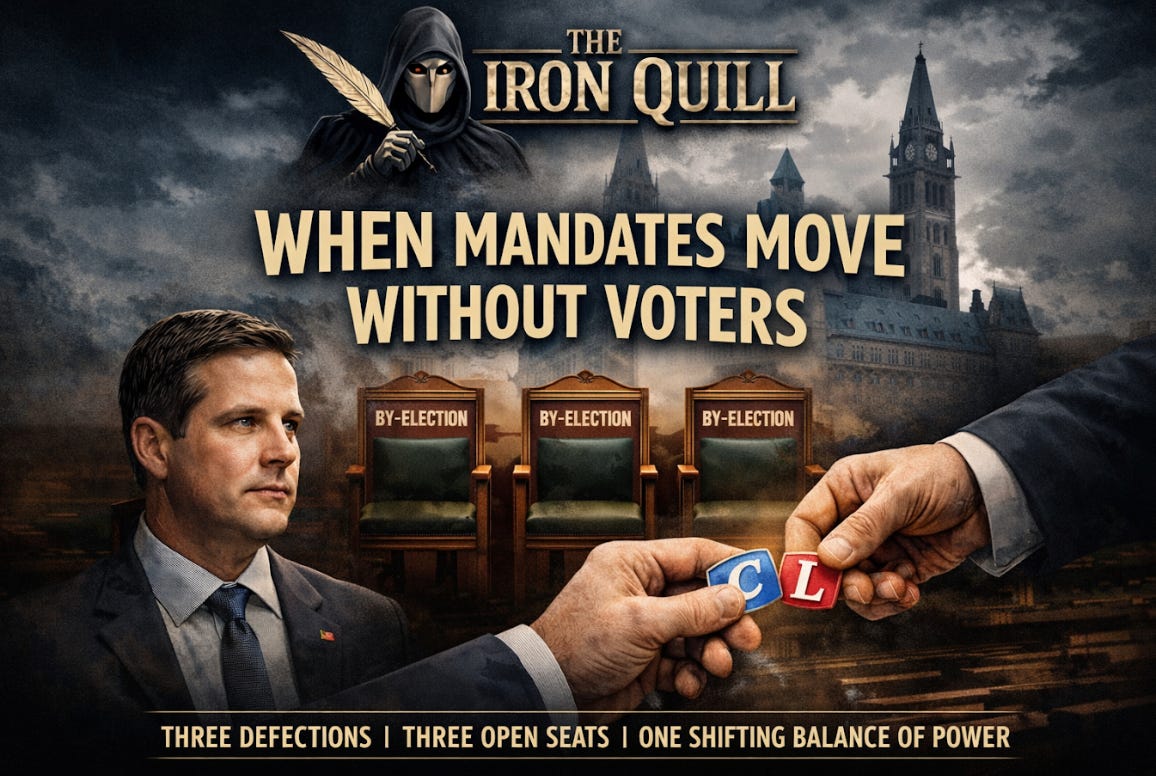
Three cross the floor and it becomes a pattern.
Three ridings sit open, waiting for by-elections.
This is no longer personal.
It is power.
⸻
The Timeline That Changed
In November, Matt Jeneroux told the public his departure was a long-standing decision.
He cited a desire to spend more time with his family.
He signaled an exit in the spring.
Canadians understand that. Public life is demanding.
But instead of stepping away from politics, he crossed the floor and joined the governing party.
That is legal.
It is not what voters were told to expect.
If the decision to step away was long-standing, voters deserve to know when discussions about crossing began — before or after that public statement.
That is not an accusation.
It is a reasonable question.
Public trust rests on clarity.
⸻
The Numbers Matter
Canada is governed by a minority Parliament.
A majority requires 172 seats.
The Liberal government currently sits short of that number.
Each defection reduces the gap.
Three Conservative MPs have now crossed the floor.
Three ridings are awaiting by-elections.
In a minority Parliament, this is not symbolic.
It strengthens one side.
It weakens the other.
It alters committee leverage.
It shifts confidence math.
Most voters do not track seat counts.
Seat counts still determine outcomes.
⸻
Not Routine — Consequential
Floor crossings are not new in Canadian politics.
They have happened before.
But multiple defections during a minority Parliament, when margins determine survival, carry weight.
Context matters.
Timing determines impact.
⸻
The Mandate Question
Voters technically elect a local candidate.
In reality, they vote for direction.
In Edmonton Riverbend, voters chose a Conservative platform centered on affordability, housing supply, and resource development.
Mid-term, that seat now strengthens a Liberal government.
Legal? Yes.
Neutral? No.
Mandates are not personal property.
They are borrowed authority.
If direction changes mid-cycle, consent should matter.
⸻
When Leadership Escalates the Issue
Pierre Poilievre publicly described the move as an attempt to secure a majority through “dirty backroom deals.”
That language raises the temperature.
Whether one agrees with it or not, when the Leader of the Opposition frames defections as strategic consolidation of power, Canadians should pay attention.
Strong claims require clear answers.
Silence invites suspicion.
⸻
The Reform Question
Perhaps this moment exposes a structural gap.
Should Canada require MPs who change parties mid-term to:
Sit as independents?
Seek re-election under their new banner?
Trigger a by-election?
Not as punishment.
As consent.
Democracy does not weaken when parties compete.
It weakens when representation shifts without voter input.
⸻
The Iron Quill Verdict
This is not about personalities.
It is not about outrage.
It is about trust.
Three defections.
Three open seats.
A minority government.
Power consolidates quietly when scrutiny fades.
Scrutiny is not hostility.
It is citizenship.
—Iron Quill
Agree. Jeneroux fits in, you have to say, to Carney values.
Lied to his constituents.
Lied to his family
Lied to his party
The one item you should have mentioned, is that backroom deals, deals that are not subject to public scrutiny or approval, represent the utter corruption of the political system in Canada. It highlights that individual politicians are not accountable to their constituents; they have no moral backbone; they are utterly contemptible for breaching the trust of their voters; and they can act with impunity, and their voters are left out to dry.
The fact that these shenanigans are allowed, and that they should at the very least, serve as independents until their term is up, highlights the fact elections are mere theatre, the appearance of choice.
The real power sits in the backroom doing deals. And never to the benefit of voters.