
WHEN GOVERNMENTS STOP THINKING IN GENERATIONS
Great nations are built by people willing to sacrifice today for tomorrow. Declining nations begin sacrificing tomorrow for today.

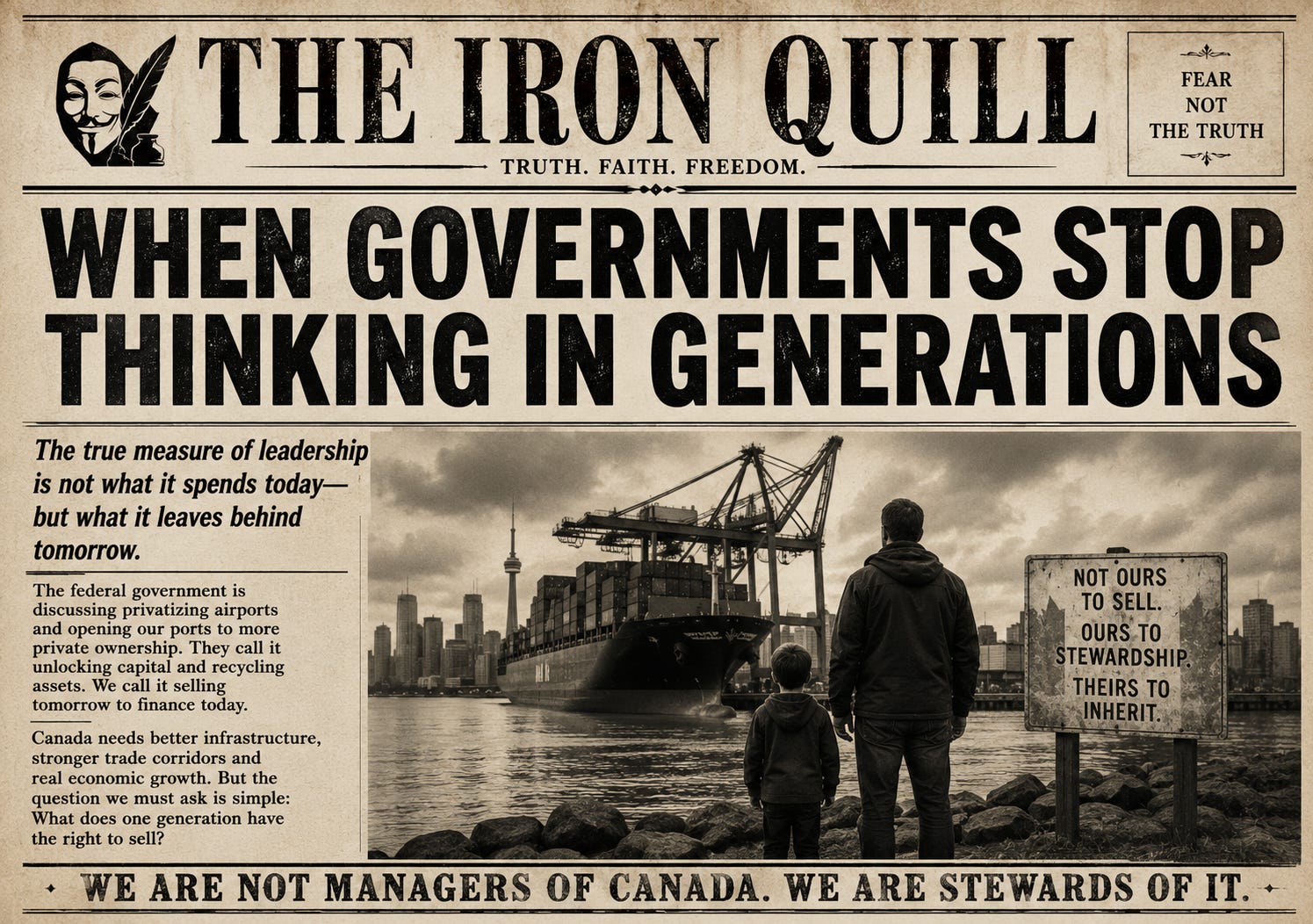
The federal government has opened a discussion Canadians should not ignore.
Budget 2025 raised the possibility of airport privatization and greater private investment in marine ports. A later Transport Canada discussion paper proposed major changes to port governance, including the possible divestiture of certain ports. Prime Minister Mark Carney has also confirmed that his government is willing to consider selling public assets and using the money to finance new infrastructure.
No specific port sale has been approved.
But the idea is now on the table.
The government calls it unlocking capital and recycling assets. The language is designed to sound technical, temporary and harmless.
Governments rarely say they are selling part of the country.
They say they are making better use of the balance sheet.
Behind that language is a question Canadians should be asking:
What does one generation have the right to sell?
THE PORT STORY IS ONLY THE BEGINNING
A port is not an empty warehouse or a surplus government office.
It is a national gateway.
Canadian grain passes through it on the way to foreign markets. Machinery, vehicles, food, fuel and raw materials move across its docks. Railways, highways, farms, mines and factories all depend on those connections.
Canada’s ports handle a significant share of the country’s imports and exports. They are not passive pieces of property. They help determine whether Canadian producers can reach the world and whether Canadian consumers can receive the goods they depend upon.
They also matter when the world becomes unstable.
A government may view a port as an asset with a market value. A country must also view it as a trade corridor, a supply-chain lifeline and a point of national leverage.
Canada is being told that it must diversify its trade, reach new markets and reduce its dependence on the United States.
Every one of those goals requires stronger transportation corridors.
Yet at the very moment ports are becoming more important, Ottawa is asking whether some could be amalgamated, transferred or opened further to private ownership.
That is not a minor administrative matter.
Canadians deserve to know where this road leads before the government takes another step.
GREAT NATIONS BUILT BEYOND THE NEXT ELECTION
Previous generations did not build Canada by asking what would produce the quickest return.
Rail lines were driven across the Prairies.
Ports were expanded.
Hydroelectric projects were built.
Highways stretched across provinces that contained more distance than population.
Those projects were expensive. Some were imperfect. Many took years to complete.
But the people responsible understood something modern politics has begun to forget.
A country is not merely something to manage during one term of office.
It is something inherited from those who came before and held in trust for those who come next.
Every generation receives roads it did not pave, institutions it did not establish and opportunities created by sacrifices it did not make.
Its responsibility is not merely to use that inheritance.
It must leave something behind.
Modern government increasingly operates according to a different clock.
The next quarter.
The next budget.
The next announcement.
The next election.
The future still appears in political speeches. It is becoming harder to find in political decisions.
FROM STEWARDSHIP TO MONETIZATION
A steward begins by asking what must be protected.
Modern governments increasingly begin by asking what can be monetized.
Private investment is not automatically harmful. Governments do not need to own every building, company or service. Some public assets can be leased, restructured or sold without weakening the country.
But infrastructure essential to trade, transportation and national security must be judged by more than the size of the cheque offered for it.
Selling a port may provide immediate capital, but the sale could also transfer future revenue, operating influence and long-term bargaining power.
Those consequences will not disappear when the money is spent.
The real calculation must include who controls fees, who makes investment decisions, what restrictions bind future governments and what authority Canada retains during a war, trade conflict or supply-chain emergency.
It must also include the cost of reversing the decision.
Public assets can be sold quickly.
Recovering them may take generations.
THE HIGHWAY 407 LESSON
Canada has already seen how attractive short-term money can become.
Ontario placed Highway 407 under a 99-year private lease in 1999 for approximately $3.1 billion.
The province received immediate revenue. Long-term operating and toll-setting control over a major transportation corridor moved into private hands.
Years later, transactions involving only part of the company operating the highway placed values on that partial ownership comparable to what Ontario had received for the original lease of the entire asset.
That does not prove every privatization will fail.
It proves that an amount appearing enormous in one budget can look very different when measured across several decades.
Governments facing immediate financial pressure are often poor judges of what future generations will need.
The politicians who sign long-term agreements rarely live with their full consequences.
Their successors do.
The public does.
Their children do.
SELLING TOMORROW TO FINANCE TODAY
Carney’s argument is easy to understand.
Capital tied up in existing assets could be released and redirected into new infrastructure. Something already built could help finance something Canada still needs.
There may be circumstances where that makes sense.
But the value of national infrastructure cannot always be reduced to what an investor is willing to pay today.
A port provides revenue, but it also provides leverage.
An airport occupies valuable land, but it connects regions and communities.
A rail corridor may appear underused until a crisis makes it indispensable.
Assets that seem expendable during stable times often reveal their true importance when stability ends.
That is the danger of treating national infrastructure as inventory.
The government receives the cash.
Investors receive the future income.
Canadians inherit the conditions written into the agreement.
Then, years later, another government explains that buying back what the country once controlled would be too expensive.
THIS STANDARD MUST APPLY TO EVERY GOVERNMENT
This temptation did not begin with Mark Carney.
Conservative governments have sold public assets. Liberal governments have done the same. Provinces across the country have exchanged long-term control for immediate financial relief.
That history is precisely why this debate cannot be reduced to party loyalty.
The standard must remain the same regardless of who sits in government.
No party should be allowed to trade away national leverage simply because it needs money, wants a better-looking balance sheet or hopes to finance a new list of promises.
A government cannot claim to be building for the future while steadily selling the foundations beneath it.
NOT EVERYTHING MUST BE UNLOCKED
The modern political class is obsessed with the language of transformation.
Everything must be reimagined, mobilized, unlocked or monetized.
Sometimes a country does need reform.
Sometimes it needs new investment.
Sometimes it needs better management and stricter accountability.
But wisdom also requires knowing what should remain beyond the reach of short-term political pressure.
There are assets a government happens to own.
Then there are assets a nation depends upon.
Ports belong to the second category.
Canada may need more port capacity, faster approvals and stronger connections between rail, road and sea. It may need partnerships with private companies and pension funds. It may need better governance and more disciplined management.
None of that automatically requires surrendering long-term ownership or control.
Fixing an asset is not the same as selling it.
Improving a port is not the same as turning it into a financial product.
THE QUESTIONS CANADIANS DESERVE ANSWERED
Before any port, airport or major transportation corridor is sold, leased or transferred, the government should be required to explain the entire arrangement publicly.
Who will control it?
Who will collect the revenue?
How long will the agreement last?
What protections will remain?
What authority will Canada retain during a national emergency?
What will future Canadians be forced to pay for infrastructure their country once controlled?
Those answers must come before a deal is signed, not years later when the public finally discovers what was buried in the agreement.
Great leadership is not measured only by what a government builds.
It is also revealed by what it has the judgment to preserve.
Nations rarely surrender their independence all at once.
They trade it away slowly.
One agreement.
One corridor.
One asset.
One generation at a time.
A government may have the legal authority to sell an inheritance.
That does not mean it has the moral right to leave the next generation poorer.
—The Iron Quill
In Europe, Africa and likely South America, China already possesses many infrastructures. Who benefits? Are these countries truly independent? In a crisis, who will control: their governments or China? Seeing the way Carney has negotiated the Gordie Howe bridge, I would not leave him negotiate any infrastructure. But then Carney does not see beyond 2030 and in the meantime will give away anything that will benefit Brookfield (therefore himself) and his buddies. In any event, he should not have the power to sell any "essential" infrastructure. I'm not looking forward to September when he has invited investors to gather here. It looks like it might be the auction of our resources (and maybe infrastructures) to his globalist buddies.
..Kinda interesting how "labeling" our generation had names applied to their period in history (Boomers/ Millenials), then for some reason SOMEBODY labeled the last 3 generations X..Y..and Z
...also funny that Z is the last letter in the alphabet..Coincedence??..NOPE..