
When Chicago Becomes Ottawa

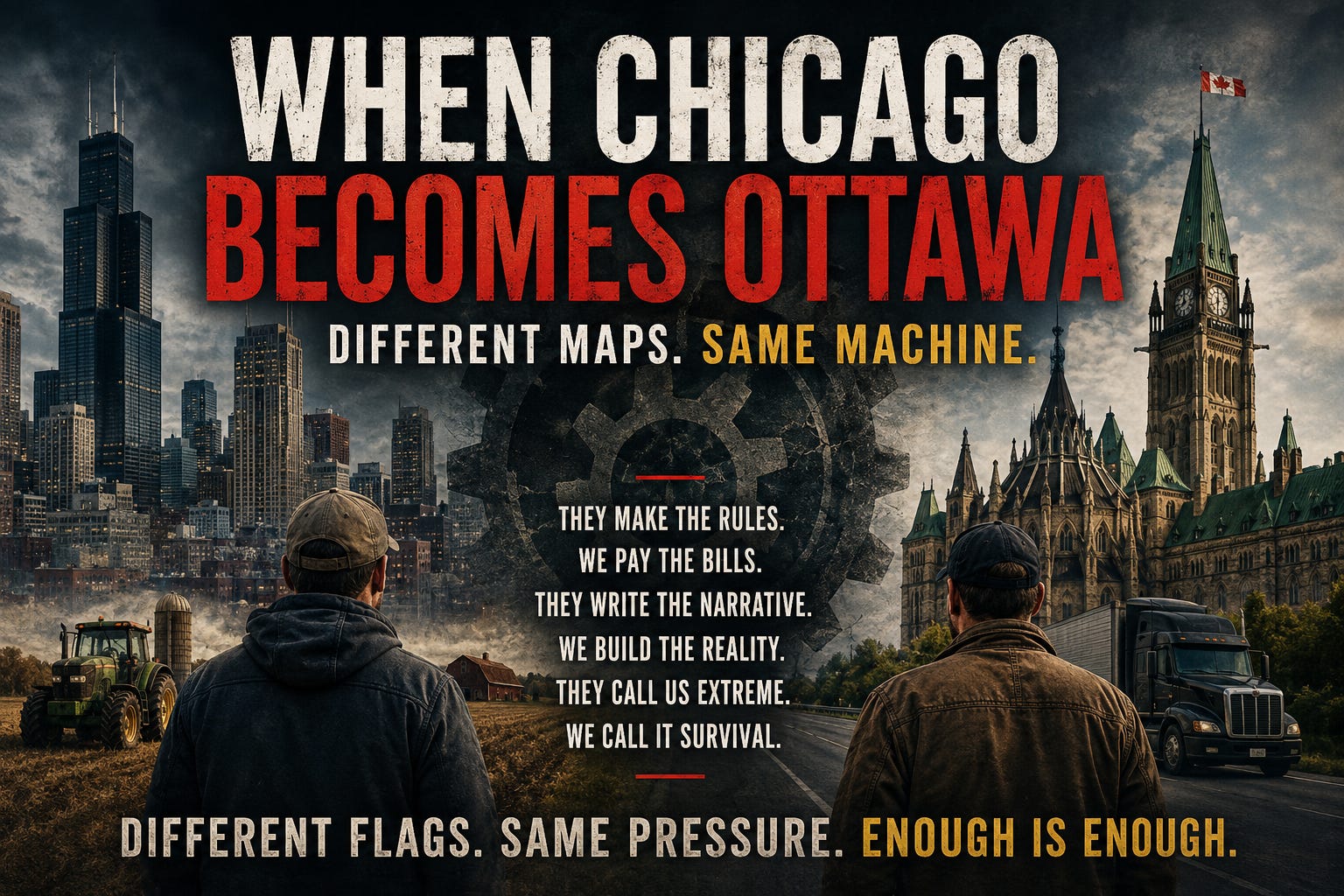
Every country has its capital. Every state has its machine. And every forgotten place eventually learns the same lesson: the people who grow the food, haul the freight, fix the engines, raise the children, pay the taxes, keep the lights on, and hold the line are rarely the people writing the rules.
That is true in Saskatchewan.
It is true in Alberta.
And it is true in Illinois.
The names change. The flags change. The accents change. But the pattern does not.
A political class gathers around a major city. A bureaucracy grows around it. A media culture learns to flatter it. Money flows toward it. Influence hardens inside it. Then the people outside that orbit begin to understand what has happened.
They are no longer treated like citizens.
They are treated like supply lines.
Chicago has become to Illinois what Ottawa has become to the Canadian West.
Not because every person in Chicago is the problem. Not because every person in Ottawa is the enemy. That is too cheap and too lazy.
The real problem is the machine.
The machine is the network of politicians, consultants, bureaucrats, activists, media voices, lawyers, lobbyists, grant-seekers, academic managers, and institutional careerists who live off the productive class while lecturing the productive class about morality.
It regulates the field it never plowed. It taxes the fuel it never paid for. It writes permits for shops it never built. It studies roads it never fixes. Then, when the people carrying the weight finally object, the machine calls them angry, backward, dangerous, uneducated, selfish, or extreme.
That is not leadership.
That is contempt wearing a suit.
The Productive Class Is Carrying the Weight
There is a class of people across North America that almost never gets properly named.
They are not glamorous. They are not polished. They are not permanently online, speaking in the approved language of the managerial class.
They are farmers, truckers, welders, mechanics, ranchers, linemen, builders, oilfield workers, factory hands, small business owners, young families, old men with busted knees, mothers holding households together, and fathers working longer than they should because everything costs more than it used to.
They do not need a theory to explain the country. They live inside the consequences.
They know when diesel goes up. They know when taxes bite harder. They know when grocery money does not stretch. They know when the school has changed. They know when the town is thinner than it used to be.
They know when government help somehow never reaches the people who actually need it, but always finds its way to another office, another department, another consultant, another program with a beautiful name and no visible spine.
These are the people feeding the machine.
And increasingly, they are being fed into it.
In Illinois, many of them live outside the glow of Chicago power. In Saskatchewan, many of them live outside the imagination of Ottawa.
The maps are different. The insult is the same.
The productive class is told to be quiet, pay up, accept the lecture, absorb the cost, and stop noticing the pattern.
But people are noticing.
That is why this moment matters.
Because the frustration forming across North America is not merely political. It is not just about parties, campaigns, slogans, or elections.
It is about recognition.
The farmer in Illinois recognizes the rancher in Saskatchewan. The trucker in Iowa recognizes the oil worker in Alberta. The mechanic in a small town recognizes the father trying to hold a family together three provinces away.
They may not know each other’s names.
But they know the same pressure.
The Urban Machine
Every machine has a headquarters.
In Illinois, people look at Chicago and see a city whose politics often dominates the rest of the state.
In Canada, the West looks at Ottawa and sees a federal class that talks about unity while treating western frustration like a behavioral problem.
Again, the point is not hatred of cities.
Cities matter. Cities contain families, workers, churches, businesses, and ordinary people trying to survive like everyone else.
The issue is not the existence of cities.
The issue is domination by a political culture that forgets the rest of the map exists except when it needs revenue, votes, compliance, or applause.
That is how the machine thinks. It does not see regions with their own histories, burdens, loyalties, and limits. It sees resources. It does not see towns with families trying to hold together. It sees tax bases. It does not see citizens with memory and dignity. It sees populations to be managed.
The farther power gets from the ground, the more it mistakes compliance for unity.
That is the danger.
A country can survive disagreement. A state can survive argument. A federation can survive hard constitutional questions. What it cannot survive forever is a governing class that confuses its own comfort with the public good.
That is where resentment begins.
Not because people are hateful.
Because they are awake.
They see the contradiction. They are told the system is compassionate, yet it crushes the working family. They are told it is democratic, yet every serious objection is treated like a threat. They are told it is inclusive, yet whole regions are culturally mocked and politically dismissed.
This is how trust dies.
Not all at once.
Quietly.
One ignored town at a time.
Rural People Are Not Extremists
The machine has developed a useful trick.
It takes normal concerns and renames them as extremism.
Wanting affordable energy is extremism. Wanting safe communities is extremism. Wanting secure borders is extremism. Wanting schools to teach children instead of reshape them is extremism. Wanting taxes that do not strangle working people is extremism. Wanting local control is extremism. Wanting politicians to remember who pays the bills is extremism.
The trick works only as long as people are willing to accept the label.
And many are no longer willing.
The farmer is not extreme because he wants to farm without being buried by regulation. The trucker is not extreme because he wants fuel he can afford. The parent is not extreme because he wants a say in what his child is taught. The small business owner is not extreme because she wants to build something without being treated like a suspect. The rural voter is not extreme because he refuses to be ruled forever by people who sneer at his way of life.
The machine calls normal people radical the moment they stop apologizing for existing.
That is what this is really about.
It is not extremism.
It is exhaustion.
And exhaustion, when ignored long enough, becomes resistance.
The Forgotten Towns Are Finding Each Other
The machine made one mistake.
It thought these people were isolated.
It thought the farmer in Illinois was alone. It thought the rancher in Saskatchewan was alone. It thought the trucker, the welder, the mother, the mechanic, the small-town pastor, the business owner, and the young family trying to stay above water were all separate problems.
They were not.
They were the same warning appearing in different places.
The old political language is failing because the old categories no longer explain the whole moment.
Left versus right does not explain everything. Liberal versus conservative does not explain everything. Republican versus Democrat does not explain everything.
The deeper divide is rooted versus detached.
Productive versus managerial.
Local versus centralized.
Real versus theoretical.
Built life versus administered life.
There are people who live by reality, and there are people who manage narratives about reality.
One group has to make the numbers work.
The other group invents language to explain why the numbers do not matter.
That is why independent voices are growing. People are not only looking for news. They are looking for recognition. They want someone to say what they already know in their bones.
Something is wrong.
The people carrying civilization are being treated like obstacles to it.
That cannot hold forever.
The Quill’s Verdict
This is not an argument against cities, government, America, Canada, Illinois, Saskatchewan, Chicago, or Ottawa.
It is an argument against imbalance.
A nation cannot survive when the people producing reality are ruled entirely by people managing narratives. A state cannot survive when one political machine treats the rest of the map like a funding source. A federation cannot survive when its productive regions are lectured, taxed, regulated, and then mocked for noticing.
There is a limit to how long people will carry a system that despises them.
There is a limit to how long rural communities will accept being treated as backward by institutions that cannot keep their own cities safe, solvent, honest, or sane.
There is a limit to how long the productive class will fund its own humiliation.
And across North America, that limit is coming into view.
The farmer in Illinois, the rancher in Saskatchewan, the welder in Alberta, the trucker in Iowa, the mechanic in Indiana, and the mother in a town nobody in the capital can find on a map are not identical people. They do not live under the same flag. They do not all vote the same way. They do not all use the same language for what they feel.
But they are beginning to recognize the same pressure.
They are beginning to recognize the same machine.
And they are beginning to understand that obedience is not the same thing as unity.
The machine wanted silence.
It got recognition.
And recognition is where resistance begins.
—The Iron Quill
The Iron Quill is reader-supported.
Most of this work remains free because truth should travel.
If you believe in the mission, become a paid supporter and help keep the signal alive.
This is a problem as old as civilization itself, most likely. For example, the first major Secessio Plebis was in 495 BC when the majority of the plebians (commoners) moved out of Rome to protest tyranny at the hands of the aristocracy. And it worked, for a time. The aristocracy were forced to negotiate and make concessions before the city was restored.
It is noteworthy, however, Secession Plebis happened again in 449 BC and 287 BC. As the old saying goes, the only thing we learn from history is we learn nothing from history.
The other thing we learn from history is that if the people stick together, those in their ivory towers, and no damn idea of how things work, must listen. We are the force to be reckoned with.