
When Access Becomes a Threat
A Canadian Member of Parliament boards a plane to Washington.

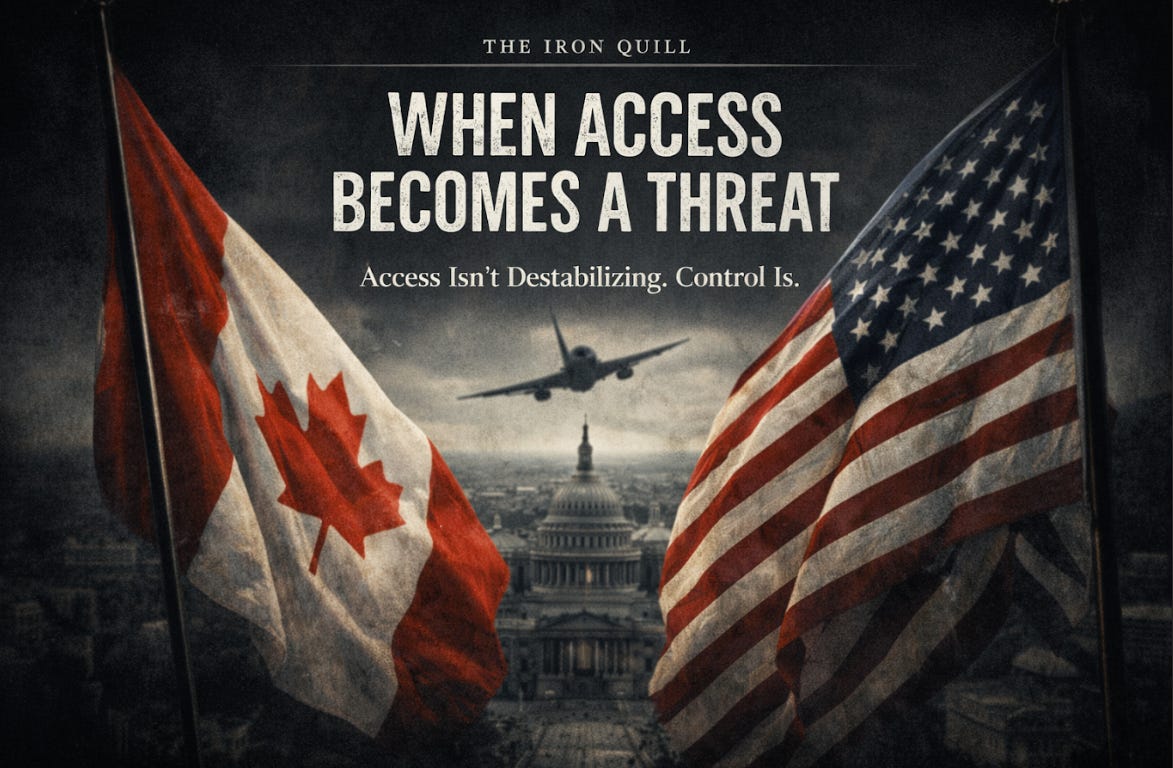
He carries no treaty.
No formal mandate.
He carries relationships.
He meets senior officials. He speaks. He listens. He returns and calls the meetings productive.
And in Ottawa, the temperature rises.
That reaction is the story.
Canada is moving toward formal CUSMA renegotiations. Tariff tensions have not disappeared. Defence procurement is shifting. Three-quarters of our exports move south. The Canada–U.S. relationship is not symbolic.
It is structural.
In that environment, improving tone before negotiations begin should not be controversial. Clarifying priorities before bargaining hardens should not be controversial. Reducing friction before leverage is tested should not be controversial.
And yet, it was.
The trip was not controversial because it failed.
It was controversial because it might succeed.
⸻
Access Is Leverage
Diplomacy does not live only at podiums.
Formal talks are the visible layer. Beneath them runs something older — trust built privately, signals exchanged quietly, relationships formed long before cameras arrive.
Back channels are not reckless improvisations. They are tools of statecraft.
When two economies are fused as tightly as Canada and the United States, leverage often begins with tone. Tone shapes posture. Posture shapes outcome.
Access is leverage.
If a Canadian MP can lower rhetorical heat, clarify American red lines, or better understand the negotiating climate before CUSMA talks intensify, that is not destabilizing.
It is preparation.
Unless the discomfort is not about results.
Unless it is about control.
⸻
The Ownership Instinct
Modern Ottawa is highly centralized.
Foreign policy is guarded. Messaging is disciplined. Authorization flows downward. International engagement is managed carefully.
Coherence matters.
But centralization produces instinct.
When influence emerges outside the approved hierarchy, the reflex is rarely curiosity. It is containment.
In centralized systems, influence that cannot be managed becomes influence that must be questioned.
Not because it harms the country.
Because it dilutes ownership.
Governments run on attribution. Wins must be identifiable. Progress must be traceable. Success must be brandable.
Political credit is currency.
Unofficial access complicates the ledger.
If progress is made through channels that do not flow directly from cabinet, the monopoly on diplomacy weakens.
And monopolies do not surrender ground easily.
⸻
Optics Versus Outcomes
The criticism focused on protocol. On precedent. On whether a backbench MP should be meeting at that level.
Procedure matters.
But outcomes matter more.
If informal engagement reduces friction before negotiations begin, Canada benefits.
If it provides clearer understanding of U.S. leverage, Canada benefits.
If it lowers the emotional temperature around tariffs and trade irritants, Canada benefits.
So the real test is simple.
Are we protecting national interest?
Or protecting narrative control?
When ego interferes with leverage, countries pay the price.
That is not partisan. It is historical.
⸻
A Cultural Mirror
This moment is not about one MP. It is about political culture.
What does it say when relationship-building becomes suspect?
What does it say when independent access is framed as freelancing rather than opportunity?
Canada’s prosperity depends on stability in Washington. Trade, energy, agriculture, manufacturing — these are not abstractions. They are livelihoods in Saskatchewan, Alberta, Ontario, Quebec.
If personal relationships can soften friction before formal negotiations begin, that is not disloyalty.
It is strategic advantage.
A confident political culture absorbs useful engagement from any source.
An insecure one protects turf.
It worries about who opened the door more than what was said inside the room.
⸻
The Standard of Strength
CUSMA renegotiation will not be shaped by press conferences alone. It will be shaped by tone, leverage, relationships, and preparation long before signatures are inked.
If unofficial conversations reduce friction before formal talks intensify, Ottawa faces a choice.
Leverage the access.
Or resent it.
The question was never whether the meetings were appropriate.
The question is whether Canada’s political culture is secure enough to use every advantage available.
A government confident in its authority does not fear access.
It uses it.
And a country confident in its direction does not panic when someone opens a door.
It walks through it.
—The Iron Quill
As amusing as it is to watch the il-Liberals frantically screamings whilst setting their hair on fire, it would be nice if someone competent would walk thru the door Jamil opened soon before it closes.
Our PM and his cabinet lack humility too much to use every tool available and have proven to be ineffectual in anything that matters. Besides, I don't think they even want successful negotiations, they are working on Agenda 2030 much more successfully: building "better" so you will own nothing and be happy. And that is for you, me and Canada as an entity.