
WATCHMAN’S WARNING
When Truth Becomes Treason

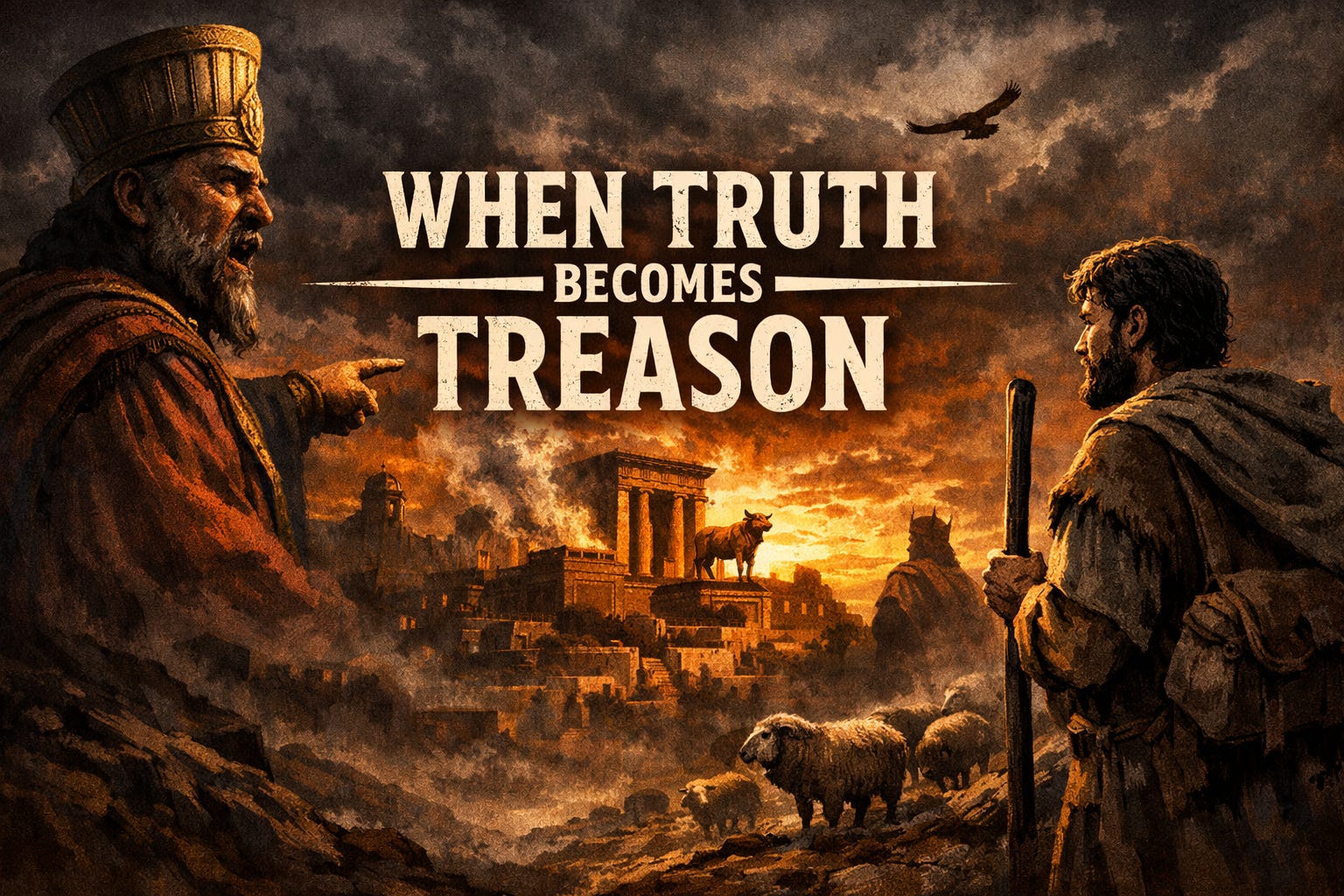
Text: Amos 7:10–17 (ESV)
There is a moment in the life of a declining nation when truth stops being debated and starts being criminalized.
Not outlawed in statute. Not yet.
But quietly redefined until no one recognizes it. Reframed until warning sounds like rebellion. Labeled until conviction becomes conspiracy.
That moment is not new.
It happened in Israel.
And it happened to a shepherd named Amos.
⸻
Strength on the Surface
In the days of Jeroboam II, Israel looked powerful. Borders were secure. Commerce was strong. The sanctuaries were active.
From a distance, it looked like strength.
But beneath the surface there was rot. The wealthy crushed the poor. Justice bent toward influence. Worship continued, but it had been fused to political security.
Bethel, which means “House of God,” had become something else. It was no longer simply sacred ground. It had become the king’s sanctuary. Religion had been nationalized. The altar had been placed in service of the crown.
Into that environment God sent a shepherd from Tekoa.
Not a court insider.
Not a professional prophet.
A herdsman.
God often chooses shepherds when kings forget how to lead.
⸻
When Warning Is Called Conspiracy
Amos spoke plainly. He did not flatter power. He warned it.
In Amos 7:10–11 we read:
“Then Amaziah the priest of Bethel sent to Jeroboam king of Israel, saying, ‘Amos has conspired against you in the midst of the house of Israel. The land is not able to bear all his words.’”
Conspired.
The accusation is telling. Amos did not take up arms. He took up words. Yet his words were treated as an organized threat.
Power rarely debates what threatens it. It redefines it.
Truth becomes destabilization.
Warning becomes extremism.
Correction becomes rebellion.
Amaziah then confronts Amos directly:
“O seer, go, flee away to the land of Judah, and eat bread there, and prophesy there, but never again prophesy at Bethel, for it is the king’s sanctuary, and it is a temple of the kingdom.” (Amos 7:12–13, ESV)
The issue was not whether Amos was right.
The issue was where he was standing.
This was the king’s sanctuary. This was the temple of the kingdom. In other words, this space belonged to power. Speak somewhere else. Say it somewhere safer. Just not here.
Truth was welcome in theory. It was forbidden in proximity.
⸻
The Authority That Cannot Be Revoked
Amos answers with clarity that still echoes:
“I was no prophet, nor a prophet’s son, but I was a herdsman and a dresser of sycamore figs. But the Lord took me from following the flock, and the Lord said to me, ‘Go, prophesy to my people Israel.’” (Amos 7:14–15, ESV)
He had no prophetic pedigree. No institutional backing. No political leverage.
He was following sheep when the Lord interrupted him.
The Lord took me.
That is the difference between manufactured outrage and divine assignment.
Amos did not speak because it advanced him. He spoke because he was commanded.
Calling outranks credentials.
Obedience outranks approval.
When authority comes from God, it cannot be revoked by men.
⸻
Silencing the Messenger Does Not Stop the Consequence
After being told to be silent, Amos delivers a hard word of judgment. Exile would come. Security would fracture. The illusion of permanence would dissolve.
Here is the uncomfortable truth.
Nations do not collapse because someone warned them.
They collapse because they refused to listen.
Silencing the watchman does not strengthen the wall. It only guarantees that the breach arrives without preparation.
The problem was never Amos’ voice.
The problem was Israel’s refusal.
⸻
Do Not Be Surprised
There will always be seasons when clarity is treated as danger.
When moral conviction is described as instability.
When those who speak plainly are accused of conspiracy rather than answered with argument.
This pattern is ancient.
But so is the calling.
The people of God are not commanded to secure applause. They are commanded to remain faithful. Amos was not responsible for acceptance. He was responsible for obedience.
That remains the standard.
⸻
The Watchman’s Charge
So what do we take from this?
Do not be shocked when truth meets resistance. Resistance often reveals where truth has landed.
Do not confuse rejection with failure. If obedience is intact, faithfulness is intact.
Do not surrender your voice for the sake of comfort. Temporary silence may buy relief, but it mortgages the future.
Do not ask permission to obey God.
Do not apologize for speaking plainly.
Do not trade your voice for safety.
God has never left Himself without a witness.
Empires rise. Sanctuaries are politicized. Institutions drift.
But the Word of the Lord stands.
Amos was a shepherd.
He was told to leave.
He was told to be quiet.
He did not.
And because he did not, we are still reading his words.
Truth may be resisted.
It may be relabeled.
It may be unwelcome in the king’s sanctuary.
It does not expire.
Stand firm. Speak clearly. Obey fully.
The Lord still calls shepherds.
—The Iron Quill
Very good piece. Thanks for posting. It is so true if people would look at history.
I love your Watchman Warnings.
So apropos for the day we live in.
Some of us stood against the cxvid pandemic and the proposed mandates.
We were vilified and marginalized.
Some of us have warned of the direction our country is heading, toward communism, Marxism, totalitarianism.
We are called conspiracy theorists.
In both cases we have been proven correct.
I am very thankful for reading the Watchmans Warnings.
They give me hope.