
Two Voices Are Calling
The Watchman’s Warning

The world is not silent.
It is preaching every hour of the day.
It does not always sound like a sermon. Sometimes it comes through a screen, a slogan, a classroom, a government program, a song, a movement, a friend group, or the quiet pressure to nod along when your conscience has already begun to object.
Every generation is discipled.
That is the part modern man does not want to admit. He likes to imagine himself neutral, independent, untouched, self-made, and free from influence. But Proverbs 9 tears that illusion apart.
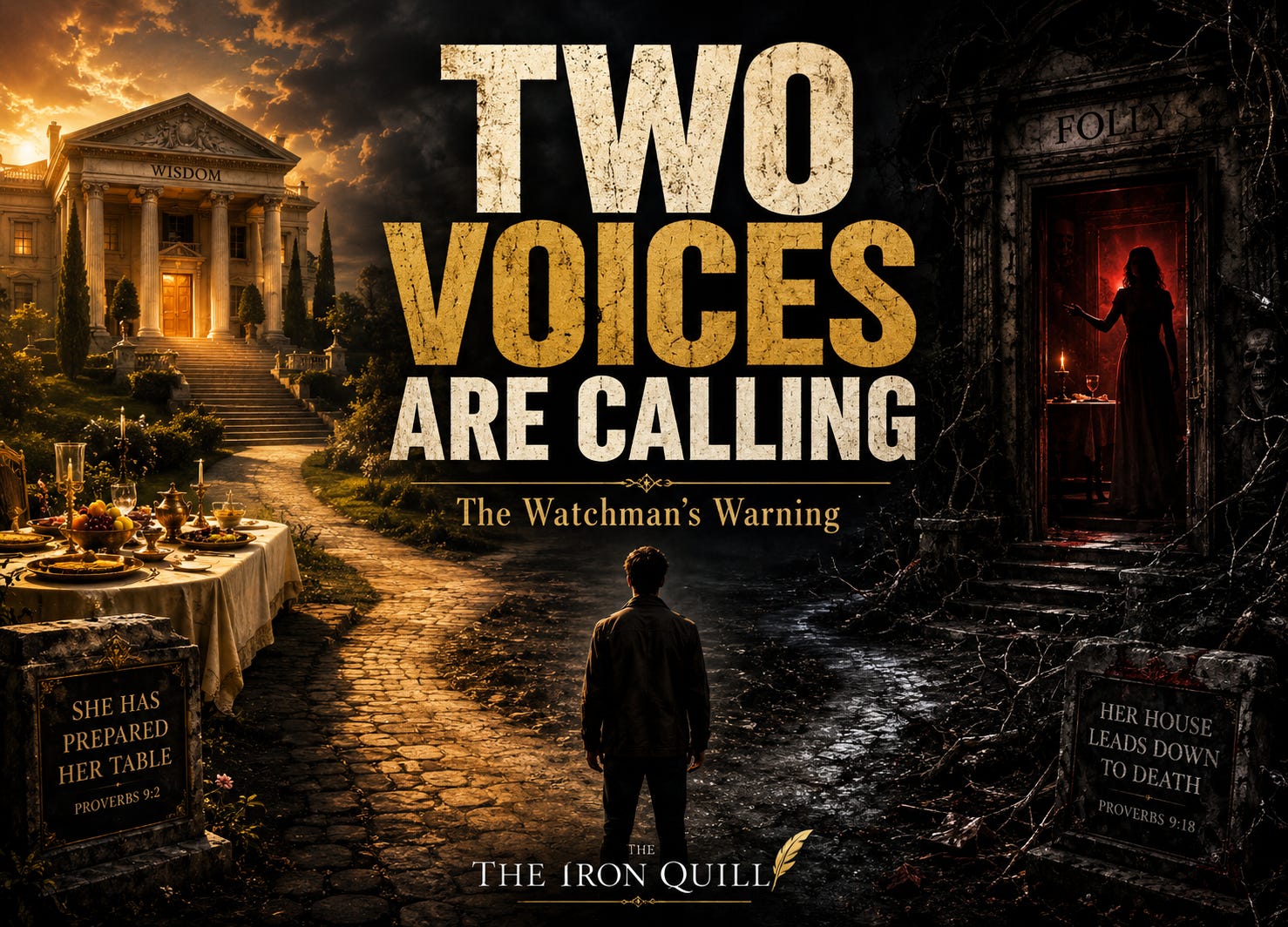
Proverbs 9 shows two voices calling into the same street. One is Wisdom. The other is Folly.
Both speak publicly. Both invite the simple. Both offer a table and promise a way forward.
But only one leads to life.
Proverbs 9 is not merely a poem about better choices. It is a warning about two kingdoms, two invitations, and two endings. It shows us that the human heart is never standing in a silent room. Something is always calling it. Something is always forming it. Something is always pulling it toward a table.
The question is not whether you are being discipled.
The question is who is discipling you.
Wisdom Builds Before She Calls
Proverbs 9 opens with Wisdom building.
“Wisdom has built her house; she has hewn her seven pillars.”
Proverbs 9:1, ESV
That matters.
Wisdom does not begin with noise. She begins with order. She builds a house. She prepares a meal. She mixes her wine. She sets her table. Then she sends out her servants and calls from the highest places of the town.
Wisdom is not frantic, impulsive, or desperate to win the hour. It carries the patience of something built on rock.
That is one of the clearest marks of godly wisdom. It produces order. It strengthens households. It forms children. It disciplines appetites. It restores responsibility. It teaches a man to work, to tell the truth, to govern himself, to fear God, to correct his steps, and to build something that can stand after his emotions have passed.
Modern man often confuses wisdom with information. He thinks because he has access to a thousand opinions, he has understanding. He thinks because he can repeat headlines, arguments, phrases, and slogans, he is wise.
But Wisdom is not measured by how much noise a man can collect.
Wisdom is seen in what his life builds.
A wise man’s house may not be flashy, but it has posts in the ground. It has a gate that closes. It has children who know where the boundaries are. It has habits that survive bad weather. It has prayers that are not only spoken in crisis. It has a table where truth is served even when it is not comfortable.
Wisdom prepares a table because wisdom is not empty. She has something to feed those who answer her call.
Folly does not.
Folly Sits and Shouts
Then Proverbs 9 shows us the other voice.
“The woman Folly is loud; she is seductive and knows nothing.”
Proverbs 9:13, ESV
That is not a gentle description.
Folly is loud because she has no depth. She is seductive because she has no truth. She knows nothing, but she speaks as if she knows everything.
The contrast is deliberate. Wisdom builds and prepares. Folly sits and consumes. One creates order before calling others in. The other waits at the doorway and interrupts travelers on their road.
She does not need to build anything lasting. She only needs to distract the traveler long enough to pull him off the path.
That is how folly works.
It rarely begins by announcing destruction. It begins by sounding harmless. It sounds like freedom. It sounds like relief. It sounds like secret pleasure, private compromise, easy belonging, and escape from the hard demands of truth.
It tells a man he does not need discipline.
It tells a woman she does not need restraint.
It tells a child he does not need correction.
It tells a church it does not need holiness.
It tells a nation it does not need God.
Every gate becomes oppression. Every appetite becomes identity. Every warning becomes hatred. Every boundary becomes harm. Every ancient truth becomes something to mock, soften, or explain away.
This is how captivity becomes voluntary.
Folly does not need to conquer a man if she can get him to step inside willingly.
The Simple Are the Battleground
Both Wisdom and Folly call to the simple.
That is one of the most important truths in the chapter.
“Whoever is simple, let him turn in here!”
Proverbs 9:4, ESV
Then Folly says almost the same thing.
“Whoever is simple, let him turn in here!”
Proverbs 9:16, ESV
It is the same target, the same invitation, and the same vulnerable soul standing between two voices.
The simple are not always wicked. They are unformed. They are immature. They are undecided. They are easily pulled because they have not yet learned discernment. They hear confidence and mistake it for truth. They hear popularity and mistake it for wisdom. They hear compassion language and mistake it for righteousness.
That is why the simple are always the battleground.
Children are the battleground. Homes are the battleground. Churches are the battleground. Nations are the battleground.
The simple do not stay simple forever. They become disciples. They are shaped by whatever voice they answer most often.
A child raised by screens will not remain untouched.
A citizen trained by propaganda will not remain neutral.
A church fed on comfort without correction will not remain faithful.
A man who obeys appetite long enough will eventually call appetite truth.
This is why Proverbs 9 is so urgent. It does not allow us to pretend that influence is harmless. It does not allow us to imagine that a man can sit at the table of Folly all week and somehow walk in the wisdom of God on Sunday morning.
The voice you answer forms you.
The table you return to feeds you.
The road you walk changes you.
Neutrality is one of Folly’s favourite disguises.
Correction Reveals the Heart
Proverbs 9 does not only contrast Wisdom and Folly. It also shows us how to recognize the difference between a wise man and a scoffer.
“Do not reprove a scoffer, or he will hate you; reprove a wise man, and he will love you.”
Proverbs 9:8, ESV
That line cuts.
A man’s response to correction reveals more than his response to praise.
Anyone can receive applause. Anyone can smile when admired. Anyone can look humble while being celebrated. But correction exposes the foundation.
The scoffer hears correction and looks for an enemy.
The wise man hears correction and looks for the lesson.
This is where much of modern Christianity has grown dangerously weak. Many want encouragement, but not correction. They want grace, but not repentance. They want forgiveness, but not transformation. They want Jesus as comfort, but not Christ as King.
That is not wisdom.
That is Folly wearing religious clothes.
The gospel does not flatter the sinner. It saves him. It does not leave a man chained and call the chain compassion. It does not excuse rebellion and rename it authenticity. It does not offer mercy so a man can continue walking toward death with a cleaner conscience.
Grace is not permission to remain foolish.
Grace is the hand of God pulling a man out of the house where the dead are seated.
A wise man can be wounded by truth and still thank God for the wound. A foolish man treats every wound as persecution.
That distinction matters. Especially now.
Because a generation that cannot receive correction cannot receive wisdom. And a church that refuses to correct cannot claim to love.
The Fear of the Lord Is the Divide
Then Proverbs 9 gives the dividing line.
“The fear of the LORD is the beginning of wisdom, and the knowledge of the Holy One is insight.”
Proverbs 9:10, ESV
Not the middle.
Not the accessory.
Not the decorative verse stitched onto an otherwise worldly life.
The beginning.
Wisdom begins with the fear of the Lord.
That is why the modern world cannot produce true wisdom. It can produce technology. It can produce systems. It can produce credentials, policies, experts, slogans, studies, conferences, and endless language about progress. But it cannot produce wisdom while treating God as optional.
The age wants the fruit of wisdom while cutting down the root. It wants stable homes without obedience, justice without truth, compassion without judgment, freedom without restraint, and blessing without repentance.
Scripture gives no such path.
A man cannot be wise while mocking the One who made him.
A home cannot be wise while rejecting the order of God.
A church cannot be wise while fearing controversy more than the Lord.
A nation cannot be wise while despising truth, celebrating confusion, rewarding cowardice, and calling rebellion compassion.
The fear of the Lord is not primitive. It is not backward. It is not religious superstition for weak minds.
It is the first sane response of a creature standing before his Creator.
Without it, knowledge becomes arrogance. Freedom becomes appetite. Compassion becomes manipulation. Law becomes a weapon. Education becomes conditioning. Religion becomes theatre. Politics becomes power without restraint.
A nation without the fear of the Lord does not become enlightened.
It becomes clever without conscience.
It becomes easy to govern, easy to deceive, easy to flatter, and easy to sell.
Stolen Water Still Tastes Stolen
Folly’s invitation is short, sweet, and deadly.
“Stolen water is sweet, and bread eaten in secret is pleasant.”
Proverbs 9:17, ESV
There it is.
The oldest sales pitch in the world.
No one will know.
You deserve this.
This is freedom.
This is private.
This is harmless.
This is your truth.
Folly always advertises the taste and hides the cost.
She talks about sweetness, not consequences. Pleasure, not chains. Secrecy, not judgment. Appetite, not death.
That is how sin sells itself. It narrows the imagination to the immediate. It says nothing about the morning after. Nothing about the hardening heart. Nothing about the damaged home. Nothing about the seared conscience. Nothing about the child watching. Nothing about the soul slowly learning to love darkness.
Stolen water may taste sweet for a moment.
But it is still stolen.
Secret bread may feel pleasant for a moment.
But it is still eaten in rebellion.
And Proverbs does not soften the ending.
“But he does not know that the dead are there, that her guests are in the depths of Sheol.”
Proverbs 9:18, ESV
That is the line Folly never includes in the invitation.
The dead are there.
Not the free.
Not the enlightened.
Not the brave.
Not the liberated.
The dead.
Folly’s house is never empty. It is filled with those who thought they could manage compromise. Those who thought they could sit at her table without becoming her guest. Those who thought secrecy would protect them. Those who mistook delayed consequence for divine approval.
This is why the watchman must warn.
Not because he enjoys the sound of alarm.
Because the dead are there.
Every House Has a Table
Wisdom has a table.
Folly has a table.
Both invite. Both feed something. But one feeds life, and the other feeds death.
This is where every man must stop pretending the issue is abstract. Proverbs 9 does not leave the reader above the scene as a critic. It drags him into the road and makes him listen to both voices.
A man should ask what voice is actually forming his house. Not the voice he claims to respect, but the one his children hear most often, the one his habits obey, the one his church refuses to challenge, and the one that governs him when no one is watching.
That is the true table.
Many say they love Wisdom while eating with Folly. Many claim Christ while nursing secret rebellion. Many speak of truth while fearing correction. Many praise righteousness while arranging their lives around appetite.
But the road tells the truth.
The table tells the truth.
The fruit tells the truth.
Wisdom is still calling. She has not gone silent. She still calls the simple to leave their foolish ways and live.
Folly is still calling too. She is loud. She is seductive. She knows nothing. But she knows how to invite a careless soul toward death.
The Quill’s Verdict
The age is not silent.
It is preaching.
Wisdom is calling from the high places.
Folly is calling from the doorway.
The simple are listening. The proud are mocking. The fearful are hesitating. The wise are correcting their steps.
And over all of it stands the line that still divides life from ruin:
“The fear of the LORD is the beginning of wisdom.”
Not education, status, politics, popularity, or religious vocabulary.
The fear of the Lord.
That is where wisdom begins. That is where a man becomes teachable. That is where a home becomes ordered. That is where a church becomes faithful. That is where a people begin to wake up.
Wisdom still calls from the heights. Folly still calls from the doorway. One has built a house. The other has filled a room with ghosts.
The simple man thinks he is choosing a moment, but he is choosing a master, a table, and an ending.
And Proverbs leaves no room for polite confusion.
The fear of the Lord is still the beginning of wisdom.
Everything else is just a louder road to the house where the dead are seated.
—The Iron Quill
The Iron Quill is reader-supported.
Most of this work remains free because truth should travel.
If you believe in the mission, become a paid supporter and help keep the signal alive.
Let us hear the conclusion of the whole matter: Fear God and keep His commandments, for this is the whole duty of man.