
Two Doctrines, One Future
Watch the reaction.

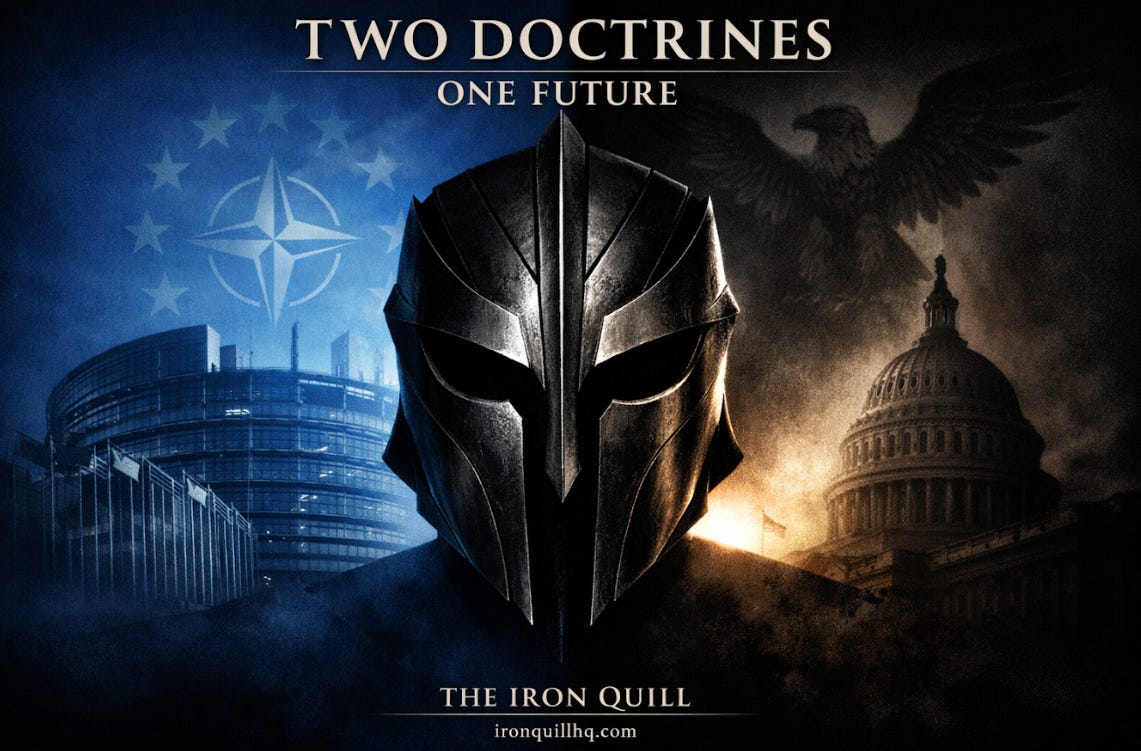
The moment the so-called Board of Peace concept surfaced, the temperature changed. European officials stiffened. Media outlets scoffed. Think tanks filled panels with warnings about instability and recklessness.
That response was not accidental.
When a proposal threatens structure, structure defends itself.
This is not about personality. It is not about tweets. It is not about liking or disliking Donald Trump.
It is about a fracture inside the West.
Two doctrines are competing for control of Western power.
They cannot both dominate.
⸻
What the Board of Peace Represents
Strip away the headlines.
The idea represents compression of American leverage. It concentrates diplomatic authority, reduces layered committee management, and pushes negotiations from economic and military strength.
For decades Washington operated through expanding alliances, councils, multilateral forums, and coalition architecture. Problems moved through process. Conflicts required consensus. Commitments accumulated gravity.
This doctrine challenges that architecture.
Why manage endless entanglements if leverage can shorten them?
Why absorb permanent cost when pressure can accelerate settlement?
Call it disruptive. Call it blunt. Call it transactional.
It is coherent.
Leverage first. Settlement second.
Peace not as performance, but as negotiated advantage.
That is strategic compression.
Compression threatens expansion.
⸻
The European Model
Europe’s discomfort is structural.
The European Union derives power through consensus. Legitimacy flows through institutional architecture. Diplomacy is layered. Security rests heavily on NATO integration. Stability is achieved through alignment.
The system rewards predictability.
It rewards continuity.
It rewards procedure.
A doctrine built on compressed leverage disrupts that rhythm. Rapid recalibration forces budget shifts. Security reassessments. Domestic political strain.
Adjustment costs money.
Adjustment creates uncertainty.
Europe is not irrational. It is defending the structure that empowers it.
If American diplomacy shifts from layered consensus to centralized leverage, Europe must spend more, decide faster, and assume greater strategic risk.
Resistance follows naturally.
⸻
The Cost Question
Endless institutional management carries a price.
Permanent forward positioning carries a price.
Coalition maintenance carries a price.
Diplomatic bureaucracy carries a price.
For two decades the West absorbed that cost quietly. Voters were told stability required complexity. Complexity required expansion. Expansion required spending.
Peace through leverage argues something different.
Shorten commitments. Compress negotiations. Reduce exposure.
If it works, it lowers cost.
If it fails, volatility increases.
That is the wager.
And voters understand cost faster than they understand doctrine.
⸻
Managed Stability vs Transactional Strength
This is the divide.
Managed stability believes institutions prevent chaos. It accepts slower movement in exchange for predictability. It prioritizes continuity.
Transactional strength believes leverage prevents drift. It accepts volatility in exchange for speed. It prioritizes decisiveness.
Both carry risk.
Managed stability can harden into permanent bureaucracy. Dependency becomes normalized. Low-grade conflict becomes permanent background noise.
Transactional strength can miscalculate pressure. It can overshoot. It can rattle markets and alliances.
Risk is unavoidable.
The real question is which risk compounds faster.
Quiet bureaucratic expansion.
Or visible strategic compression.
That is the contest unfolding beneath the headlines.
⸻
Why The Reaction Was Immediate
When concentrated leverage re-enters American doctrine, influence shifts.
Committee rooms shrink.
Advisory bodies lose gravity.
Shared governance mechanisms lose automatic authority.
Those who built influence inside layered structures sense contraction.
Objection is rarely abstract. It is positional.
Western unity has long depended on shared frameworks. But frameworks distribute influence. They create dependency. They determine speed.
Change the framework and you change the balance.
The reaction was swift because the implications are real.
⸻
The Canada Question
Here is the uncomfortable part.
While Washington experiments with leverage driven diplomacy, Ottawa leans deeper into European alignment structures.
Canada speaks the language of multilateral coordination, global frameworks, and rules based order.
That is a choice.
But choices narrow options.
Canada cannot preach consensus abroad while depending on American leverage for continental security.
Canada cannot embed itself deeper in European institutionalism while assuming American decisiveness will remain automatic.
If the West splits between transactional nationalism and managed globalism, Ottawa will be forced to clarify its alignment.
Trade negotiations will reflect it.
Defense procurement will reflect it.
Energy strategy will reflect it.
Security guarantees will reflect it.
Two doctrines moving in opposite directions eventually demand clarity.
Ambiguity does not last forever.
⸻
The Hard Truth
This debate is bigger than Trump.
It is bigger than Brussels.
The post Cold War consensus is fragmenting.
For decades the West assumed layered institutions would manage conflict and extend influence. That assumption is now challenged by the belief that leverage must be reasserted directly.
One side trusts structure.
One side trusts strength.
One side seeks stability through process.
One side seeks stability through pressure.
Neither guarantees peace.
But only one directly challenges the institutional gravity that has quietly expanded for a generation.
The age of automatic alignment is ending.
The next decade will not be shaped by polite declarations of unity.
It will be shaped by who controls leverage.
Who decides first.
Who absorbs cost.
Who refuses permanent entanglement.
This is not a policy disagreement.
It is a power realignment.
And when doctrines collide, alignment stops being symbolic.
It becomes strategic survival.
—The Iron Quill
I am grateful your prose skills allow such concepts to become coherent enough to be wholly reflected upon for Canada. Concepts that express an already large void between EU and the USA specifically: "Managed stability can harden into permanent bureaucracy. Dependency becomes normalized. Low-grade conflict becomes permanent background noise." This is how I would (if I could) summarize the now unrecognizable "direction" of Canada influenced since Trudeau #1, from that of our former ancestors who would not now recognize its fairy tale symbology.
The moment Mark Carney landed back in Ottawa for take over; I sensed his purpose was to align Canada within his Socialist ideals comfortably within the EU and China. And I sensed then Trump knew this to be true -- knowing the symbolic character of Canada would not be a fit for his; and simply moved on. I've been telling my Conservative friends it would take another century to move Central Canada beyond their entrenched fairy tale beliefs of Canada. And that larger Population burdens the rest of the country -- aligned or not -- with these fairy tale beliefs created by the Laurentian Elites style of Governance.
It is particularly telling how Trump initially invited Canada's participation, then revoked the invitation. Carney seems to be deliberately burning bridges.