
Traceability Is Control, Not Safety
This Is Not About Fixing a System

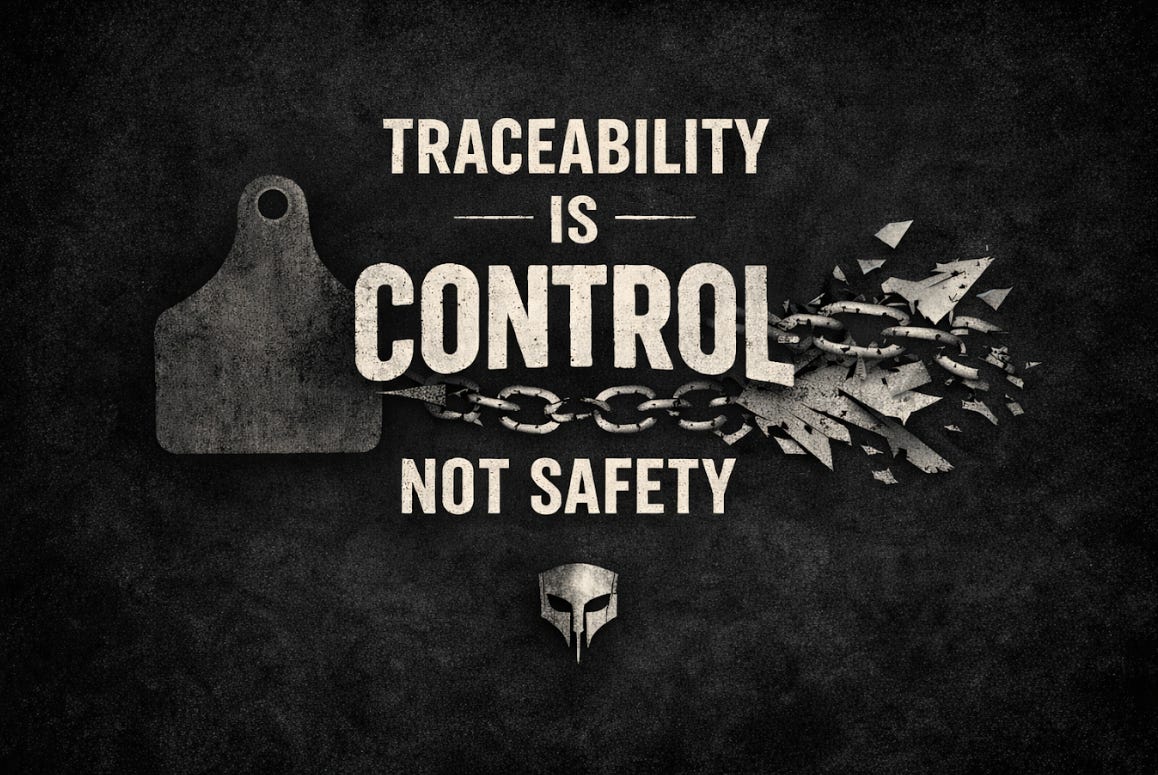
They tell us traceability is about safety.
They tell us it is about efficiency.
They tell us it is about modernizing agriculture.
Those words are chosen carefully. They always are.
This is not an argument about whether livestock should be healthy or food should be safe. That debate is a decoy. This is about something far more fundamental.
Traceability is a system that turns participation into permission.
And once participation requires permission, freedom becomes conditional.
This is not a call to improve traceability.
It is a warning about what traceability does once it takes hold.
⸻
What Traceability Really Is
Strip away the language and traceability becomes simple to define.
It is constant reporting.
Constant disclosure.
Constant compliance.
It requires producers to continually prove that what they are doing is allowed rather than assumed to be normal. It replaces judgment with checklists. It replaces relationships with records. It replaces trust with surveillance.
This system is enforced by institutions like the Canadian Food Inspection Agency, not because individual inspectors are malicious, but because the system itself is built to see people as risks first and stewards second.
When you must constantly prove innocence, freedom is already gone.
⸻
Traceability Criminalizes Normal Rural Life
Rural agriculture does not operate like a factory floor.
Animals are loaned.
Trailers are borrowed.
Pastures are shared.
Care is temporary and informal by necessity.
This is not chaos. It is how rural life has functioned for generations. It is built on reputation, accountability, and trust earned over time.
These arrangements are not exceptions. They are routine. They happen every day, across every rural region, without incident and without harm. Traceability does not distinguish between recklessness and responsibility. It flattens everything into reportable risk.
A missed report becomes a violation.
A delayed entry becomes non-compliance.
An honest mistake becomes an offence.
Intent no longer matters. Context no longer matters. Paperwork becomes the judge.
Traceability does not target criminals.
It creates them.
⸻
Why Small Cattle Producers Pay First
Traceability systems assume scale.
They assume administrative staff.
They assume digital infrastructure.
They assume time margins that small operations do not have.
For large, centralized operators, compliance is absorbed as overhead. For small and mixed producers, it is a constant pressure that never relents. Costs rise per head. Exposure to penalties multiplies. Anxiety replaces stewardship.
For many small producers, the decision is no longer about profitability. It becomes a question of tolerance. How much paperwork, exposure, and uncertainty is worth continuing?
When the answer becomes “not much,” quitting is not failure.
It is survival.
The rules do not scale down. They squeeze.
⸻
Rodeo Cannot Exist Inside a Bureaucratic Cage
Rodeo stock moves constantly.
Short-term custody.
Multiple venues.
Multiple jurisdictions.
Rapid transitions.
This is not a flaw. It is the nature of the sport.
Traceability assumes fixed ownership and linear movement. Rodeo is neither. It is fluid, relational, and fast-moving. When traceability is applied to rodeo, liability fear replaces tradition.
What disappears first is not the sport, but the willingness to participate. People who once hauled stock as a way of life begin to step back. And when participation drops, the culture collapses quietly.
Stock contractors decide it is not worth the risk.
Events shrink or disappear.
Communities lose more than entertainment. They lose continuity.
You cannot regulate rodeo like an industrial spreadsheet.
⸻
4-H Is Where the Damage Becomes Permanent
The most destructive impact of traceability does not show up on balance sheets. It shows up in silence.
Parents decide it is not worth the stress.
Volunteers decide the risk is too high.
Kids lose access to livestock, mentorship, and responsibility.
Traceability turns learning into liability. It replaces guidance with forms and fear. Families do not protest. They simply walk away.
A generation raised outside livestock does not return later to learn it. Skills not passed down are not paused. They are lost. When programs shrink, the damage is not temporary. It is cumulative.
When youth leave agriculture, it does not regenerate.
You do not notice the loss immediately. You notice it a decade later when no one is left to replace those who carried the knowledge forward.
⸻
Who This System Actually Serves
This system does not exist in a vacuum.
This is not about intent. It is about incentives and outcomes.
Traceability rewards scale.
It rewards consolidation.
It rewards centralized ownership with administrative capacity.
Independent producers are not pushed out by force. They are eroded by friction. Participation becomes exhausting. Risk becomes constant. Exit becomes rational.
Policy does not have to target you to erase you.
⸻
Trust Versus Tracking
Rural life is built on trust.
Trust earned through years of work.
Trust reinforced by reputation.
Trust enforced by community memory.
Traceability replaces trust with tracking. It assumes bad faith by default. It treats people as problems to be managed rather than stewards to be relied upon.
Participation declines not because people are irresponsible, but because people withdraw from hostile systems.
A society that replaces trust with tracking will eventually lose both.
⸻
Where This Always Ends
Once normalized, traceability does not stop.
It expands.
It tightens.
It demands more data, more reporting, more permission.
The end state is always the same.
Fewer independent producers.
Fewer community events.
Fewer kids involved.
More consolidation.
More institutional control.
By the time the damage is measurable, the people who made rural life work are already gone.
⸻
The Iron Quill Verdict
This System Will Not Save Agriculture
Traceability is sold as safety.
It functions as control.
It does not strengthen rural life.
It filters it.
You do not kill rural culture overnight.
You regulate it until it quits.
And when all that remains are compliant systems and empty traditions, the paperwork will be perfect.
The land will be poorer for it.
—The Iron Quill
It mirrors all their ideas.
They crushed small businesses. Mom and pop restaurants and such. They have disposed of small farmers. Herdsmen.
Anything that bound society together.
Now ask yourself why we should trust them….
Planned society demolition to accompany the desired culling of the population.