
The Western Shield

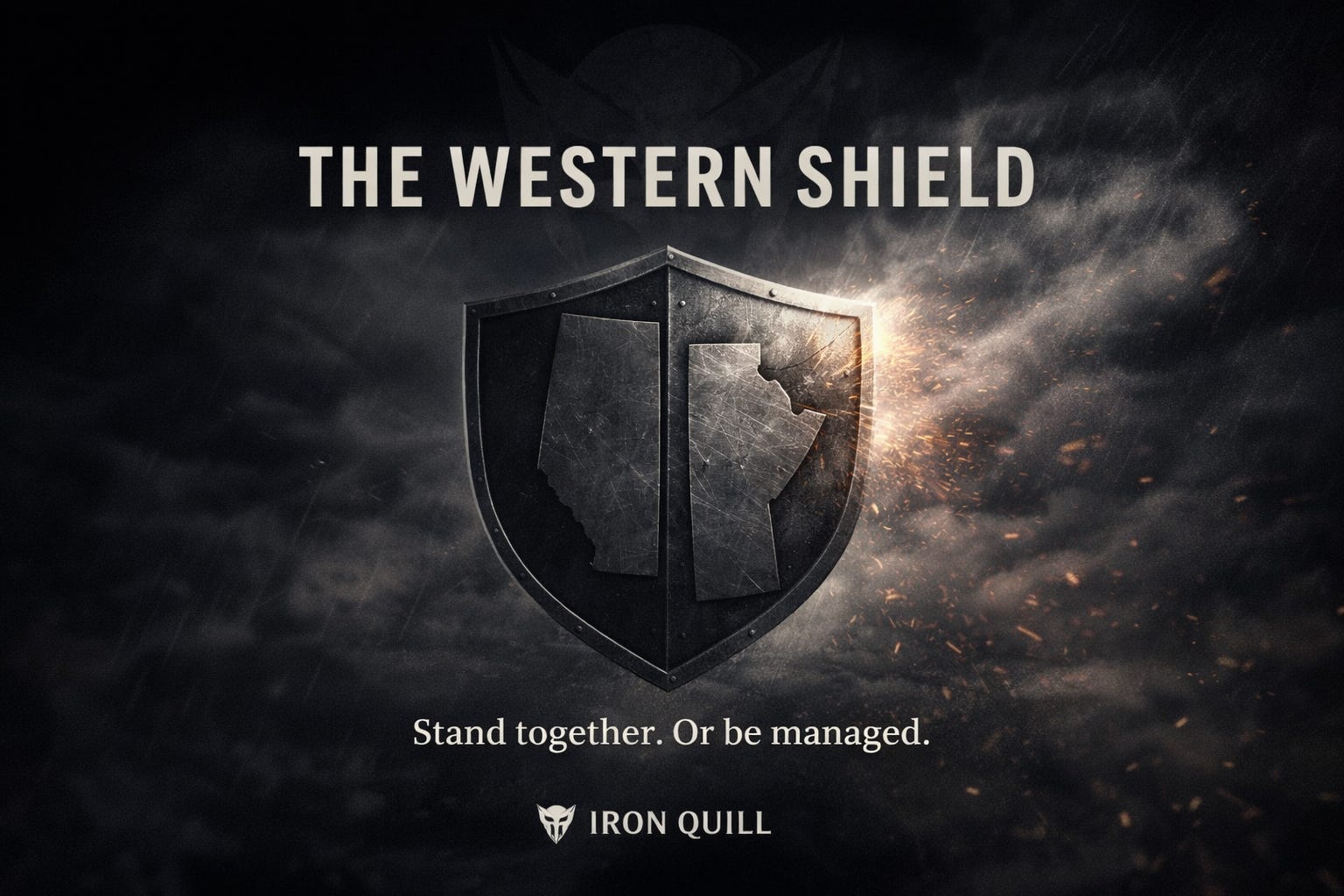
Canada has just crossed a line it cannot easily walk back.
Most people won’t notice it immediately. But they will feel it.
With Mark Carney now holding a majority government, the balance of power in this country has shifted in a way that cannot be ignored.
This is no longer a system built on negotiation.
It is a system that can move without it.
And when power consolidates at the center, the question is no longer what Ottawa will do.
The question is how the rest of the country responds.
⸻
When Power Centralizes
A majority government changes the rules of engagement.
It does not need permission to act. It does not need consensus to move. It does not need to slow down for regions that disagree.
Policy becomes direction.
Debate becomes process.
Outcome becomes predictable.
For provinces that align with that direction, this creates stability.
For those that do not, it creates pressure.
And once that shift happens, it does not easily reverse.
⸻
The Western Reality
The West has always lived in a different political reality than the rest of the country.
Saskatchewan and Alberta are not just geographically separate. They are economically structured in a way that often puts them at odds with federal direction.
Energy. Agriculture. Resource development.
These are not side issues in the West.
They are the foundation.
Decisions made in Ottawa land hardest in places farthest from it.
When those sectors are constrained, the impact is not theoretical.
It shows up in jobs lost. Investment delayed. Growth redirected elsewhere.
It is immediate.
It is economic.
It is generational.
⸻
The End of Assumed Influence
For years, Western provinces have relied on influence through pressure.
Negotiation. Public pushback. Strategic resistance.
That only works in a system where influence matters.
A majority government reduces that leverage.
It does not eliminate the ability to speak.
But it changes the weight of that voice.
Because when the numbers are locked, persuasion becomes optional.
And when influence becomes optional, so does listening.
⸻
This Isn’t New—But It Is Different
Tension between the West and Ottawa is not new.
It has existed for decades.
But this moment is different.
Because the system itself has changed.
This is not a fragile government navigating competing interests.
This is a consolidated one, capable of moving faster, further, and for longer without interruption.
What used to be a negotiation is now a direction.
And direction, when sustained over time, becomes reality.
And that is where the risk begins.
⸻
The Strategic Shift
This is where the conversation has to change.
This is not about outrage.
It is about positioning.
Individually, provinces can be managed.
Their concerns can be acknowledged, delayed, or absorbed into broader national policy.
But alignment changes that equation.
When Saskatchewan and Alberta move together, they are no longer isolated voices.
They become a bloc.
Not a protest.
A position.
⸻
What a Western Shield Looks Like
A shield is not built in reaction.
It is built in preparation.
This is not separation.
It is not instability.
It is coordination.
A Western Shield is built on alignment across key areas:
Policy Coordination
Provincial governments moving in step on major issues rather than reacting independently.
Economic Cooperation
Strengthening interprovincial trade, infrastructure, and energy development that reduces reliance on federal direction.
Legal Resistance
Challenging federal overreach where necessary through the courts, not rhetoric.
Unified Negotiation
Presenting a single, consistent position to Ottawa instead of fragmented responses.
This is how smaller voices become harder to ignore.
Not louder.
Stronger.
⸻
The Risk of Standing Alone
If Saskatchewan and Alberta continue to act independently, they remain exposed to the same cycle:
Push back.
Acknowledge.
Override.
Repeat.
That cycle benefits the center.
Not the regions.
Because it keeps opposition fragmented.
Predictable.
Manageable.
⸻
The Power of Alignment
Alignment does not guarantee victory.
But it changes the landscape.
It forces engagement.
It raises the cost of ignoring regional concerns.
It introduces friction back into a system that has lost much of it at the federal level.
And friction, when applied strategically, is power.
⸻
What Comes Next
The next phase will not be defined by what Ottawa announces.
It will be defined by how the West responds.
Watch for signals:
• Do provinces begin to coordinate messaging?
• Do policy positions start to align publicly?
• Do economic strategies shift toward internal strengthening?
These are the early signs of a region that understands the moment it is in.
⸻
Final Word
Ottawa has consolidated power.
That reality is now fixed.
But centralization does not eliminate regional strength.
It tests it.
The West now faces a choice.
Stand divided and be managed.
Or stand together and become something far more difficult to ignore.
Not louder.
Not reactive.
Deliberate.
Aligned.
Because a shield is not built to make noise.
It is built to absorb impact.
And when the pressure comes, the only question that matters is whether it holds—or breaks.
—The Iron Quill
I would rather have Quebec separate and take their pernicious Laurentian Elites with them. Then the Rest of Canada won't have to pay Quebec's bills anymore and we can "fix" the Constitution to redress the balance of power between Ottawa and the rest of the provinces.