
The Watchman’s Warning
The Danger of Borrowed Faith

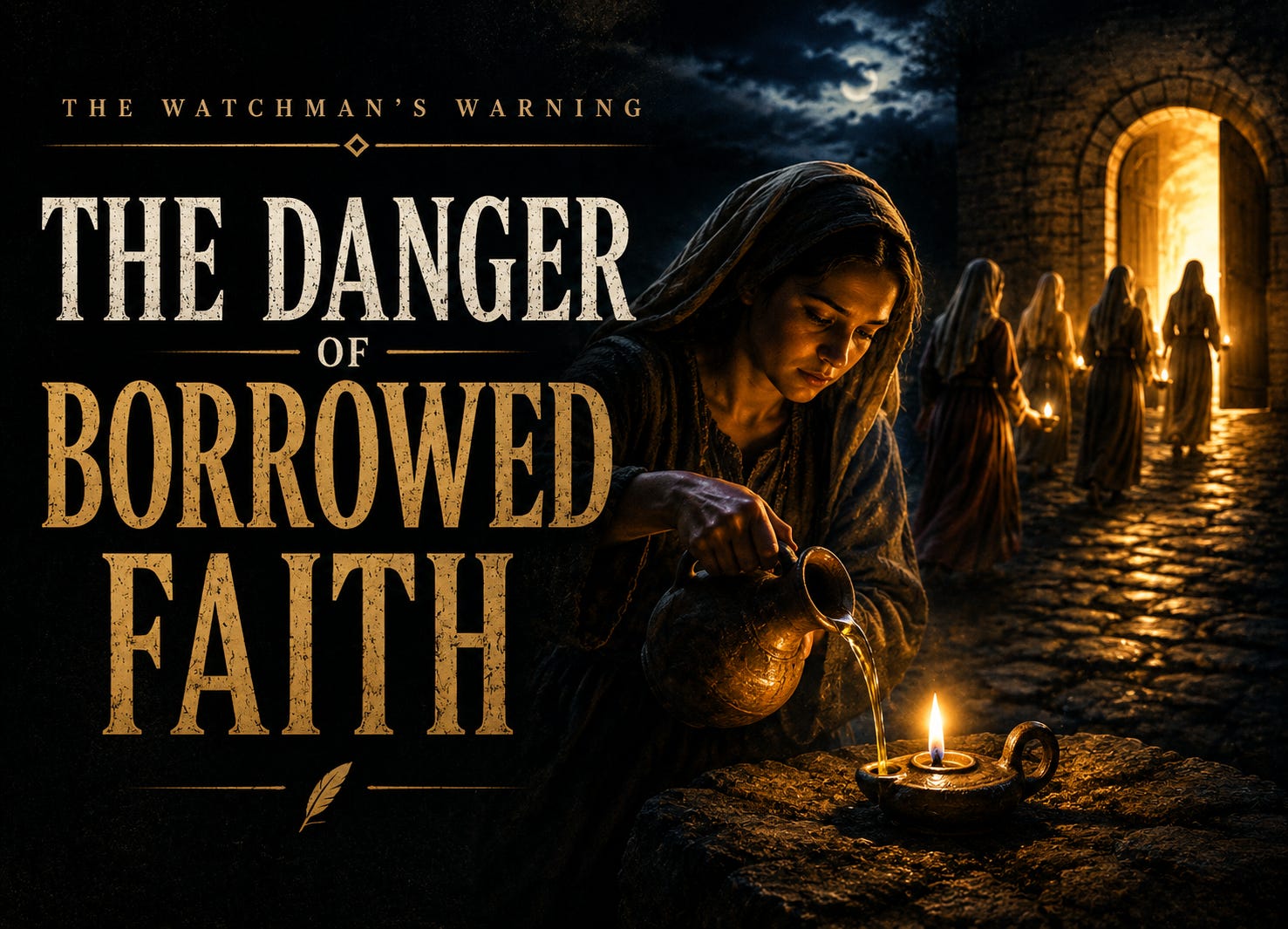
Matthew 25:8–9, ESV
“And the foolish said to the wise, ‘Give us some of your oil, for our lamps are going out.’ But the wise answered, saying, ‘Since there will not be enough for us and for you, go rather to the dealers and buy for yourselves.’”
There are some things a man can borrow.
He can borrow money.
He can borrow tools.
He can borrow advice.
He can borrow a truck, a ladder, a book, or a helping hand when the work is too heavy to carry alone.
But he cannot borrow faith.
He cannot borrow conviction.
He cannot borrow obedience.
He cannot borrow repentance.
He cannot borrow a relationship with God.
And one day, many will discover that far later than they should.
Christ’s parable of the ten virgins is often read as a warning about His return.
It is that.
But it is also a warning about assumption.
Five were wise.
Five were foolish.
All ten knew the bridegroom was coming.
All ten had lamps.
All ten went out to meet him.
From the outside, they all looked ready.
That is what makes the warning so severe.
The difference was not visible at first.
The difference was hidden.
The difference was oil.
The Appearance of Readiness
This is where the parable cuts deep.
The foolish virgins were not standing in open rebellion.
They were not mocking the bridegroom.
They were not denying that he was coming.
They were not outside the group.
They were among those waiting.
They had lamps in their hands.
They had enough religious appearance to look prepared.
But appearance is not preparation.
A lamp without oil can look useful until the darkness deepens.
A profession without faith can look strong until the pressure comes.
A person can stand among believers, speak the language, know the songs, attend the gatherings, share the posts, quote the verses, and still be living on something borrowed.
Borrowed faith can look fine in daylight.
It does not survive midnight.
The Illusion of Borrowed Faith
Many people live on borrowed faith.
Their parents believed.
Their grandparents believed.
Their spouse believes.
Their pastor believes.
Their church believes.
Their favourite preacher believes.
Their favourite political commentator uses Christian language.
Their favourite movement speaks about God, tradition, family, and country.
But what do they believe?
Not what did their father believe.
Not what did their church believe.
Not what did their side believe.
What do they believe when the crowd is gone?
What do they believe when obedience costs something?
What do they believe when the pressure comes?
What do they believe when God delays?
That is the test.
Borrowed faith can survive good weather.
It can survive comfortable seasons.
It can survive cultural Christianity.
It can survive weekly routines and social approval.
But borrowed faith cannot endure the hour when the lamp begins to go out.
The Delay Reveals Everything
The bridegroom was delayed.
That detail matters.
The crisis in the parable was not simply the arrival.
It was the waiting.
The delay revealed what appearance had hidden.
This is how God often works.
Abraham waited.
Joseph waited.
David waited.
Israel waited.
The disciples waited.
The church waits still.
Waiting is a test.
It burns away assumptions.
It exposes motives.
It reveals whether a person has oil or only a lamp.
Many people think they are prepared because nothing has tested them yet.
They think they are faithful because the cost has not risen.
They think they are strong because the night has not stretched long enough.
But the delay tells the truth.
When God does not move as quickly as we expected, what happens?
When the answer does not come?
When the culture turns darker?
When the crowd thins out?
When the easy version of faith no longer works?
That is when the difference between oil and appearance becomes visible.
When the Oil Runs Low
The foolish virgins did not realize the danger until it was urgent.
That is how spiritual neglect works.
It rarely announces itself.
It accumulates.
One neglected prayer.
One unopened Bible.
One compromise.
One excuse.
One quiet surrender.
One season of drifting.
Then another.
Then another.
Nothing seems catastrophic at first.
The lamp is still in the hand.
The language is still familiar.
The identity is still intact.
The person still knows how to look the part.
But slowly, the oil runs low.
And then midnight comes.
The cry goes out.
“Here is the bridegroom!”
Suddenly appearance is not enough.
Suddenly old habits are not enough.
Suddenly being near the wise is not enough.
Suddenly the borrowed glow of others cannot light your own lamp.
That is when panic begins.
The Panic of Last-Minute Faith
The foolish said to the wise, “Give us some of your oil, for our lamps are going out.”
That line should sober every believer.
They knew the problem.
They understood the shortage.
They recognized that the wise had what they lacked.
But they asked for something that could not be transferred.
Give us your oil.
Give us your preparation.
Give us your obedience.
Give us your relationship with God.
Give us what you gathered while there was time.
The answer was no.
Not because the wise were cruel.
Not because they lacked compassion.
Not because they wanted the foolish to fail.
But because some things cannot be borrowed at midnight.
A man cannot borrow another man’s repentance.
A woman cannot borrow another woman’s obedience.
A child cannot inherit a living faith merely because the family once had one.
A church cannot survive on the fire of a previous generation forever.
There comes a point when each soul stands before God with what was truly its own.
Modern Christianity’s Great Weakness
This is one of the great dangers of our time.
Many people know Christian culture better than they know Christ.
They know the language.
They know the arguments.
They know the political alignments.
They know the approved enemies.
They know the right slogans.
They know what to post, what to oppose, what to defend, and what to say when the room is listening.
But knowing Christian culture is not the same as knowing Christ.
Proximity is not relationship.
Tradition is not oil.
Political agreement is not conversion.
Outrage is not holiness.
A man can stand for the right causes and still neglect his own soul.
He can defend Christian civilization while failing to walk with Christ.
He can oppose the corruption of the age while allowing his own heart to grow cold.
The question is not whether you are near religious things.
The question is whether there is oil in the lamp.
The Coming Separation
The parable ends with separation.
That is the part many would rather soften.
But Christ did not soften it.
Those who were ready went in.
The door was shut.
Not because they had never heard.
Not because they did not know there was a bridegroom.
Not because they lacked outward association.
They were unprepared when preparation was required.
That is what makes the warning so uncomfortable.
All ten expected the bridegroom.
Only five were ready.
The separation was not between the obviously religious and the obviously wicked.
It was between the prepared and the presumptuous.
That should shake the modern church.
Because presumption is everywhere.
People assume tomorrow will provide more time.
They assume someone else’s faith will carry them.
They assume their history, their family, their church, their politics, or their moral opinions will be enough.
But the midnight cry does not ask what you assumed.
It reveals what you prepared.
What the Remnant Must Remember
The oil is gathered before the midnight cry.
Not after.
Faith is built before the storm.
Not during it.
Conviction is formed before the pressure comes.
Not while it is crushing you.
Obedience is practiced before the cost becomes unbearable.
Not after the door is closing.
The wise did not become wise at midnight.
They were wise before midnight.
They prepared while others assumed.
They gathered while others delayed.
They treated the bridegroom’s coming as real before the cry was heard.
That is what the remnant must recover.
A serious faith.
A prepared faith.
A faith that does not depend on the mood of the crowd, the strength of the nation, the health of the economy, or the approval of men.
A faith with oil.
The Quill’s Verdict
The greatest danger facing many believers may not be open persecution.
It may be assumption.
The assumption that tomorrow will offer more time.
The assumption that knowing the language is the same as knowing the Lord.
The assumption that being near the faithful is the same as being faithful.
The assumption that someone else’s oil will be available when your own lamp starts to fail.
It will not.
There are some things that cannot be borrowed.
Not at midnight.
Not when the cry goes out.
Not when the door is closing.
No one will stand before God holding another man’s lamp.
No one will enter on another woman’s faith.
No generation will be saved by the obedience of the one before it.
The wise will enter.
The foolish will scramble.
And the difference will not be talent, intelligence, status, politics, or reputation.
It will be oil.
It will be preparation.
It will be whether the faith was truly your own.
—The Iron Quill
The Iron Quill is reader-supported.
Most of this work remains free because truth should travel.
If you believe in the mission, become a paid supporter and help keep the signal alive.
Truer words were never spoken. Let this be a wake-up call to all of us.