
The Tower Builders Return
Babel, Global Coordination, and God’s Limits

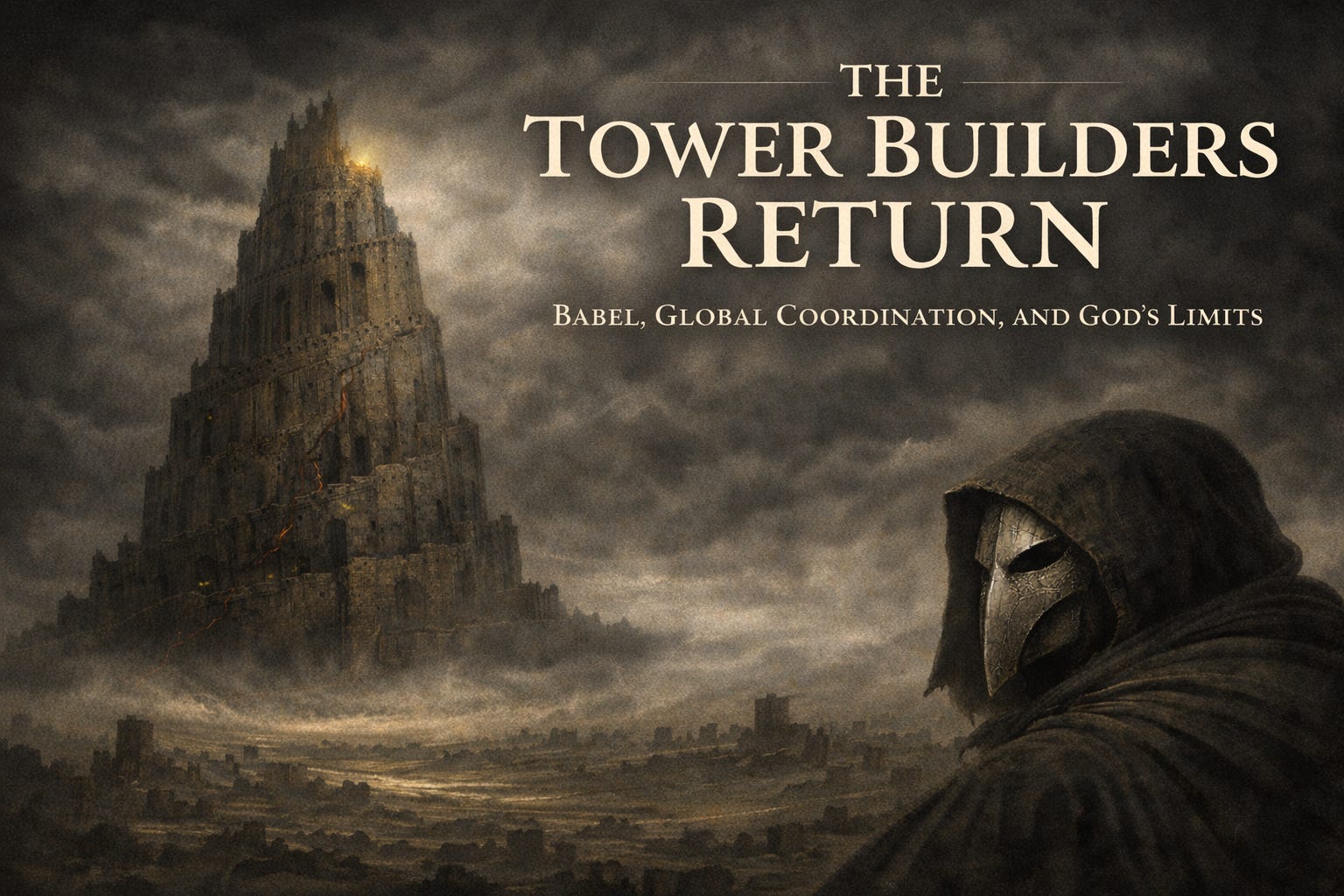
Babel was not an ancient mistake.
It was the first clear pattern.
Most people read Genesis 11 as a primitive story about bricks and ambition. Scripture presents something far more unsettling. Babel is not about height. It is about centralized authority without God.
The Bible does not mock the builders.
It interrupts them.
And that interruption tells us how God responds when human systems grow too unified, too confident, and too detached from heaven.
⸻
Babel Was Never About Construction. It Was About Control
Genesis tells us the world had one language and the same words. That detail is not decorative. It is foundational.
Shared language created shared assumptions.
Shared assumptions created shared purpose.
Shared purpose created self-legitimizing authority.
The builders say, “Let us make a name for ourselves.”
God is not mentioned.
He is not consulted.
He is not feared.
This is civilization organized entirely around itself.
Babel was humanity discovering coordination without obedience.
That is why the tower mattered less than the mindset behind it.
⸻
Why God Intervened. The Mercy Hidden Inside Judgment
God’s response to Babel surprises many.
He does not send fire.
He does not erase the city.
He does not kill the builders.
He scatters them.
Language is confused. Coordination collapses. Central authority fractures.
This was not cruelty.
It was restraint.
Total coordination accelerates rebellion. It allows error to spread without friction. Dispersion slows evil long enough for conscience, culture, and truth to survive.
Unity becomes rebellion when it no longer requires obedience.
God interrupted Babel not because humanity was weak, but because it was becoming too unified without Him.
Fragmentation was mercy.
⸻
Babel Is a Template, Not a One-Time Event
Babel reappears whenever human systems seek:
Unity without truth
Order without accountability
And coordination that no longer answers to God
Scripture shows this pattern repeatedly.
Egypt centralized power and enslaved.
Babylon centralized culture and demanded worship.
Rome centralized law and crushed dissent.
Different empires.
Same architecture.
Every time humanity builds a system that claims permanence, inevitability, and moral authority apart from God, the tower returns under a new name.
⸻
When Language Becomes a Weapon
Genesis tells us the world had one language and the same words.
That is not nostalgia.
It is warning.
Shared vocabulary governs before force ever appears. When language is standardized, the range of acceptable thought narrows quietly.
Unity becomes moral.
Dissent becomes disorder.
Obedience becomes “alignment.”
This is how power grows without ever announcing itself.
Babel did not begin with force.
It began with agreement.
⸻
God’s Ceiling on Human Power
Psalm 2 describes kings taking counsel together, rulers coordinating their plans, nations aligning their will.
And God laughs.
Psalm 2 does not describe panic in heaven. It describes laughter.
God allows coordination.
He never allows sovereignty over Him.
Every tower reaches a height where heaven intervenes. There is always a ceiling beyond which human systems cannot pass.
No amount of unity can override divine authority.
⸻
The Final Babel. When the System Feels Permanent
Revelation describes Babylon not as a city alone, but as an integrated system.
It is economic, cultural, and political at the same time.
And when it falls, the kings do not mourn righteousness.
The merchants do not mourn truth.
They mourn stability.
They mourn a system they believed could not collapse.
The most dangerous towers are the ones that feel inevitable.
⸻
Why God Always Disrupts Centralization
God scatters because total capture destroys conscience.
Centralized systems always move from coordination to allegiance. From efficiency to enforcement.
God disrupts before allegiance becomes irreversible.
Dispersion preserves:
Choice
Conscience
Truth
Remnant faithfulness
This is why God interrupts towers instead of reforming them.
⸻
Recognizing Babel Without Naming It
Babel never announces itself as rebellion.
It presents as:
Stability
Efficiency
Safety
Coordination
Resilience
The danger is not tyranny arriving loudly.
The danger is comfort without accountability.
When systems speak calmly, confidently, and without reference to God, Babel is already underway, even if no one calls it that.
⸻
The Role of the Watchman
Scripture never calls the watchman to dismantle Babel.
It calls him to name it.
The Bible does not promise the tower will be reformed.
It promises the faithful will be preserved.
Awareness is preparation.
Those who recognize the pattern are not meant to panic. They are meant to endure without assimilation.
⸻
The Sentence Already Written
Babel always feels permanent.
Until it isn’t.
God does not negotiate with towers.
He scatters them.
The question is not whether Babel will fall.
The question is whether you will still be standing inside it when it does.
That is the warning.
That is the mercy.
That is the pattern.
— The Iron Quill
This sounds similar to what I’m working on.
The framing of Babel as coordination without obedience rather than just architectural ambition shifts the whole reading. What's particuarly striking is how dispersion functions as protection instead of punishment, basically fracturing power before it can compound into somethin irreversible. Reminds me of how distributed systems in tech are actually more resiliant than centralized ones for similar reasons.