
The Strait Tightens
Not a Press Conference. A Boarding Operation.

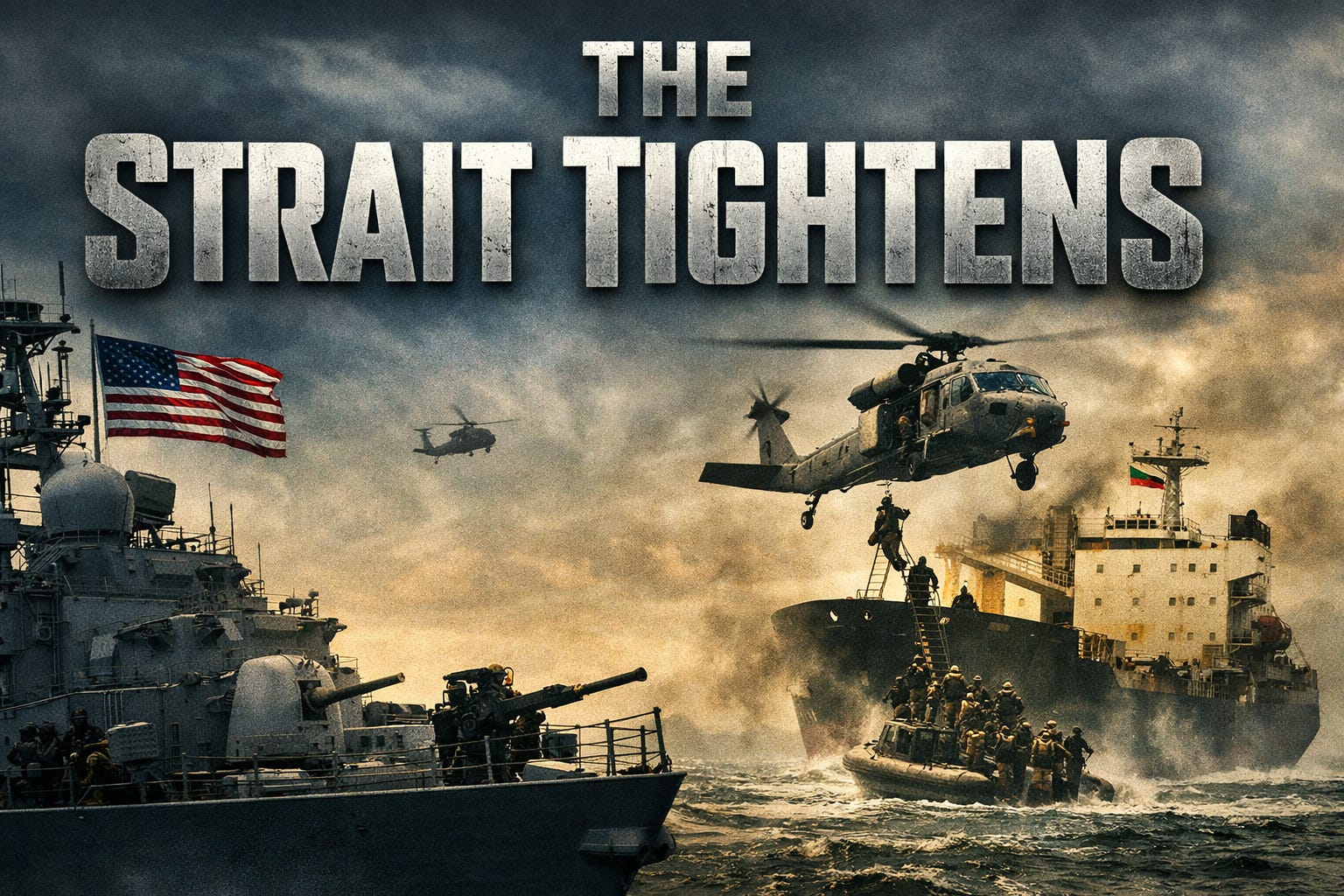
Some announcements come from a podium.
This one came from the deck of a ship.
Donald Trump announced that U.S. forces seized an Iranian-flagged cargo vessel near the Strait of Hormuz after it allegedly tried to run the American naval blockade. That is not a talking point. That is not routine diplomacy. That is force brought to a chokepoint the whole world depends on.
A vessel was intercepted in one of the most dangerous waterways on earth. The United States made it clear the blockade is real. Iran called it piracy and threatened retaliation. In a single move, the distance between standoff and escalation got shorter.
That is the story.
Not the headline. Not the personalities. Not the usual social media circus that reduces every serious event into team sports for people with no skin in the game.
The story is that one of the world’s most dangerous bottlenecks just got tighter, and once that happens, the pain does not stay local.
The Chokepoint That Can Make the World Hurt
The Strait of Hormuz is not an obscure patch of water for foreign policy nerds to argue over on television. It is one of the narrow gates through which modern life moves. Oil passes through it. Shipping depends on it. Markets watch it because they know what happens when a military confrontation gets too close to a bottleneck that feeds the global economy.
When Hormuz gets hot, the consequences travel.
They show up in diesel. They show up in freight. They show up in grocery prices, heating costs, farm input costs, and every other corner of life that depends on fuel being available and affordable. That is the part the comfortable class always misses. They treat geopolitics like a distant spectacle right up until it lands on a family budget.
Then suddenly it becomes real.
That is what this event did. It took a fragile situation and made it more expensive, more dangerous, and harder to contain.
This Was a Show of Force
Do not let this get watered down into some shallow argument about Trump’s tone or Iran’s wording.
This was a demonstration of control.
A blockade only matters if someone is willing to enforce it. Warnings only matter if someone is willing to act on them. Today, the United States showed the region, the markets, and the rest of the world that this is no longer a matter of abstract threats and diplomatic fog. A ship was taken, a blockade was tested, and every player tied to that corridor was forced to think twice.
That raises the cost of caution, delay, and denial for everybody connected to it.
Ship owners start thinking differently. Insurers start pricing differently. Governments start talking differently. Traders start moving differently. The moment a chokepoint becomes a test of military will, hesitation gets more expensive for everyone downstream, including countries that are not firing a shot.
That is why this is bigger than one vessel and one statement from the White House.
It tells the world the pressure point is live.
The Real Danger Is What Comes Next
Fragile is one of those polite words the media uses when it does not want to say unstable.
This situation is unstable.
The United States says it is enforcing order. Iran says it is being attacked. Those are not two versions of the same calm moment. Those are the ingredients of a wider confrontation. Maybe the response comes directly. Maybe it comes through proxies. Maybe it comes through threats to shipping, stalled talks, selective retaliation, or a slow tightening of the screws across the region.
Whatever form it takes, this is no longer theoretical.
That matters because the costs start rising before the missiles do. Markets do not wait for a full-scale war to price in danger. Supply chains do not wait for a formal declaration before reacting to risk. Ordinary people do not wait for a history book to learn they are the ones who get handed the bill.
That is how the modern system works. It does not break all at once. It passes the pain outward in layers until the public finally notices what the experts were too arrogant to admit.
Canada’s Weakness Is Self-Inflicted
Now bring it home.
Canada should be one of the last countries on earth worried about energy shocks. We have resources. We have land. We have producers. We have every natural advantage needed to build resilience, lower costs, and protect ourselves from the instability of foreign choke points.
Instead, we are governed like a country embarrassed by its own strength.
That is the real Canadian angle in this story.
When a place like Hormuz starts tightening, a serious country asks how to shield its people. A foolish country discovers, once again, that it has spent years sabotaging its own capacity in the name of ideology, delay, and managed decline. We keep acting like energy abundance is a moral problem instead of a strategic advantage. We keep treating self-sufficiency like an outdated idea instead of the backbone of national stability.
Then the world gets rough and the weakness becomes obvious.
Higher fuel costs hit harder when your own government has already made energy more expensive. Supply shocks bite deeper when your policy class has spent years throttling infrastructure and punishing production. Global instability is bad enough on its own. It becomes worse when domestic leadership has been actively making the country less resilient on purpose.
That is the trap Canada is in.
We are not just exposed to the world. We are exposed by the people who were supposed to protect us from it.
Not because we were doomed to be here. Because too many people in power chose it.
When Reality Hits, Excuses Die
Events like this have a way of stripping the varnish off political lies.
All the nice words about transition, moderation, and careful balance start sounding hollow when a single confrontation in a narrow waterway can send tremors through the whole system. All the smug lectures about what a modern country should be become harder to sell when ordinary people are the ones paying more to drive, heat, farm, ship, and live.
Reality does not care how elegant the lie sounded in Ottawa.
It does not care about slogans. It does not care about polished talking points. It does not care how many panels, experts, and bureaucrats insist the system is under control. The moment force enters a strategic bottleneck, the mask of stability starts slipping.
And once people see that slip, they start asking questions the ruling class hates.
Why are we this exposed?
Why are we this dependent?
Why did our leaders make us weaker in a world that was obviously getting more unstable?
Why are citizens always expected to carry the burden of elite failure?
Those questions are dangerous for the people who created this mess.
They should be.
The Quill’s Verdict
This was not about one ship.
It was about leverage. It was about force. It was about the world being reminded that the system everyone depends on is held together by narrow routes, hard power, and political decisions with real consequences.
The Strait of Hormuz just got tighter. That means the margin for error just got smaller. And countries that spent the last decade weakening themselves are now in a worse position to absorb what comes next.
That includes Canada.
The danger is not only that the world is becoming more volatile. The danger is that our own leaders prepared us poorly for volatility, then sold that weakness as wisdom. They called it progress. They called it balance. They called it responsible management.
Now reality is calling their bluff.
A ship was seized. A warning was sent. And the message was not subtle: the artery can be pinched, the pressure can spread, and the public will pay long before the political class tells the truth about what is happening.
That is what today was.
Not a spectacle.
Not a sideshow.
Not something to scroll past between distractions.
A reminder.
The world is still ruled by choke points, force, and consequences. And a country that refuses to take its own strength seriously will always suffer more when the water starts closing in.
—The Iron Quill
All it will take is one spark to light the powder keg.
Liars beware. You have a lot to atone for.
Every word you write I'd truth!
Thank you IQ 🙏❤️