
The Panic Merchants

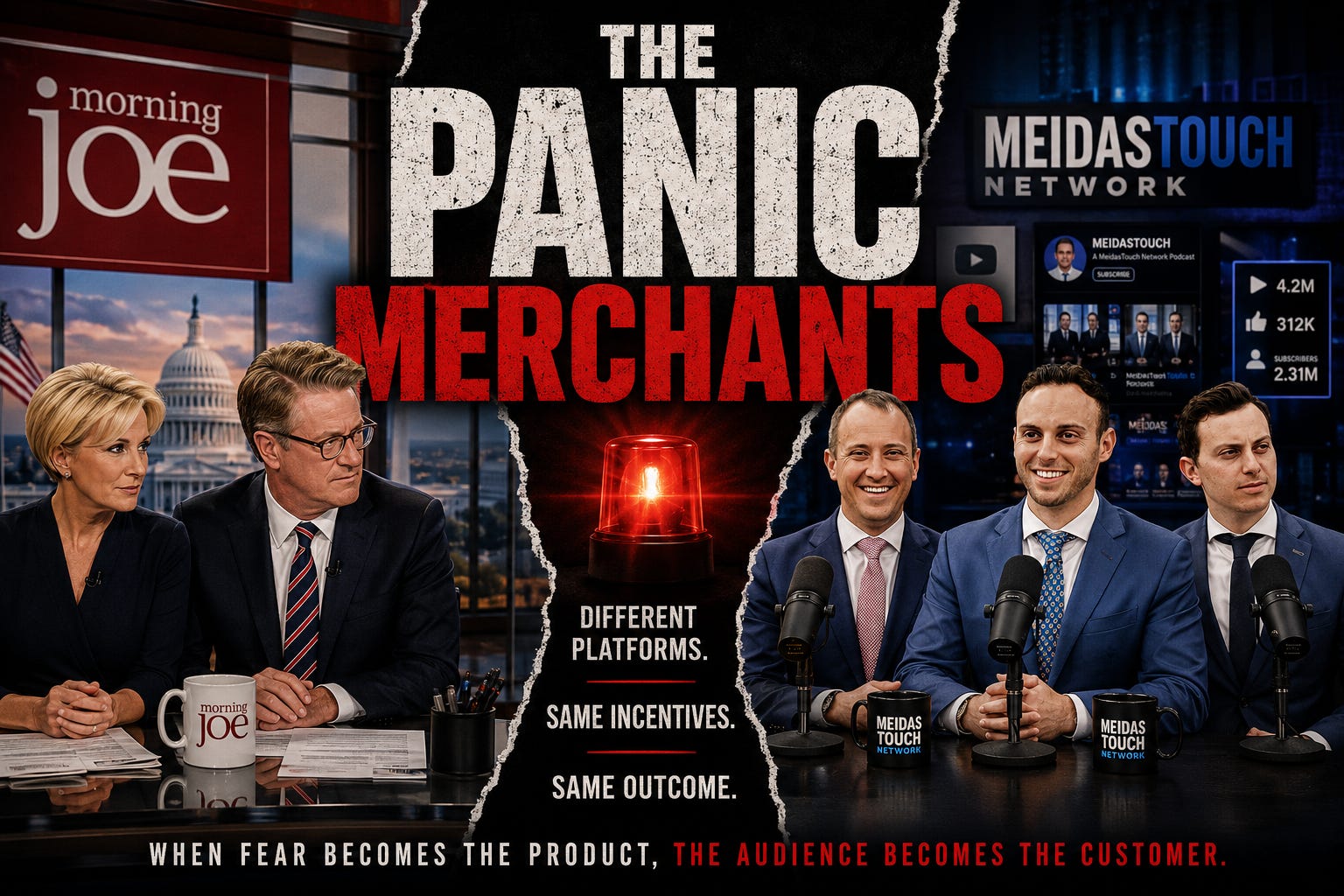
Morning Joe looks like the old media world.
MeidasTouch looks like the new one.
One has the polished television desk, the familiar cable format, the professional lighting, the suits, the panel, the rehearsed seriousness.
The other has the digital energy, the podcast clips, the YouTube thumbnails, the social media pile-ons, the urgent captions, the constant churn of short-form outrage.
They appear different.
They sound different.
They reach people in different ways.
But underneath the packaging, the product is often the same.
Panic.
Not wisdom.
Not patience.
Not public understanding.
Panic dressed up as analysis.
That is the commodity.
That is the business model.
That is what keeps the machine running.
The platform changed.
The business model did not.
Different Platforms, Same Product
The old media class has a problem.
People stopped trusting them.
The anchors still talk. The panels still nod. The producers still stack the segments. The headlines still arrive with the same breathless urgency.
But something changed.
The audience got smaller.
The authority got weaker.
The spell wore off.
So the panic industry adapted.
It did not disappear.
It migrated.
Some of it stayed on cable, where shows like Morning Joe still function as the breakfast table of the political class. A place where insiders talk to insiders, perform concern for each other, and explain to the country why the country keeps disappointing them.
But some of it moved online.
That is where operations like MeidasTouch thrive.
They present themselves as the alternative. The new guard. The scrappy digital resistance. The people’s media. The anti-establishment answer to the old networks.
But watch the rhythm long enough and the pattern becomes hard to miss.
The branding changed.
The incentives did not.
The old cable desk and the new digital studio both understand the same rule.
Keep the audience emotionally activated.
Keep them angry.
Keep them afraid.
Keep them convinced that tomorrow may be the end of everything.
Then tell them to come back after the break.
Or like.
Or subscribe.
Or donate.
Or share.
Or watch the next clip.
The delivery system changed.
The dependency remained.
The Business of Permanent Crisis
Modern media does not simply compete for truth.
It competes for attention.
That matters.
Because attention does not always reward the honest thing. It often rewards the loud thing. The dramatic thing. The frightening thing. The thing that confirms what people already fear.
Calm analysis rarely wins the algorithm.
Nuance does not spread like fire.
Careful reporting does not always produce a viral clip.
But panic does.
Panic spreads faster than careful analysis.
It gets shared more often.
It keeps people refreshing the feed.
It convinces viewers that looking away might be dangerous.
That is why every week becomes historic.
Every election becomes the most important election of our lifetime.
Every speech becomes a threat to democracy.
Every opponent becomes an existential danger.
Every disagreement becomes proof that the country is on the edge of collapse.
And once that becomes the rhythm, the audience is no longer being informed.
It is being conditioned.
A crisis audience is easier to keep than an informed audience.
An informed audience may walk away when the facts are clear.
A crisis audience stays because the emergency never ends.
That is the brilliance of the panic business.
It never has to finish the story.
It only has to keep the alarm ringing.
From News to Emotional Management
There was a time when journalism at least pretended to separate the event from the reaction.
Here is what happened.
Here is who said what.
Here is what we know.
Here is what remains unclear.
Then the public could think.
Now much of the media skips that process.
The reaction arrives before the facts have even cooled.
The approved emotional response is packaged into the headline.
The conclusion is placed at the front.
The viewer is not simply told what happened.
The viewer is told what kind of person would feel the correct way about what happened.
That is not reporting.
That is emotional management.
The audience is guided.
Not toward understanding.
Toward reaction.
This is why so much political media feels less like news and more like a reassurance circle for people who already agree with each other.
The hosts reassure the viewers.
The viewers reassure the hosts.
The guests repeat the framework.
The framework becomes reality.
Nobody leaves better informed.
They leave more certain.
More angry.
More convinced that the other side is not merely wrong, but dangerous.
And that is where the damage begins.
Because a free people cannot think clearly if every issue is filtered through panic first.
The Audience Trap
The audience is not innocent in this either.
Media companies learned what works because people showed them.
Outrage gets rewarded.
Confirmation gets rewarded.
The sharpest attack gets clipped.
The most dramatic warning gets shared.
The most smug monologue gets applause from the people already waiting to agree.
So the machine adjusts.
It gives the audience more of what the audience consumes.
More certainty.
More villains.
More emergency.
More proof that your side is righteous and the other side is insane.
This is how the trap closes.
The audience thinks it is being informed.
In reality, it is being measured.
What keeps them watching?
What makes them click?
What keeps them angry?
What makes them donate?
What makes them share?
What makes them feel morally superior while doing very little?
That is the question behind the curtain.
And once the machine finds the answer, it feeds it back every day.
Your side is good.
Their side is evil.
You are informed.
They are brainwashed.
You are defending democracy.
They are destroying it.
Stay afraid.
Stay angry.
Come back tomorrow.
That is not citizenship.
That is dependency.
The Permanent Emergency
There is a cost to living in permanent emergency.
At first, people become alert.
Then they become anxious.
Then they become exhausted.
Then they become numb.
If everything is a crisis, eventually nothing is.
If every week is the end of democracy, eventually people stop hearing the warning.
If every opponent is a fascist, a dictator, a traitor, a threat, or a monster, eventually the words lose meaning.
That is what panic merchants never seem to understand.
They burn the language down to keep the audience warm for one more night.
But when real danger comes, the words are gone.
They spent them.
They cheapened them.
They turned every political conflict into the final battle between good and evil.
And now the public does not know what to believe.
This is how trust dies.
Not only through lies.
Through exaggeration.
Through selective outrage.
Through emotional manipulation.
Through pretending every story is the one that will finally prove everything.
A society cannot remain permanently panicked and permanently free.
Fearful people are easier to steer.
Angry people are easier to divide.
Exhausted people are easier to govern.
And confused people are easier to lie to.
Why Trust Keeps Collapsing
Media trust did not collapse because the public suddenly became stupid.
It collapsed because people noticed.
They noticed the double standards.
They noticed which scandals got oxygen and which ones disappeared.
They noticed which protests were framed as noble and which ones were framed as dangerous.
They noticed which politicians were described as complicated and which ones were described as evil.
They noticed how often the same people who claimed to defend democracy seemed furious when democracy produced an answer they disliked.
They noticed the sneer.
That matters.
People can forgive mistakes.
They have a harder time forgiving contempt.
And contempt has been dripping from much of the media class for years.
Contempt for voters who refuse to obey.
Contempt for parents who question schools.
Contempt for workers who do not speak the approved language.
Contempt for rural people.
Contempt for Christians.
Contempt for ordinary citizens who looked at the official story and said, “I do not believe you anymore.”
Instead of asking why trust was broken, the media class often blamed the people who stopped trusting them.
That is easier.
It avoids the mirror.
But the mirror is still there.
Trust is rarely destroyed by one lie.
It is destroyed by a thousand small manipulations.
A thousand little edits.
A thousand missing facts.
A thousand loaded questions.
A thousand smirks.
A thousand moments where the public realized the people claiming to inform them were really trying to manage them.
The Old Guard and the Digital Guard
This is why Morning Joe and MeidasTouch belong in the same conversation.
Not because they are identical.
They are not.
One represents the old guard.
The other represents the digital guard.
One speaks in the language of cable respectability.
The other speaks in the language of online resistance.
But both exist inside a media economy that rewards alarm.
Both understand the power of a loyal audience that believes the stakes are always apocalyptic.
Both benefit when politics becomes less about persuasion and more about emotional identity.
Both thrive when viewers are trained to see disagreement as danger.
That is the shared ecosystem.
The old guard tells the audience the experts are worried.
The digital guard tells the audience the movement is fighting back.
The old guard frames the panic.
The digital guard spreads it.
The old guard sits at the table.
The digital guard floods the feed.
Different uniforms.
Same incentives.
And the public is left more divided, more suspicious, more reactive, and less capable of thinking clearly.
What Real Journalism Should Be
Real journalism should not flatter the audience.
It should challenge the audience.
It should not protect one side and hunt the other.
It should investigate power wherever power sits.
Government power.
Corporate power.
Institutional power.
Judicial power.
Media power.
Party power.
All of it.
Real journalism should separate facts from activism.
It should admit uncertainty.
It should correct errors clearly.
It should resist becoming a campaign office with press credentials.
It should give citizens enough truth to think for themselves.
That is the job.
Not emotional supervision.
Not moral babysitting.
Not partisan therapy.
Not daily panic management.
Information.
Context.
Accountability.
Truth.
That is what citizens need.
Because free people do not need to be herded.
They need to be trusted with facts.
The Panic Merchants
The panic merchants survive by convincing people the emergency never ends.
That is the whole game.
There is always another threat.
Another warning.
Another clip.
Another scandal.
Another historic moment.
Another reason to stay glued to the screen.
Another reason to believe the country will collapse unless you keep listening to the people who keep getting it wrong.
But at some point, citizens have to step back.
They have to ask what this constant panic is doing to them.
Is it making them wiser?
Is it making them harder to manipulate?
Is it helping them understand their neighbours?
Or is it keeping them trapped in a loop of fear, anger, and contempt?
Because that is the real danger.
Not merely bad media.
A bad public.
A public trained to react instead of think.
A public trained to hate instead of discern.
A public trained to panic instead of judge.
Morning Joe may be the old breakfast table.
MeidasTouch may be the new digital megaphone.
But the warning is bigger than both of them.
The machine is the problem.
The incentive is the problem.
The permanent emergency is the problem.
The panic merchants do not want citizens.
They want an audience.
They do not want questions.
They want reactions.
They do not want calm judgment.
They want emotional dependence.
And a free people cannot live that way forever.
The business survives by keeping the alarm ringing.
Free citizens survive by learning to think clearly while everyone else is trying to keep them afraid.
—The Iron Quill
The Iron Quill is reader-supported.
Most of this work remains free because truth should travel.
If you believe in the mission, become a paid supporter and help keep the signal alive.
I call it panic porn.
24×7×365 Right on Crisis Commandos 😩