
The Managed Country
Democracy by Design, or Democracy by Manipulation?

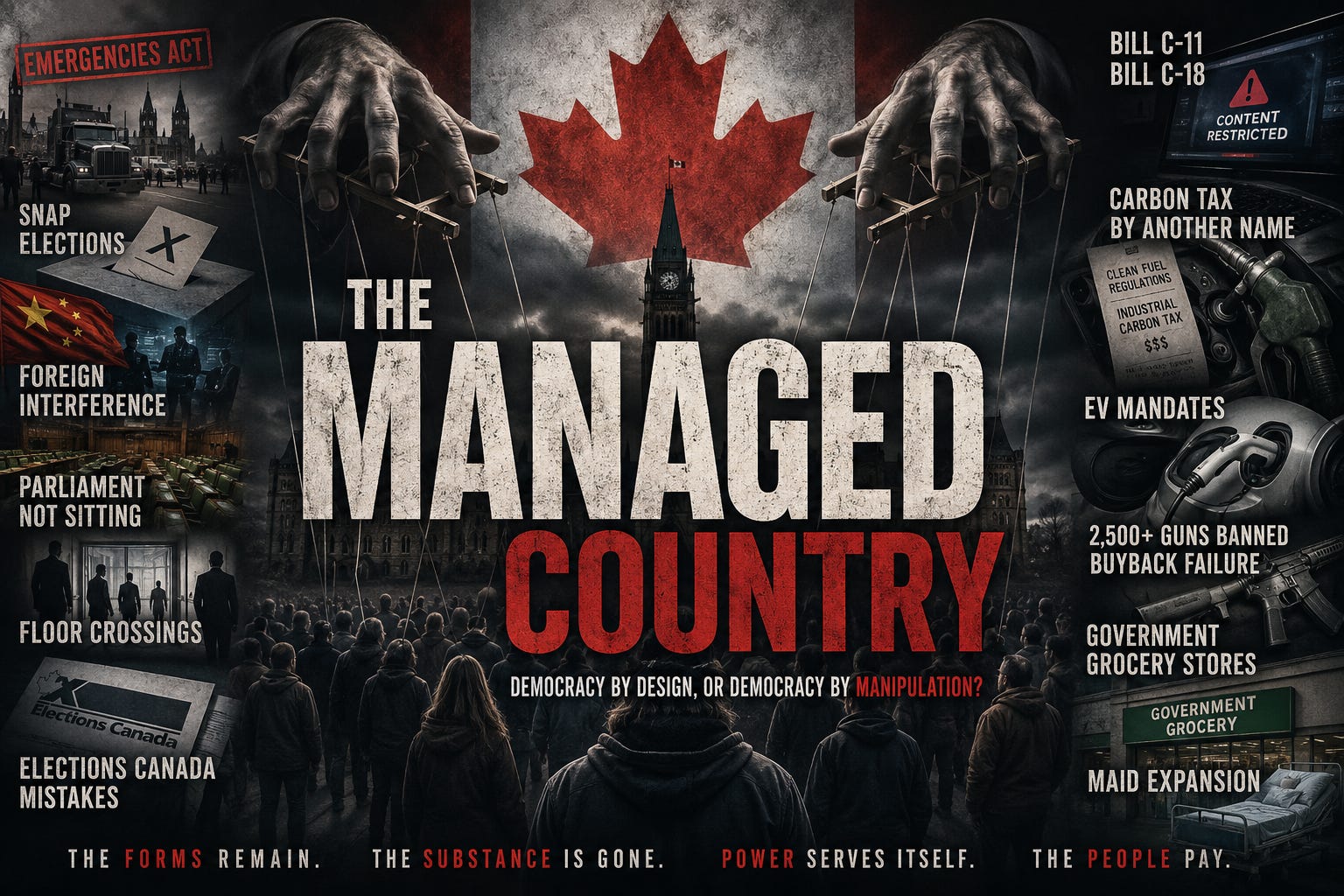
Canada has not fallen because the flag came down.
That would have been too honest.
The maple leaf still flies. Elections are still held. Parliament still opens with ceremony. Leaders still speak the language of democracy, rights, compassion, safety, inclusion, and national interest.
But behind the symbols, something colder has taken shape.
Canada is becoming a managed country.
Not openly conquered. Not formally abolished. Not ruled by a man in a uniform standing on a balcony. Managed. Regulated. Narrated. Nudged. Corrected. Priced. Licensed. Monitored. Reclassified. Subsidized. Punished.
The democratic forms remain.
The democratic spirit is being drained out of them.
And the question now sitting in front of every Canadian is simple.
Are we still living under democracy by design?
Or democracy by manipulation?
The Costume of Democracy
A country can keep elections and still lose accountability.
A country can keep Parliament and still hollow out representation.
A country can keep courts, commissions, committees, and public consultations while ordinary citizens begin to understand that the real decisions are made somewhere else, by people they did not elect, under rules they did not write, using language designed to make resistance sound dangerous.
That is the Canadian problem now.
The system still wears the costume of democracy. It still holds the rituals. It still counts ballots. It still lets the opposition speak. It still allows citizens to complain, post, protest, write letters, and vote every few years.
But the governing machine has learned how to absorb dissent without obeying it.
That is not freedom.
That is management.
And once you see the pattern, you cannot unsee it.
Crisis Became the Operating System
Covid did not create this system.
It revealed it.
For a season, Canadians were told that ordinary rights could be suspended in the name of safety. Movement could be restricted. Livelihoods could be threatened. Families could be divided. Worship could be limited. Protest could be condemned. Medical decisions could become passports into normal life.
The state discovered something during Covid.
It discovered how much power fear could produce.
Then came the Emergencies Act.
On February 14, 2022, the federal government declared a public order emergency. The declaration was revoked on February 23, 2022, but the precedent remained. The message had been sent. Under the right language, with the right crisis, the state could reach farther than most Canadians ever imagined.
That moment mattered.
Not because every protester was perfect. Not because every tactic was wise. Not because every blockade should have lasted forever.
It mattered because the government crossed a line.
Bank accounts became pressure points. Protest became an emergency. The citizen was no longer treated as someone to be answered. He was treated as a disruption to be managed.
That is how a free country changes.
Not all at once.
One emergency at a time.
The Lab, the Secrecy, and the Managed Truth
Then there was the Winnipeg lab scandal.
This is where the language must be precise.
The issue is not wild speculation. The issue is national security, secrecy, and the public’s right to know what happened inside one of the country’s most sensitive scientific institutions.
A House of Commons committee examined the National Microbiology Laboratory in Winnipeg, the firing of scientists, security concerns, and links to Chinese institutions. The deeper issue was not only what happened in the lab. It was how hard the system fought before Canadians were allowed to see behind the curtain.
That is not a minor administrative story.
That is a trust story.
Canadians were told to obey the experts, trust the institutions, accept emergency measures, and stop asking questions. Yet when questions touched national security, foreign influence, sensitive research, and government accountability, the same system resisted transparency.
This is how managed democracy works.
The citizen gets lectures.
The state gets secrecy.
Elections Without Full Trust
Then came the election machinery.
In 2021, Justin Trudeau called a snap election during the pandemic, seeking a majority while Canadians were still living under the shadow of restrictions, fear, and public health messaging. The official explanation was that Canadians deserved a say. The obvious political reality was that the governing party wanted a stronger hand.
Then came the foreign interference revelations.
The public inquiry into foreign interference examined interference in the 2019 and 2021 federal elections. It found that foreign interference occurred, with China identified as the most active foreign actor, while also stating that the overall election results were not changed.
That distinction matters.
The claim is not that every ballot was fake.
The claim is that a country worthy of trust should not need to be dragged into admitting foreign interference is real.
The question is not whether Canada still holds elections. The question is whether the system defends the citizen’s vote with the same intensity it defends its own reputation.
When Elections Canada later faced scrutiny over a special ballot error in Terrebonne, a riding decided by a single vote after a recount, Canadians were again asked to trust the machine while the machine admitted a mistake existed.
One vote.
One riding.
One mistake.
One more crack in the wall.
A healthy democracy does not fear scrutiny.
A managed democracy resents it.
Parliament Paused, Power Continued
Then look at Parliament.
On January 6, 2025, Parliament was prorogued until March 24, 2025. In plain language, the country’s democratic chamber was put on hold while the governing class handled its own survival.
The citizen still had bills to pay.
The farmer still had inputs to price.
The small business owner still had payroll.
The family still had groceries, fuel, mortgage payments, taxes, and anxiety.
But Parliament could wait.
This is one of the clearest signs of a managerial state. The machinery pauses accountability when accountability becomes inconvenient, then tells the public it is all perfectly normal because the procedure allows it.
Procedure becomes the shield.
Democracy becomes the language used to explain why democracy must wait.
Representation, or Acquisition?
Then came the floor crossings.
By 2026, opposition MPs crossing to Mark Carney’s Liberals had become a major political story, with reports describing the Liberals moving closer to majority territory through defections from opposition benches.
That raises a brutal democratic question.
If voters deny a party a majority, but the majority is later assembled through floor crossings, pressure, ambition, access, or crisis language, is that representation?
Or is it political acquisition?
Yes, floor crossing is legal.
Legal is not the same as clean.
Legal is not the same as democratic in spirit.
When citizens vote for one thing and receive another, trust rots. When politicians change teams without going back to the people who sent them there, the citizen learns the lesson.
Your vote sends them to Ottawa.
Ottawa decides what they become after that.
That is not a small problem.
That is the quiet arrogance of a system that believes voters are useful on election day and manageable afterward.
Speech Under Supervision
Then came the speech laws and information controls.
Bill C-11 amended the Broadcasting Act and expanded federal regulation into online streaming. Bill C-18 created a regime around digital platforms and news content. The government sold these laws as fairness, culture, support for journalism, and modernization.
The Quill sees the deeper problem.
A free country should be extremely cautious when the state begins positioning itself between the citizen and the information stream.
Because once government decides it has a duty to manage visibility, discoverability, access, platform responsibility, news compensation, and approved cultural priorities, the line between support and supervision becomes thin.
Very thin.
The danger is not always censorship with a boot.
Sometimes it is curation with a smile.
Sometimes it is control dressed as culture.
Sometimes it is speech management wrapped in Canadian politeness.
The Carbon Tax Did Not Die
Then there is energy.
Canadians were told the consumer carbon tax fight was over. But the control model did not disappear. It changed form.
The Clean Fuel Regulations still impose carbon-intensity requirements on gasoline and diesel. Industrial carbon pricing remains part of the broader machinery. The labels change, but the pressure stays.
That is the trick.
When one policy becomes politically toxic, the system does not surrender the objective. It moves the objective into another mechanism. It shifts the burden from one line item to another. It changes the name, changes the instrument, changes the explanation, and keeps moving.
This is how coercion wears a halo.
It is not sold as control. It is sold as transition. It is not presented as punishment. It is presented as pricing. It is not admitted as central planning. It is praised as climate leadership.
And the citizen pays.
At the pump. At the shop. On the farm. Through transport. Through groceries. Through everything that moves.
They Moved to Mandate the Future
The same mentality showed up in electric vehicle policy.
The federal government moved to impose regulated sales targets for zero-emission vehicles, beginning with 20 percent of new light-duty vehicle sales in the 2026 model year and rising toward 100 percent by 2035. The mandate later became politically difficult enough that the government backed away from the first stage while still keeping the larger emissions agenda alive.
Again, notice the pattern.
The government does not simply let citizens, markets, infrastructure, weather, distance, industry, and affordability decide. It tries to mandate the future, then retreats when reality becomes politically dangerous.
This is not leadership.
It is bureaucratic ambition colliding with real life.
Saskatchewan knows the difference.
A farmer does not move because Ottawa wrote a target.
A trucker does not survive because a minister gave a speech.
A family does not buy a vehicle because a regulator imagined a cleaner spreadsheet.
Reality still exists.
And the governing machine hates reality because reality refuses to obey memos.
Property Rights by Permission
Then came the firearms bans and buyback mess.
The federal government says more than 2,500 makes and models of firearms have been prohibited since May 2020. It also says an amnesty period remains in place for lawful owners while they take steps to comply.
Leave aside the emotional language for a moment.
Look at the principle.
A citizen lawfully owns property.
The state reclassifies it.
The state creates a surrender or compensation process.
The process drags.
The citizen is told he remains protected only under an amnesty while he moves toward compliance.
That is not property rights.
That is permission dressed up as ownership.
Real property rights mean the state cannot simply change the category of your lawful property and turn you into a potential criminal for refusing to surrender it.
Again, the point is bigger than one policy.
The managed state does not believe you own anything securely by right.
It believes you hold things conditionally until the state changes its mind.
The State Enters the Grocery Aisle
Then Toronto gave us another symbol.
In 2026, Toronto City Council moved toward a pilot project for municipally operated grocery stores, framed around food access and affordability.
On the surface, that sounds compassionate.
But the deeper question remains.
What kind of country helps make life unaffordable through taxes, regulation, land policy, debt, energy costs, monetary pressure, and market distortion, then offers government-run grocery stores as the answer?
That is the system in miniature.
Government helps create the pressure, then arrives as saviour. It squeezes the local business owner, then competes with him. It distorts the market, then claims moral authority over the rescue.
That is not compassion.
That is dependency architecture.
MAID and the Final Logic of Management
And then there is MAID.
This is where the mask comes off.
Canada’s assisted dying regime began with narrow promises and expanded over time. Eligibility where mental illness is the sole underlying medical condition has been delayed until March 17, 2027.
Think about what that means morally.
A country that cannot house its people affordably somehow has administrative capacity for assisted death.
A country that cannot protect the elderly from loneliness somehow has forms ready for exit.
A country that cannot fix wait times somehow finds speed when the answer is final.
A country that cannot make life livable for the suffering has become increasingly comfortable making death procedural.
That is not mercy.
That is collapse wearing a medical badge.
The managerial state does not know how to restore meaning, family, duty, faith, belonging, affordability, dignity, and hope.
So it manages despair.
It medicalizes despair.
It processes despair.
And then it calls that compassion.
The Pattern Is the Point
None of these stories stands alone.
That is the mistake people make.
They argue one policy at a time. One bill. One tax. One court case. One scandal. One mandate. One floor crossing. One lab. One election issue. One emergency. One regulation.
But the Quill is not looking at isolated events.
The Quill is looking at the governing pattern.
Crisis expands power.
Secrecy protects power.
Procedure delays accountability.
Regulation supervises speech.
Policy disciplines energy.
Mandates reshape markets.
Reclassification weakens property.
Subsidy creates dependency.
Compassion becomes administration.
Death becomes a service.
That is not democracy in full health.
That is managed democracy.
That is a country where the citizen still votes, but the machinery increasingly decides what those votes are allowed to mean.
The Quill’s Verdict
Canada has not lost democracy because the ballot box vanished.
Canada has lost trust because the ballot box no longer feels like the centre of power.
Canada still has elections, but millions of people no longer believe the ballot box sits at the heart of power. Canada still has Parliament, but Canadians have watched it paused, bypassed, and treated as an inconvenience whenever the governing class needed room to reorganize itself. Canada still has rights, but those rights suddenly became flexible when emergency language entered the room. Canada still has property, but lawful ownership now feels conditional when the state can reclassify what a citizen already owns. Canada still has speech, but speech is moving under a growing fog of regulation, platform pressure, and official supervision.
That is the fall.
Not the loss of the flag.
The loss of the country behind it.
The maple leaf still flies.
The rituals still continue.
The speeches still come wrapped in compassion, safety, democracy, and national purpose.
But underneath it all, a quieter question now burns in the minds of millions.
Is this country still governed by the people?
Or are the people merely being managed by those who govern?
That is the question Ottawa does not want asked plainly.
So ask it plainly.
Democracy by design?
Or democracy by manipulation?
—The Iron Quill
The Iron Quill is reader-supported.
Most of this work remains free because truth should travel.
If you believe in the mission, become a paid supporter and help keep the signal alive.
A detailed and clear assessment of the state of a declining country. How we’ve let it happen to us is a question we’ll all likely never answer.
Magnificent thinking. This needs to be shared far and wide.