
The King Understood the Map

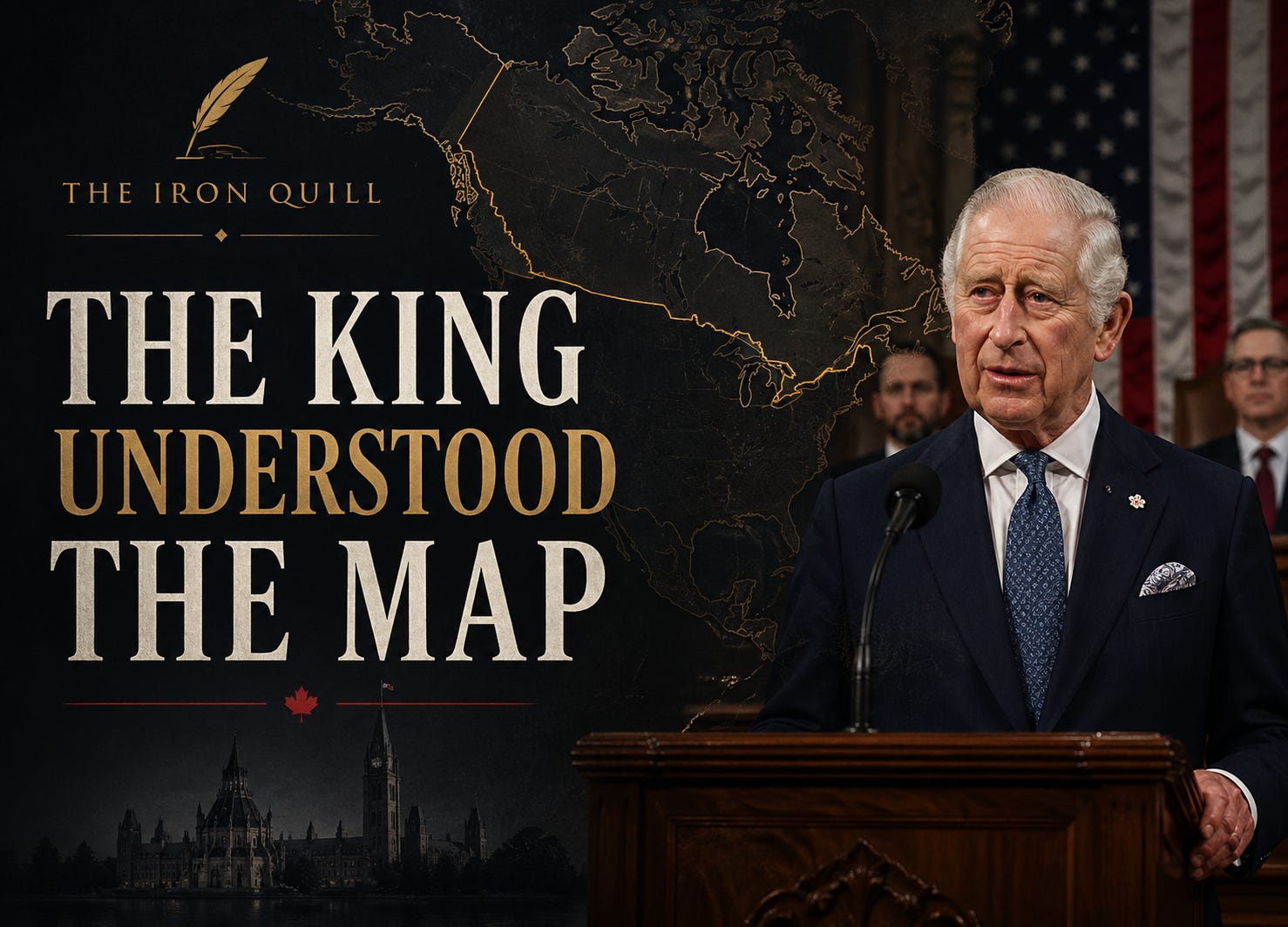
A British king stood before the American Congress 250 years after the Declaration of Independence and somehow spoke more clearly about the American alliance than Canada’s own prime minister.
That should bother us.
Not because King Charles was wrong.
Because he was right.
He did not speak like a man embarrassed by America. He did not treat the United States as a disease to be managed, a threat to be escaped, or a neighbour to be lectured from a safe distance while quietly depending on everything it provides.
He spoke of history, law, sacrifice, defence, and partnership.
He spoke like a man who understood the map.
Canada should have been listening.
And the timing matters.
Canada is being told by its own leadership class that sovereignty means pulling away from America, reducing dependence, and repositioning ourselves somewhere inside the fog of global management.
Then a British king crossed the Atlantic and did the opposite.
He did not run from the American relationship.
He honoured it.
Not as a servant.
As an ally.
Because while Ottawa wraps itself in the language of sovereignty, diversification, independence, and global repositioning, the King walked into the heart of the American republic and did something much simpler.
He honoured reality.
He did not pretend Britain’s relationship with America made Britain weak. He did not suggest that partnership was the same thing as submission. He did not act as though working with the United States required surrendering national identity.
He understood the difference.
That is what serious nations do.
They know who they are.
They know where they stand.
And they know who their friends are.
Canada used to understand that. Now we have a political class that seems more interested in sounding sophisticated than being serious. They speak as if geography is optional. They speak as if trade routes can be replaced by slogans. They speak as if America is just another market, another file, another diplomatic inconvenience to be balanced against Europe, Asia, and whatever global forum is currently applauding itself.
But Canada does not live in a theory.
Canada lives on a continent.
And that continent has a map.
The Speech Was Not the Problem
The Iron Quill does not need to manufacture outrage where none exists.
The King spoke well.
That may be uncomfortable for some people to admit, but it is true.
There was dignity in the speech. There was history in it. There was memory. There was an understanding that the relationship between Britain and America is not merely a trade arrangement or a diplomatic convenience. It is rooted in law, language, sacrifice, culture, war, commerce, and a shared inheritance that shaped the modern world.
He spoke to America as an ally, not as an enemy.
He spoke of a partnership built over centuries, tested through wars, strengthened through institutions, and renewed through common purpose.
That does not mean Britain and America are the same country.
That does not mean they always agree.
That does not mean one must kneel before the other.
It means mature nations understand that alliances matter.
And that is the point Canada should not miss.
Charles did not stand before Congress and beg America for permission to exist. He did not bow to Washington. He did not erase British sovereignty in the name of friendship.
He honoured an alliance because he understood that alliances, properly held, do not erase sovereignty.
They protect it.
That is the mature position.
That is the position Ottawa seems determined to forget.
Partnership Is Not Submission
There is a childish idea spreading through Western politics that strength means distance.
If you are close to America, you are weak.
If you trade heavily with America, you are dependent.
If you cooperate with America, you are compromised.
If you speak well of America, you are somehow less loyal to your own country.
This is nonsense.
A serious nation can stand beside America without becoming America.
A serious nation can defend its own interests while recognizing the value of its closest ally.
A serious nation can negotiate hard, protect its workers, guard its sovereignty, secure its borders, build its own industries, and still understand that partnership with the United States is not a national embarrassment.
It is an advantage.
The problem is not that Canada is close to America.
The problem is that Canada has allowed itself to become weak while pretending that weakness was caused by proximity.
That is the dodge.
Ottawa fails to build.
Ottawa fails to defend.
Ottawa fails to develop.
Ottawa fails to secure.
Ottawa fails to lead.
Then Ottawa points south and says the problem is America.
No.
The problem is not the neighbour.
The problem is the leadership class that spent years hollowing out the house and now blames the fence line.
Canada Is More Tied to America Than Britain Is
This is where the King’s speech becomes uncomfortable for Ottawa.
Britain has an ocean between itself and America.
Canada has a border.
Britain can speak honestly about the American alliance because it understands the value of the relationship.
Canada has even less excuse for pretending otherwise.
Our trade is tied to the United States.
Our energy future is tied to the United States.
Our defence is tied to the United States.
Our supply chains are tied to the United States.
Our agriculture, manufacturing, transportation, border security, continental defence, and resource economy are all tied to the United States in ways no speechwriter can erase.
This is not an opinion.
It is the map.
Canada cannot simply pivot away from America like a customer changing grocery stores.
We are not an island power.
We are not a detached European capital.
We are not a global consultant’s slide deck.
We are a northern nation sharing a continent with the most powerful country in the world, connected by geography, commerce, security, infrastructure, families, industries, and shared continental reality.
Any Canadian leader who does not begin from that fact is not being bold.
He is being unserious.
Carney’s Sovereignty Talk Misses the Point
Mark Carney loves the language of sovereignty.
He talks about independence. Diversification. Resilience. New partnerships. Reduced reliance. A new Canadian posture in a changing world.
Some of that sounds reasonable on the surface.
Of course Canada should build more at home.
Of course Canada should expand trade.
Of course Canada should become stronger, less fragile, less lazy, less dependent on any one buyer or any one route.
But there is a difference between strengthening Canada and pretending we can detach from reality.
Carney often speaks as if sovereignty means distance.
Charles understood that sovereignty means strength.
That is the difference.
Sovereignty is not proven by sneering at your closest ally.
Sovereignty is not built by giving speeches about diversification while blocking pipelines, weakening the military, strangling resource development, expanding bureaucracy, and leaving the country more dependent on imported capital, imported technology, imported policy language, and imported approval from global institutions.
Sovereignty is not a mood.
It is capacity.
It is energy.
It is defence.
It is food.
It is industry.
It is law.
It is borders.
It is a people who can still govern themselves without asking permission from every international conference, court, bank, lobby, and climate committee on earth.
Canada does not become sovereign by talking down to America.
Canada becomes sovereign by becoming strong enough to deal with America from a position of confidence instead of resentment.
That is the lesson.
That is what Ottawa refuses to say.
The Crown Saw What Ottawa Refuses to See
King Charles’ speech revealed something larger than one ceremony.
The old alliances still matter.
The English-speaking world still matters.
Shared law still matters.
Shared military history still matters.
Shared economic foundations still matter.
The West is being pressured from the outside and hollowed from within. Our enemies are not confused about this. They understand weakness. They understand division. They understand that a civilization unsure of itself is easier to pressure, manipulate, and fracture.
That is why this moment mattered.
A king crossed the ocean and reminded America of continuity.
Not perfection.
Continuity.
The West is not held together by hashtags or summits. It is not preserved by speeches about values from people who no longer believe those values.
It is held together by memory, sacrifice, institutions, law, faith, courage, industry, and nations that still know what they are defending.
Canada should understand this better than most.
We fought beside Britain.
We fought beside America.
We built with both.
We traded with both.
We inherited law, language, Parliament, restraint, common sense, and a civilizational framework that allowed free people to live ordered lives under accountable government.
That inheritance is not something to be spat on because the latest political class wants to sound post-national.
It is something to be defended.
And it cannot be defended by a country that does not know who its friends are.
Canada Does Not Need to Beg
Now let the small minds calm themselves before they start screaming.
This is not an argument for Canada to grovel.
This is not an argument for Canada to become an American province.
This is not an argument for surrendering our laws, our land, our resources, our identity, or our national interest.
Canada should not beg.
Canada should build.
That is the point.
Build the pipelines. Build the ports. Build the Arctic presence. Rebuild the military. Open the corridors. Move the grain, the oil, the gas, the potash, the steel, and the goods a serious country should be able to move.
Then deal with America as a strong neighbour.
Not as a resentful dependent.
Not as a spoiled child.
Not as a government that quietly needs the American market while publicly performing contempt for the Americans who buy our goods, defend the continent, and share the burden of Western security.
There is a way to be pro-Canadian without being anti-American.
In fact, for a serious Canadian, that should be obvious.
Being pro-Canadian means understanding Canada’s actual position in the world. It means strengthening our hand. It means respecting our allies while defending our own interests. It means trading with confidence, negotiating with discipline, and refusing to confuse independence with isolation.
The King seemed to understand that.
Ottawa does not.
The Map Does Not Care About Speeches
The tragedy of Canada’s current leadership class is that it thinks language can replace reality.
Call dependence resilience.
Call retreat strategy.
Call decline transformation.
Call distance sovereignty.
The map still does not care.
The map still puts Canada beside America.
The map still puts our exports south.
The map still puts our defence on the same continent.
The map still puts our energy, agriculture, manufacturing, and security inside a North American reality that cannot be wished away by a prime minister who prefers the language of global management to the hard work of national construction.
That is why Charles’ speech matters.
Not because Canadians need to become monarchists.
Not because Britain has all the answers.
Not because America is perfect.
But because, in that moment, the King spoke with more realism about the American relationship than Canada’s own government often does.
He saw partnership where Ottawa sees dependence.
He saw history where Ottawa sees inconvenience.
He saw alliance where Ottawa sees political branding.
He saw the map.
Carney keeps trying to redraw it.
The King Understood What Canada Forgot
There is something deeply ironic about this moment.
A British monarch stood in the American republic, 250 years after that republic broke from the Crown, and spoke with dignity about friendship, sacrifice, liberty, and shared duty.
Meanwhile, Canada, still a constitutional monarchy under the same King, often speaks about America like a teenager slamming the bedroom door while still eating from the family fridge.
That is not sovereignty.
That is immaturity dressed up as strategy.
A serious Canada would listen to Charles’ speech and understand the message beneath the ceremony.
America is not just another country to us.
It is not just another market.
It is not just another partner on a list.
It is the central relationship in Canada’s national life, whether Ottawa likes that fact or not.
That does not mean we surrender to it.
It means we handle it with seriousness.
We build strength at home.
We defend our interests.
We stop apologizing for our resources.
We stop weakening our military.
We stop treating our own workers, farmers, truckers, tradesmen, producers, and energy sector like obstacles to some elite theory of progress.
We become the kind of country that can look America in the eye.
Not because we resent them.
Because we finally respect ourselves enough to be useful.
That is what Carney’s sovereignty language keeps missing.
Sovereignty is not performative distance from America.
It is national strength beside America.
It is the confidence to cooperate without grovelling, negotiate without whining, and disagree without pretending the relationship itself is the problem.
Charles spoke like he understood that.
Canada’s prime minister should try it.
The Closing Hammer
King Charles did not go to Washington to surrender British sovereignty.
He went there to honour the alliance that helps protect it.
That is the difference Carney does not seem to understand.
A serious country can stand on its own feet and still know who its friends are.
Canada does not become stronger by pretending America is just another foreign market.
It becomes weaker.
It becomes smaller.
It becomes more dependent while calling itself independent.
It becomes a country led by people who confuse posture for power and speeches for strength.
The King understood the map.
Ottawa is still trying to redraw it.
And if Canada’s own prime minister needs a lesson in sovereignty, perhaps he should start by listening to the monarch who just explained it in the chamber of the republic.
Because the Crown did not come to America to kneel.
It came to remember.
Canada should do the same.
—The Iron Quill
The Iron Quill is reader-supported.
Most of this work remains free because truth should travel.
If you believe in the mission, become a paid supporter and help keep the signal alive.
"Canada lives on a continent" exactly we are part of the "big". I wish Carney would go back to Britain and be the EU loyalist he presents as, who economies are shrinking by the day!
I don't know how to put this easily to you...you're an idiot! They are one the same. We Canadians are being manipulated by the king and his pawn Marx Carnage. They are the scum globalists wef elites. All that fluff you wrote, throw it in the garbage as you too are a pawn.