
THE HORMUZ GAMBIT
The Watchman’s Warning

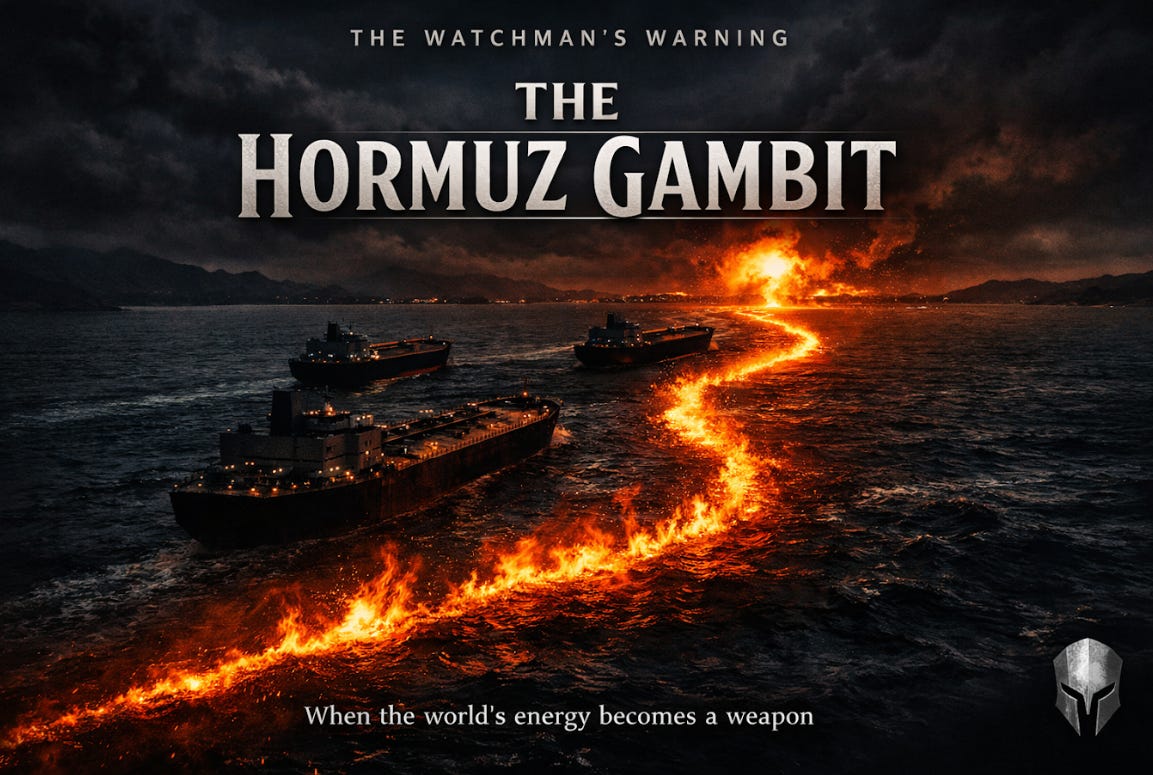
The match has been struck.
Not in some distant corner of the world, buried in headlines most will scroll past. Not theory. Not speculation. This is happening now.
A narrow strip of water, barely wide enough to notice on a map, now holds the weight of the global economy. The Strait of Hormuz. The artery through which nearly a fifth of the world’s oil flows. And today, it sits under threat.
An ultimatum has been issued. Open the Strait, or face the destruction of energy infrastructure. The response came just as quickly. Close it completely. Strike back. Expand the damage beyond ships and into the systems that sustain modern life.
This is no longer posturing.
Pressure is building at a global choke point.
And when pressure builds at a choke point, something breaks.
⸻
THE CHOKE POINT OF THE WORLD
Most people will never see the Strait of Hormuz. They will never sail through it. Never stand on its shores.
But they will pay for it.
Because everything that powers the modern world runs through places like this.
Roughly twenty percent of the world’s oil supply passes through that narrow corridor. Tankers move through it like blood through a vein. Interrupt that flow, and the effects are immediate.
Oil doesn’t wait. Markets react in hours, not weeks.
Fuel prices rise. Transportation costs climb. Food follows. Every supply chain tightens. Every household feels the squeeze.
This is not foreign policy.
It’s your grocery bill climbing. Your fuel tank draining faster than it should. Your cost of living tightening without warning.
And right now, that artery is being squeezed.
⸻
THE ULTIMATUM
Some lines are drawn with consequences.
The message was simple. Reopen the Strait, or watch the systems that power your nation be reduced to rubble. Not symbolic strikes. Not warnings.
Core infrastructure.
Energy grids. Production facilities. The backbone of a modern state.
This separates rhetoric from reality.
Because once you target infrastructure, you are no longer playing at conflict. You are stepping into a different kind of war. One where the objective is not just to weaken an opponent, but to disrupt their ability to function entirely.
A line has been drawn.
⸻
IRAN’S RESPONSE
The response was not hesitation.
It was escalation.
Threats to shut the Strait of Hormuz entirely. Not partially. Not temporarily. Completely. A move that would send shockwaves through global markets within hours.
But it did not stop there.
Threats extended outward. U.S. companies. Regional infrastructure. Utilities. Systems that millions rely on daily.
This is where it changes.
War is no longer confined to soldiers and battlefields. It has expanded into the systems that keep societies running. Energy. Water. Commerce.
Disrupt those, and you’re not just fighting a nation.
You destabilize everything around it.
⸻
THE WAR HAS CHANGED
There was a time when war meant territory.
Now it means systems.
You do not need to invade a country to break it anymore. You do not need boots on the ground to cripple an economy. You identify the critical points, the dependencies, the fragile links that hold modern life together.
Then you squeeze until something gives.
Energy grids. Shipping lanes. Financial systems. Water infrastructure.
These are the battlegrounds now.
And the Strait of Hormuz is one of the most critical nodes on that map.
Because whoever controls it, or disrupts it, holds leverage over not just one nation, but the world.
⸻
THE ESCALATION LADDER
This did not happen overnight.
It never does.
First comes disruption. Harassment of shipping lanes. Pressure without full commitment.
Then comes the ultimatum. A clear demand, backed by the threat of force.
Then the expansion. Threats move from military targets to infrastructure.
Then retaliation. A strike. A response. Another escalation.
And if it continues, it won’t stay contained.
It spreads.
Regionally. Economically. Politically.
This is the ladder.
And once you’re on it, climbing down is far harder than stepping up.
⸻
WHO PAYS THE PRICE
Governments make decisions.
Markets react.
People pay first.
The cost does not show up in strategy rooms or political statements. It shows up at the pump. At the grocery store. In the quiet realization that everything just became more expensive again.
Energy is not just fuel. It is the foundation of everything that moves, grows, and sustains life in the modern world.
Disrupt it, and you disrupt everything.
And it is not the decision-makers who absorb that first impact.
It is the people.
⸻
THE GLOBAL POWDER KEG
This isn’t about one nation anymore.
The Gulf states are watching. Allies are calculating. Every major economy knows what’s at stake.
Because this is about a system.
And systems, once destabilized, rarely stay contained to a single point of failure.
One misstep. One overreach. One miscalculation.
And the ripple becomes a wave.
⸻
THE LINE THAT HAD TO BE DRAWN
There comes a point where restraint stops being wisdom.
And starts becoming weakness.
For years, pressure has been applied in fragments. Shipping disruptions. Proxy conflicts. Regional instability pushed just far enough to test limits without triggering full response.
But the Strait of Hormuz is not just another pressure point.
It is a red line.
You cannot allow a nation to threaten the primary artery of the global energy supply and expect stability to hold. You cannot allow the systems that sustain entire populations to become bargaining chips.
Because if that line isn’t enforced, it stops being a line at all.
Delay does not reduce conflict. It compounds it. It signals that pressure works. That escalation is rewarded. That the cost of pushing further is minimal.
Strength at the right moment doesn’t create chaos.
It prevents something far worse.
The Strait of Hormuz is not a bargaining chip.
It is a boundary.
And when a boundary like that is crossed, the response is no longer optional.
⸻
THE WATCHMAN’S WARNING
The modern world runs on systems most people never think about.
Until they break.
The Strait of Hormuz is one of those systems. Invisible to most. Critical to all.
You do not shut down the flow of energy to the world without consequences. You do not threaten the foundation of global stability and expect a contained response.
You get a response.
And once that response begins, control becomes an illusion.
The Strait of Hormuz is not just a passage of oil.
It is a fuse.
And right now, it’s burning.
—The Iron Quill
Spot on. Interestingly, apparently the oil that goes through the Strait of Hormuz represents about 7% of total US crude oil imports and roughly 2% of total US petroleum liquids consumption. And thus, only a small fraction is destined for the US. Nonetheless, because oil is a fungible commodity, the price of oil in the US will increase with the choking off of the oil supply through the Strait. I would also add that the majority of oil passing through the Strait goes to Asian markets (China, India, Japan and South Korea). And with the Venezuelan oil supply to China being cut off by the US in 2026, China is especially going to face a severe energy crisis. And so, it will be interesting to watch China's reaction over the next several months if this happens. Beware of unanticipated consequences is a motto that may hold true in the near future.
Thank you for your great posts. I look forward to reading them everyday. I would also add that for anyone looking to understand what is happening in the world right now read Jeff Childers post coffee and Covid. He really is able to put together the big picture from a Christian perspective and with an understanding few people get. He is also on Substack. My personal two favourite reads.