
The Hallway Summit

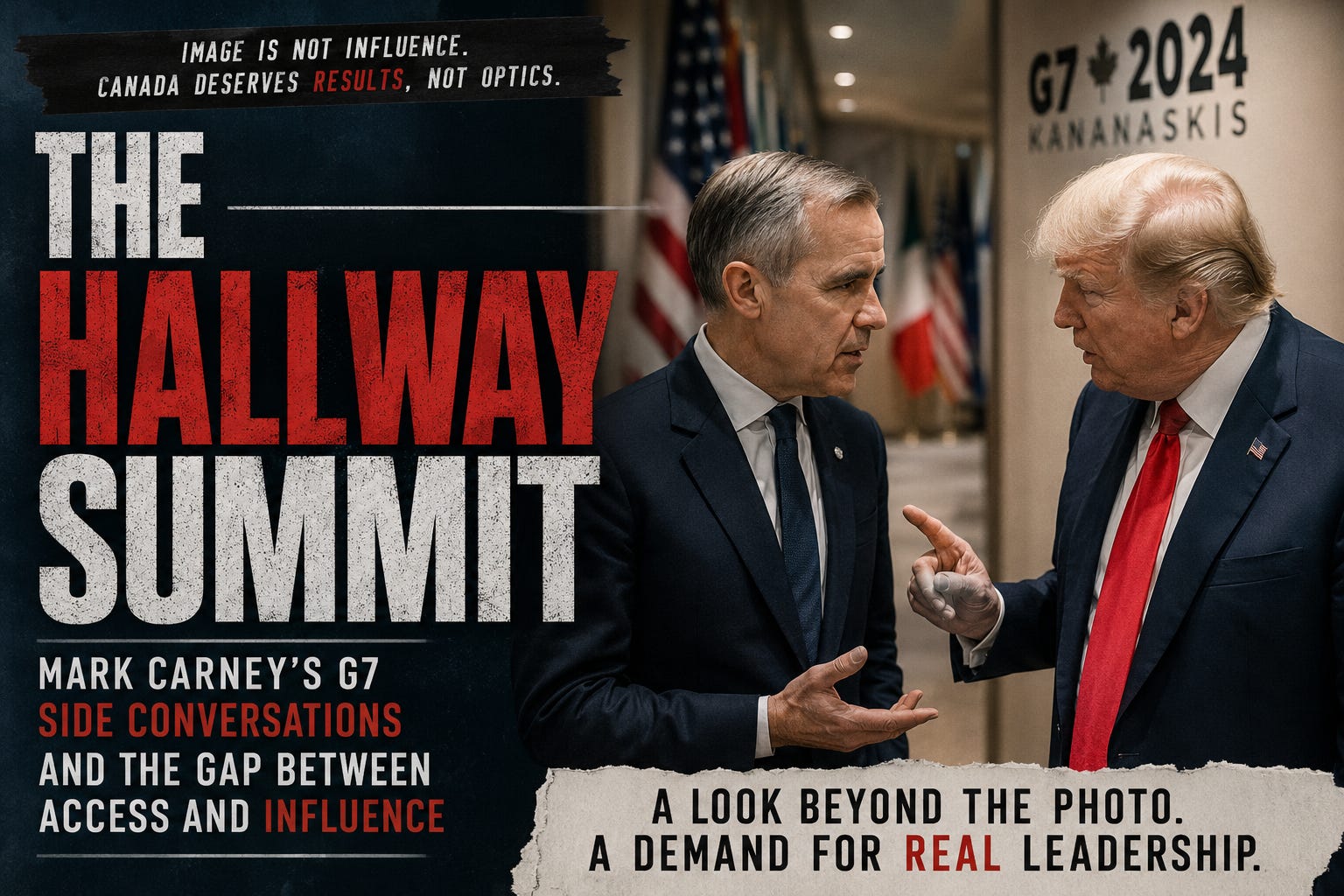
There are moments in politics when the picture says more than the press release.
The picture from the G7 was supposed to say strength.
It was supposed to say Canada was back.
It was supposed to say Mark Carney had arrived on the world stage, standing shoulder to shoulder with presidents, prime ministers, bankers, bureaucrats, and the architects of the new global order.
That was the image.
That was the sale.
That was the brand.
But then reality slipped through the cracks.
Not in a formal announcement.
Not in a grand declaration.
Not in a major trade breakthrough.
In a hallway.
In a side conversation.
In a moment where Canada’s prime minister found himself explaining Chinese electric vehicles to Donald Trump.
And that is where the real story begins.
Because this was never just about one overheard exchange. It was not just about Chinese EVs. It was not just about whether Trump liked what Carney said or did not like what Carney said.
The real story is the gap between image and influence.
And for Canada, that gap matters.
The Brand of Mark Carney
Mark Carney did not enter Canadian politics as an ordinary politician.
He entered as a product.
A brand.
A global banker. A Davos man. A central banker. A climate finance architect. A man who had moved through the highest rooms in the world and was sold to Canadians as someone who already understood how power works.
That was the pitch.
Canada did not need a fighter.
Canada did not need a builder.
Canada did not need a leader rooted in the shop floor, the farm, the rig, the small business, or the grocery bill.
Canada needed a global statesman.
At least, that is what Canadians were told.
Carney was supposed to walk into these rooms and command respect because these were his rooms. He was supposed to know the language. He was supposed to know the players. He was supposed to understand the system because he had spent his life inside it.
But politics has a way of stripping a man down.
Campaigns allow myth.
Government demands reality.
And the G7 gave Canadians a useful glimpse into the gap between the myth and the result.
Because when Canada’s most important trading relationship is under pressure, when tariffs are still hanging over the economy, when supply chains are shifting, when China is being discussed as a strategic threat, and when the United States remains the one country Canada cannot afford to mishandle, the question is simple.
What did Canada actually get?
Not what did the cameras capture.
Not what did the press release say.
Not how many leaders smiled for the photo.
What did Canada bring home?
The Meeting That Did Not Happen
The most telling detail may not be what happened.
It may be what did not happen.
There was no formal bilateral meeting between Mark Carney and Donald Trump.
That matters.
It matters because the United States is not just another country to Canada. It is the country that buys the goods, shapes the market, controls the pressure points, and holds enormous influence over whether Canadian industries breathe or bleed.
A formal meeting with the American president should not be treated as a luxury.
It should not be brushed off as unnecessary.
It should not be replaced with a smile, a handshake, and a few conversations between events.
Yes, informal conversations happen at summits.
Yes, leaders talk in hallways.
Yes, sometimes business is done outside the official schedule.
The issue is not that Carney spoke to Trump informally. Every summit is full of informal conversations. The issue is that Canadians were told a global statesman would bring unusual influence to the table. Influence is measured by outcomes, not by proximity.
But if informal conversations are enough, why do governments spend months arranging formal meetings?
Because formal meetings send a message.
They say this relationship matters.
They say this issue deserves structure.
They say both sides are committing attention, time, and political weight.
So when the formal meeting does not happen, Canadians are allowed to ask why.
And when the answer is that there were several informal talks, Canadians are allowed to ask another question.
Is that strategy?
Or is that spin?
From Lectures to Reality
There is another layer here.
For years, much of Canada’s political class has treated Donald Trump as a problem to be managed, mocked, resisted, and morally lectured.
Trump was the convenient villain.
He was the contrast.
He was the man Canadian elites could point to whenever they wanted to present themselves as more polished, more reasonable, more global, more sophisticated, and more enlightened.
But then governing arrives.
And suddenly the man they mocked is the man they need.
That is the correction reality brings.
Campaign rhetoric is cheap. Trade negotiations are not.
It is easy to posture about Trump when there is no deal on the line. It is easy to speak in moral language when the cameras are rolling and the crowd wants applause. It is easy to act like Canada can float above American politics while still depending on American markets.
But sooner or later, the speech ends.
The handshake begins.
Carney did not go to the G7 as a rebel against Trump.
He went as a man who needed Trump to listen.
That is not irony.
That is power.
Trump understands leverage. Whether people like him or hate him, he understands that countries protect their own interests first. He understands that access matters. He understands that the United States has more leverage in that relationship than Canada does.
That is the part Canadian elites never want to say out loud.
They prefer slogans.
They prefer values language.
They prefer the comfortable fantasy that good intentions are a foreign policy.
But the world does not run on good intentions.
It runs on leverage.
And Canada has spent years weakening its own.
The China Conversation
Then came the Chinese EV exchange.
This is where the story sharpens.
Because at the same summit where leaders were talking about reducing dependence on China, critical minerals, supply chains, economic security, and democratic partnerships, Canada’s prime minister was explaining Chinese electric vehicles to Donald Trump.
That is the contradiction.
That is the tension.
That is the part worth watching.
The G7 can talk all it wants about reducing reliance on China. It can create alliances. It can release statements. It can speak about trusted partners, secure supply chains, and the need to protect critical industries.
But the question remains.
What are countries actually doing?
Canada cannot stand in one room and talk about breaking dependence on China, then stand in another conversation explaining carve-outs, exceptions, and market access for Chinese EVs, without Canadians noticing the contradiction.
This has become the pattern.
China is treated as a strategic problem in speeches and a practical partner in policy.
China is the threat when leaders need to sound serious.
China is the exception when the trade math gets uncomfortable.
China is the rival in the press release and the workaround in the fine print.
That is not a strategy.
That is confusion dressed up as sophistication.
And Canada has done this before.
We talk tough when the room requires toughness.
Then we soften when the deal requires softening.
Then we tell Canadians it is all part of a careful, balanced, modern approach.
But ordinary Canadians understand something much simpler.
You cannot build economic independence by making yourself more dependent.
You cannot protect domestic industry by importing the competition through the side door.
You cannot claim to be serious about China while constantly explaining why this time is different.
The Photo Is Not the Outcome
Modern politics has become addicted to the image.
The photo becomes the proof.
The summit becomes the achievement.
The attendance becomes the accomplishment.
A leader stands in the right room, beside the right people, under the right flag, and suddenly the machine tells citizens that leadership has occurred.
But leadership is not a photograph.
Influence is not a camera angle.
It is measured by results.
That is where the G7 should be judged.
Did Canada secure a major tariff breakthrough?
Did Canada strengthen its position with the United States?
Did Canada bring home a clear win for workers, farmers, producers, exporters, manufacturers, or energy?
Did Canada leave with more leverage than it had when it arrived?
Those are the questions that matter.
Not whether Carney looked comfortable.
Not whether the room looked impressive.
Not whether the media could frame the trip as statesmanship.
Canadians are not paying grocery bills with summit photos.
They are not filling their tanks with press releases.
They are not securing jobs with diplomatic adjectives.
They need outcomes.
And if the outcome is that Canada’s prime minister came home saying he had several good informal conversations with Trump, then maybe the country should stop pretending that image is the same as influence.
The Global Statesman Test
The great test of Mark Carney was never whether he could attend the G7.
Of course he could attend.
The test was whether his global brand would translate into national benefit.
That is the whole point.
If the argument for Carney is that he understands the world better than everyone else, then Canadians are allowed to expect more than a seat at the table.
They are allowed to expect results from the table.
If the argument is that Carney has special access, then Canadians are allowed to ask what that access produced.
If the argument is that Carney is respected internationally, then Canadians are allowed to ask whether that respect changed anything materially for the country he represents.
Respect that produces nothing is ceremony.
Access that changes nothing is weakness.
Presence without results is theatre.
And Canada has had enough theatre.
Hallway diplomacy is not the scandal.
Leaders talk between meetings. Deals are sometimes shaped in side rooms. Informal exchanges can matter.
Pretending that replaces a serious meeting is the scandal.
Pretending the side conversation proves access is the scandal.
Pretending that explaining yourself is the same as winning is the scandal.
Carney was sold as the man who could walk into the most powerful rooms in the world and make Canada matter.
At the G7, Canadians saw him near those rooms.
But being near power is not the same as exercising it.
Standing beside Trump is not the same as moving Trump.
Talking to Trump is not the same as securing terms from Trump.
Explaining Canadian policy is not the same as winning for Canada.
And that distinction matters.
The Real G7 Lesson
The real lesson from the G7 is not that Carney spoke to Trump.
The real lesson is that Canada’s political class still mistakes visibility for strength.
They confuse visibility with strength.
They confuse access with leverage.
They confuse the photograph with the win.
But citizens know better.
A farmer knows whether a deal helps or hurts.
A worker knows whether the plant is hiring or closing.
A small business owner knows whether costs are rising or falling.
A family knows whether groceries are affordable.
A trucker knows whether fuel policy was written by someone who understands real life or someone who has only ever managed theories.
That is the difference between the summit world and the real world.
The summit world speaks in frameworks.
The real world pays invoices.
The summit world announces partnerships.
The real world asks whether anything got cheaper, stronger, safer, or more secure.
The summit world celebrates language.
The real world waits for results.
Outside the Room
The G7 gave Canadians the image they were supposed to see.
Mark Carney among leaders.
Canada represented.
The global stage restored.
But beneath the image was a harder question.
Was Canada leading, or was Canada explaining?
Was Canada shaping the agenda, or trying to stay close enough to it?
Was Canada exercising influence, or hoping proximity would look like influence from a distance?
That is the question the hallway moment exposed.
Because there is a difference between walking through the halls of power and holding power.
There is a difference between being photographed beside the American president and securing a serious outcome for Canadians.
There is a difference between telling the country you are a global statesman and proving you can bring something home.
The cameras will show the smiles.
The press release will say the summit was productive.
The headlines will say Canada was engaged.
But Canadians should ask the only question that matters.
What did we gain?
Because a country cannot live on optics forever.
Sooner or later, the photo fades.
The cameras leave.
The leaders go home.
And the people are left with the bill.
That is when leadership is measured.
Not in the hallway.
Not in the picture.
Not in the spin.
But in the result.
And if the great achievement of Canada’s global statesman was a handful of informal conversations and an explanation about Chinese EVs, then maybe Canadians should stop asking whether Mark Carney looked powerful at the G7.
Maybe they should ask whether Canada was powerful at all.
—The Iron Quill
The Iron Quill is reader-supported.
Most of this work remains free because truth should travel.
If you believe in the mission, become a paid supporter and help keep the signal alive.
Carney looked like a kid trying to keep a low profile in the same room as the school bully..and offering his lunch money..