
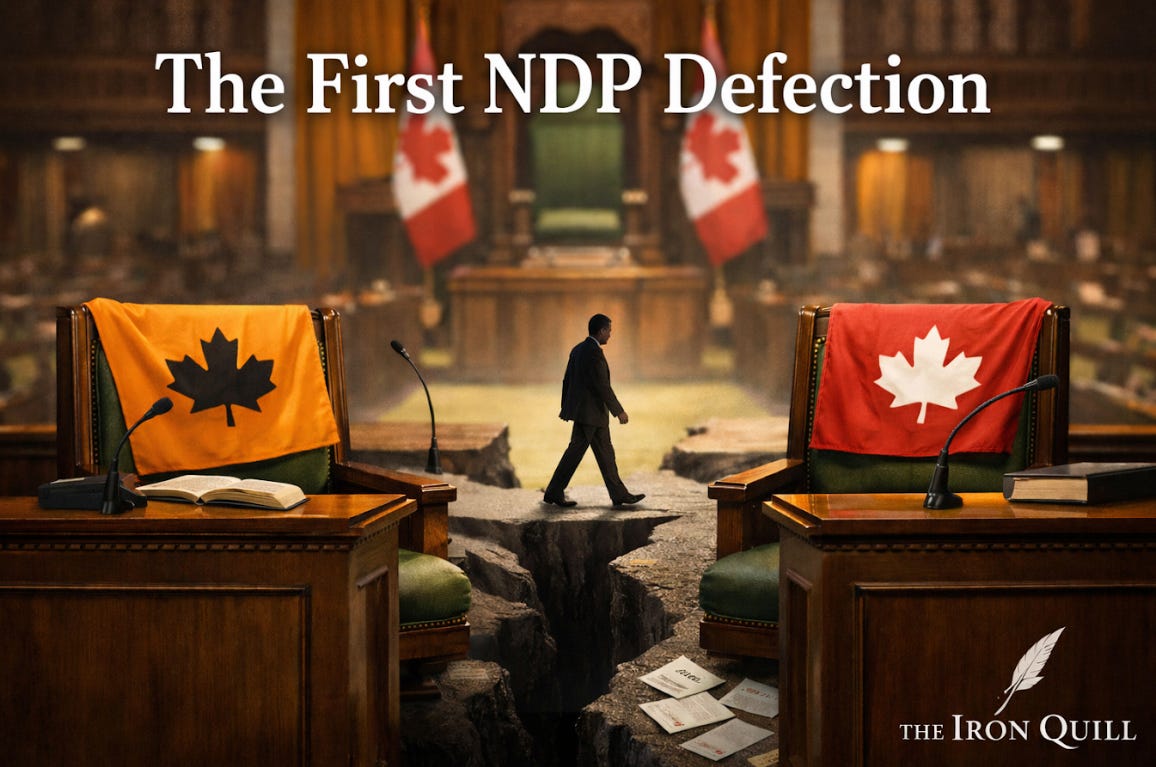
The First NDP Defection
When an opposition seat becomes a government seat without voters ever being asked

Another Line Begins to Blur
For the first time in this Parliament, a member of the New Democratic Party has crossed the floor to join the governing Liberals.
In Ottawa this kind of maneuver is treated like ordinary politics. Another headline. Another strategic shift. Another quiet change inside the walls of Parliament.
But for the voters who sent that person to Parliament, the situation looks very different.
They voted for an NDP representative.
They now have a Liberal.
No election was held. No consultation occurred. No new mandate was requested.
One political banner simply became another.
And that raises a question Canadian politics rarely confronts directly.
Who actually owns a seat in Parliament?
⸻
The Promise Made to Voters
Every election campaign begins with promises.
Candidates knock on doors. They speak with voters in community halls and coffee shops. They explain what their party stands for and why it deserves support.
When someone runs under the banner of the New Democratic Party, the message is usually clear.
The NDP presents itself as the party willing to challenge Liberal governments when they drift too far from the interests of ordinary Canadians.
For decades the party has argued that it exists to hold Liberal power accountable.
That role matters.
In a parliamentary democracy the opposition is not simply another political team competing for attention. It is a structural safeguard.
Opposition parties question government decisions. They demand transparency. They challenge policies that might otherwise pass without serious scrutiny.
Voters who choose an opposition candidate are not merely selecting a person.
They are choosing the role that person will play in Parliament.
They are choosing someone to push back.
⸻
Do Voters Choose the Person or the Party?
Whenever a politician crosses the floor, defenders of the move repeat the same argument.
They say voters elect the individual, not the party.
According to this logic, the seat belongs entirely to the representative because the public placed their trust in that specific person.
But anyone who has watched a modern election campaign knows the reality is very different.
Voters do not walk into polling stations thinking only about the personality of their local candidate.
They think about the party.
They think about the leader who represents it.
They think about the direction they want the country to move.
Campaign signs carry party colours for a reason.
National leaders dominate debates for a reason.
Party platforms shape the issues voters discuss for months before election day.
The individual candidate matters, but the party banner matters just as much.
Often it matters more.
When people vote in a federal election, they are choosing not only a representative for their riding but also the political team that representative will strengthen in Parliament.
That is why a floor crossing feels so jarring to the voters who cast the ballots.
The banner they voted for disappears overnight.
Even though their vote never changed.
⸻
When the Banner Changes
A floor crossing changes that role instantly.
The voters who cast their ballots did not suddenly decide to support the governing party.
Their vote remains exactly what it was on election day.
Yet the political identity of their representative has shifted.
The person they elected to challenge the government now sits inside it.
Legally, this is allowed under Canadian law.
Members of Parliament are not required to trigger a by-election when they change parties.
But legality and legitimacy are not always the same thing.
Many voters believe that when a politician campaigns under one banner and abandons that banner after the election, something important has been lost.
The agreement between voters and their representative has changed without the voters’ consent.
⸻
The Gravity of Power
There is another truth about Ottawa.
Power has gravity.
The governing party sits at the center of the political system itself. Resources flow through it. Influence flows through it. Political careers often flow through it as well.
Opposition MPs live on the outer edge of that gravitational field.
Some resist the pull.
Others eventually begin to drift closer to it.
Sometimes that drift appears as cooperation agreements or coordinated votes in Parliament.
Sometimes it appears as political alignment on major issues.
And sometimes it appears in the most visible way possible.
A member of the opposition stands up, crosses the floor of the House of Commons, and joins the government.
When that happens, the gravitational pull of power becomes impossible to ignore.
⸻
Why This Crossing Matters
Floor crossings are not new in Canadian politics.
But this moment carries a different significance.
Because this is the first time during this Parliament that a member of the New Democratic Party has crossed the floor to join the Liberal government.
The symbolism is difficult to ignore.
The NDP has long presented itself as the party meant to challenge Liberal power.
Its purpose has been to question, pressure, and occasionally restrain the governing party.
When a representative from that party joins the government instead, the line between government and opposition begins to blur.
And when that line begins to blur, something fundamental inside parliamentary democracy begins to weaken.
Healthy democracies rely on tension between competing political forces.
Government proposes.
Opposition scrutinizes.
That tension keeps the system balanced.
Remove that tension, and power begins to consolidate.
⸻
The Question Canadians Are Asking
Most Canadians understand that politicians sometimes change their views.
Political alliances shift. Party leadership changes. Strategic decisions get made.
But the public tends to hold onto one simple expectation.
If a politician wants to fundamentally change the political identity under which they were elected, the voters should have the chance to weigh in.
That is why some democratic systems require representatives who change parties to seek a new mandate from their constituents.
Canada does not have that requirement.
Which means voters can sometimes find themselves represented by a party they never voted for.
For many people, that feels less like political evolution and more like political substitution.
⸻
The Simple Principle
The Iron Quill has always believed something straightforward.
Seats in Parliament do not belong to politicians.
They belong to the voters who filled them.
If a representative believes their political future now lies in a different party, that decision is theirs to make.
But the honest path remains simple.
Return to the riding.
Stand before the voters again.
Explain the change.
And ask the people who sent you to Ottawa whether they still want you there.
Because in a democracy the final authority does not belong to party leaders or parliamentary strategy.
It belongs to the people who cast the ballots.
And when that authority is bypassed, trust in the system begins to disappear.
—The Iron Quill
Not political evolution.
Not political substitution.
More like political dishonesty.
I absolutely suspect political corruption.
Yes it’s disgusting that the voters mean nothing to these losers!