
The Federation Is Cracking While Ottawa Hands Out Tariff Loans

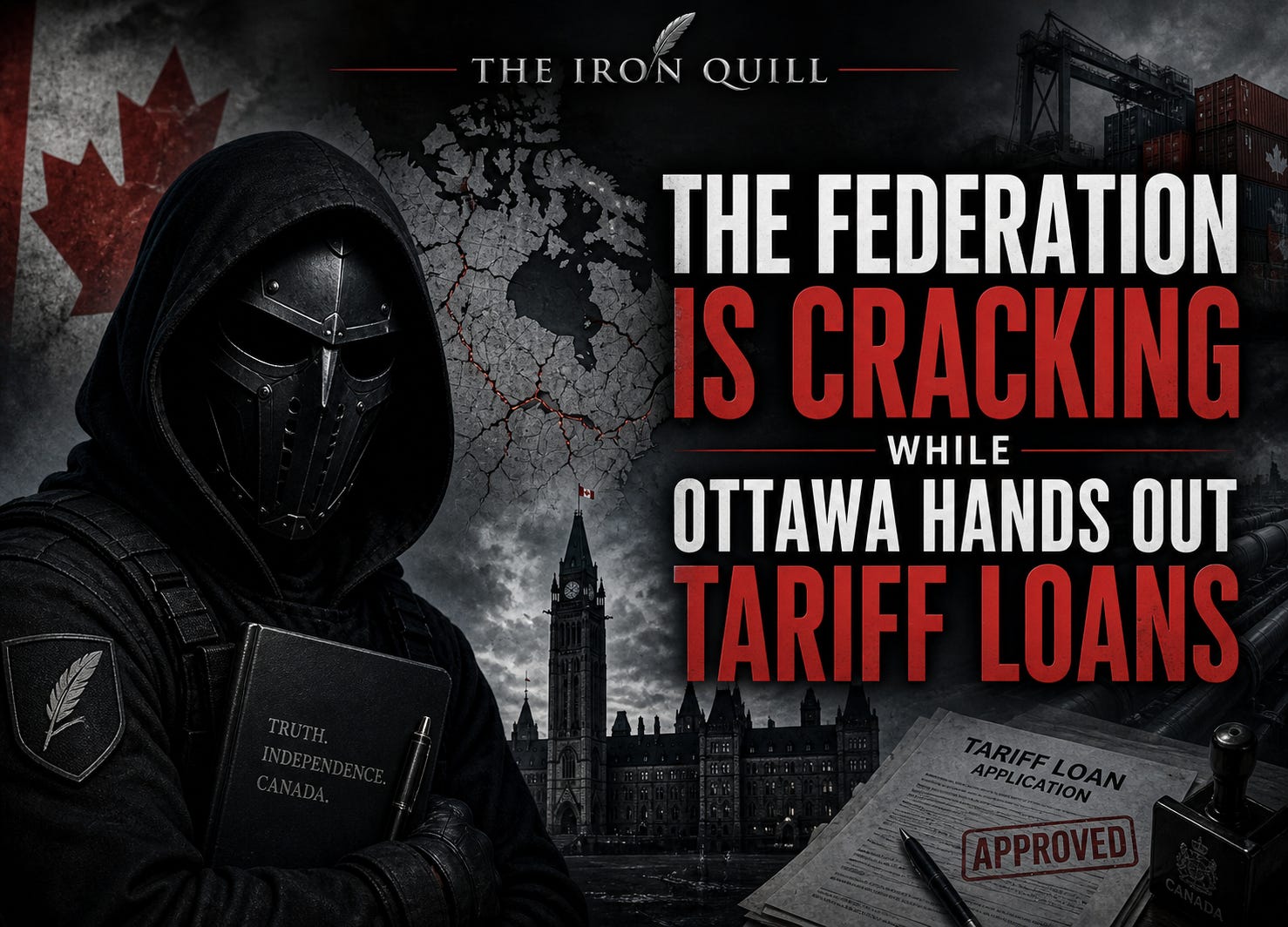
Some days do not create a crisis. They reveal one.
Ottawa announced another $1.5 billion in tariff relief, wrapped in the familiar language of support, resilience and national competitiveness. The package includes a new $1 billion Business Development Bank of Canada loan program for companies affected by U.S. tariffs, with particular focus on sectors tied to steel, aluminum and copper. Another $500 million is being directed through regional development agencies under the Regional Tariff Response Initiative.
Source: Government of Canada / Reuters
That was the official story. Help is coming. The government is responding. The system is working.
But outside the polished language of Ottawa, a different country was speaking.
In Alberta, Stay Free Alberta said it had submitted nearly 302,000 signatures to Elections Alberta in an effort to trigger a referendum process on independence. The number is reportedly well above the required threshold, though the signatures still need to be verified. If enough are accepted, a vote could be held as early as October.
Source: AP News
In British Columbia, Premier David Eby questioned why Ottawa seemed focused on a pipeline from Alberta while B.C.’s softwood lumber industry was left out of the latest round of tariff relief. His complaint was not the same as Alberta’s, but that is the point. Different regions are now looking at the same federal government and seeing different forms of neglect.
Source: CityNews / Canadian Press
And while this was happening at home, Mark Carney was in Yerevan, Armenia, attending the European Political Community summit. He spoke in the familiar language of global order, strategic partnership, Europe, security, investment and the rules-based system.
Source: Prime Minister’s Office / European Council / The Guardian
That was the day. Ottawa offered loans. Alberta delivered signatures. B.C. demanded attention. Carney addressed Europe.
The headlines looked separate only if you insisted on reading them one at a time. Step back, and the meaning becomes harder to avoid.
Canada is not being unified. It is being administered.
And administered countries do not inspire loyalty for long.
Ottawa Is Managing the Wound
Nobody should pretend tariff pain is imaginary. It is real, and the people who work in the productive economy know it before the political class finishes naming it. Canadian companies are being squeezed. Exporters are watching the ground shift. Workers in industries tied to steel, aluminum, copper, manufacturing, lumber and trade are once again being reminded that the economy does not run on slogans. It runs on production, credit, labour, transport, access to markets, stable rules and trust.
So yes, some businesses may need help. That is not the scandal.
The scandal is that Canada has become a country where every serious shock seems to require another layer of federal management because the deeper structure has been allowed to weaken. Ottawa rarely begins by asking what made the country more fragile. It asks how the damage can be handled, which agency can carry the file, which minister can explain the response, and which polished phrase can be placed over the wound.
That is how real economic pain becomes political theatre. The worker hears relief, the business owner sees paperwork, the minister gets an announcement, and Ottawa calls the whole thing leadership.
The problem is not that help exists. The problem is that Ottawa has mistaken managed weakness for national strength. A country that has spent years making it harder to build, harder to approve, harder to produce, harder to move goods, harder to develop resources and harder to trust the rules now wants applause for offering loans to industries trapped inside the weakness the system helped create.
A serious country would be strengthening the physical spine of its own economy. It would make sure goods can move, projects can be approved, mills can survive, energy can reach market, manufacturers can plan, and provinces can trade with one another without being tangled in barriers that should have been torn down years ago. That is what resilience actually looks like. It is the quiet strength of a country that made itself harder to wound before the blow landed.
Ottawa is not fixing the structure. It is managing the consequences.
Alberta Has Stopped Whispering
Alberta’s referendum push is the kind of story Ottawa will be tempted to mock before it understands. That would be foolish.
The real issue is not whether Alberta separates tomorrow. It will not be simple. A yes vote would not automatically mean independence. There would be constitutional fights, negotiations with Ottawa, legal challenges and serious treaty questions involving First Nations. Anyone pretending otherwise is selling fantasy.
But anyone dismissing this as meaningless is selling denial.
Nearly 302,000 signatures were reportedly submitted to force the question onto the table. That matters because a federation does not begin to crack only when a province leaves. It begins to crack when a province starts believing leaving may be the only way to be heard.
This is what the comfortable class cannot grasp. They think alienation is a messaging problem. They think Alberta anger can be reduced to rude bumper stickers, loud rallies and people who failed to appreciate Ottawa’s wisdom. But Alberta did not arrive here in a fit of temporary emotion. It arrived here after years of being treated like a resource colony with bad manners.
Its energy helped build the country’s wealth. Its workers powered homes, funded public services, supplied industry and carried more than their share of the economic load. Yet the national leadership class has often treated the province as something between a revenue source and a climate liability. It wanted the money, but it did not want the voice.
That is not unity. That is extraction with a sermon attached.
Now the voice has become organized enough to count. That is what should frighten the political class, not the noise around the movement, but the fact that alienation has entered the machinery. Once resentment becomes procedural, it no longer needs permission from the people who ignored it.
B.C. Shows the Fracture Is Wider Than Alberta
It would be easy to write this as an Alberta story. It is not.
British Columbia is angry for different reasons, and that makes the problem worse, not better. David Eby’s frustration over softwood lumber and pipelines reveals a country where each region feels abandoned in its own language. Alberta sees hostility to energy. Saskatchewan sees agriculture, fertilizer, energy, firearms owners, rural life and provincial autonomy treated as obstacles to a national plan designed elsewhere. B.C. sees softwood under pressure while Ottawa appears consumed by another priority. The North hears speeches about sovereignty while waiting for the roads, ports, housing and military presence that would make sovereignty more than theatre.
These are different complaints, but they come from the same wound. The question beneath them all is whether Ottawa actually sees the country it claims to govern.
A federation survives when regions believe they are respected even when they disagree. It weakens when those regions begin to feel like files on a minister’s desk. Energy becomes a file. Forestry becomes a file. Agriculture becomes a file. Mining becomes a file. Trade becomes a file. Western alienation becomes a file. Everything is categorized, processed and managed until the human reality disappears behind briefing language.
But a province is not a file. A worker is not a stakeholder category. A town is not a statistic waiting to be folded into a communications plan.
Canada is supposed to be a federation, not a portfolio. A federation listens because loyalty depends on trust. A portfolio reallocates because everything is treated as exposure, risk and asset management. That is the spirit now spreading through Ottawa. It is bloodless, credentialed, confident and dangerous.
Carney’s Global Stage and Canada’s Empty Room
Carney’s trip to Armenia belongs in this story because it shows where this government’s eyes naturally turn when pressure rises at home.
Canada should not ignore the world. We have allies, trade interests, Arctic responsibilities, defence obligations and industries tied to global instability. A prime minister cannot sit at home and pretend foreign policy does not matter.
But timing exposes priorities, and Carney appears most comfortable when Canada is being positioned inside a larger international architecture. Europe, global order, strategic partnerships, critical minerals, defence production, investment flows and rules-based systems are the natural vocabulary of the summit class. The language is smooth and familiar to every room where the coffee is expensive and nobody has mud on his boots.
It may impress the people who speak that language for a living. It does not answer the man in Alberta who believes Confederation has become a bad bargain. It does not answer the mill worker in B.C. wondering whether softwood is being treated as an afterthought. It does not answer the Saskatchewan farmer who hears another lecture from people who could not survive one bad spring on the land. It does not answer the manufacturer staring down tariffs, costs, regulations and uncertainty while Ottawa offers another program as if dependency is proof of care.
This is the disconnect.
Carney speaks as though Canada is an instrument to be positioned in the world. Canadians need a prime minister who understands Canada first as a country, not as a platform, balance sheet, investment vehicle, or diplomatic accessory for European ambition.
A country has memory. It has regions. It has loyalties. It has wounds. It has people who are tired of being represented abroad by leaders who seem far more fluent in the language of summits than in the language of home.
The warning is simple: a government that seeks status abroad while losing trust at home is not building sovereignty. It is building distance.
This Is Managed Dependency, Not Sovereignty
Ottawa keeps using the word sovereignty, which should make Canadians cautious. The word is being polished because the thing itself is weakening.
Real sovereignty is not a speech in Europe, a funding announcement in Ottawa, or a loan program for industries that need freedom more than paperwork. Real sovereignty begins with the ability of a country to feed itself, fuel itself, defend itself, build things, approve projects, move goods, protect workers, respect provinces and trust its own people.
That kind of sovereignty does not need constant branding because it can be seen in ordinary things. It is seen when a mill stays open because policy did not quietly strangle it. It is seen when a mine is approved in time to matter. It is seen when energy reaches market without being treated like a national embarrassment. It is seen when farmers are trusted instead of managed. It is seen when provinces believe Ottawa is a partner rather than a handler.
What Ottawa has built is something else. It has built managed dependency, where relief replaces reform, loans replace freedom, programs replace production, summits replace repair, and language replaces trust.
This is the machinery of the modern administrative state. It does not conquer with a sword. It smothers with process. It simply surrounds every act of production with permission, delay, compliance, consultation, review, uncertainty and cost until even survival requires help from the same machine that made survival harder.
Call it what it is: control with a human resources department.
The Damage Has Become Visible
Canada is not cracking because of one policy, one prime minister, one tariff fight or one separatist petition. It is cracking because the injuries have accumulated.
For years, federal overreach has been dressed up as national purpose. Regional contempt has been disguised as expert management. Economic confusion has been presented as virtue. Climate policy has fallen hardest on the people who produce, while the people who design the burden congratulate themselves for their moral seriousness. National unity has been treated as a communications problem instead of a trust problem.
This kind of damage does not always announce itself with a crash. Sometimes it settles quietly into the bones of the country. A town loses jobs and is told transition is coming. A province loses patience and is told to calm down. An industry loses confidence and is told to apply for help. A worker loses faith and is told the government understands.
Then one day the resentment becomes organized enough to count.
That is where we are.
The signatures in Alberta are a flare in the dark. The B.C. complaint is another province saying the centre is not listening. The tariff loans are the machine offering treatment for symptoms while avoiding the cause. Carney’s European speech is the sound of a prime minister speaking fluently to the world while the rooms at home grow emptier.
Together, they tell the truth.
The federation is cracking because too many Canadians believe the people managing the country no longer understand the country itself.
What Leadership Would Look Like
Real leadership would begin by taking the warning seriously. Alberta’s referendum push should not be mocked, dismissed, or reduced to a regional tantrum. It should force Ottawa to ask why the warning keeps getting louder.
B.C.’s frustration over softwood should be treated with the same seriousness. These are not disposable industries sitting on a spreadsheet. They are towns, workers, families, payrolls, mills, contractors and communities that cannot survive on federal sympathy after the damage is already done.
If Ottawa wants to speak of sovereignty, then it should start acting like sovereignty begins at home. That means untangling the machinery that slows production, punishes resource work, weakens regional trust, and turns every major project into a test of political endurance.
Leadership would speak to the provinces like partners, not problem areas. It would remember that Confederation is not held together by Ottawa’s confidence in itself. It is held together by the provinces’ confidence that Ottawa still understands them.
You cannot loan your way out of national fracture. You cannot summit your way out of regional betrayal. You cannot manage your way into unity. And you cannot keep telling productive Canadians they are the problem while expecting them to keep carrying the country without complaint.
At some point, people stop asking for respect.
They start looking for exits.
When a Country Stops Feeling Like One
Canada does not need another announcement. It needs a reckoning.
The federation is no longer cracking in theory. It is cracking in signatures, tariffs, angry premiers, exposed industries, regional resentment and the growing suspicion that Ottawa does not hear the country unless the country is useful to a global strategy.
The loans may help some businesses survive, and if they do, good. But loans will not rebuild trust. Regional agencies will not repair Confederation. European speeches will not calm Alberta. Global capital will not convince workers that Ottawa sees them.
A country cannot be held together by press releases. It has to be led.
That is the indictment. Canada is being managed by people who mistake administration for leadership.
There is a difference. Leadership calls a country upward. Administration files it downward. One earns loyalty by seeing people. The other assumes compliance by reducing them to categories.
The people in charge may look up from the paperwork one day and wonder why the country no longer feels like one. The answer will not be hard to find.
Canada will not be lost in a single dramatic moment. It will be managed into weakness, talked past, filed away, and told to be patient while the machine grows larger and the country grows smaller.
That is how nations drift into fracture.
Not because the people stopped loving their country.
Because the people running it stopped listening until they could no longer see what they were losing.
—The Iron Quill
The Iron Quill is reader-supported.
Most of this work remains free because truth should travel.
If you believe in the mission, become a paid supporter and help keep the signal alive.
Each of the solutions they announce make the actual structural issues worse... and either they're incapable or unwilling to recognize such.
Simply compare attitudes to Quebec seperation and Alberta seperation. B.C’s David Eby complains about softwood industry yet does nothing to change his policies for this industry. Saskatchewan used as a pawn in Mark Carney’s China campaign. It’s infuriating that the comatose easterners refuse to see it. Basically the welfare provinces of Canada are complicit in its destruction!