
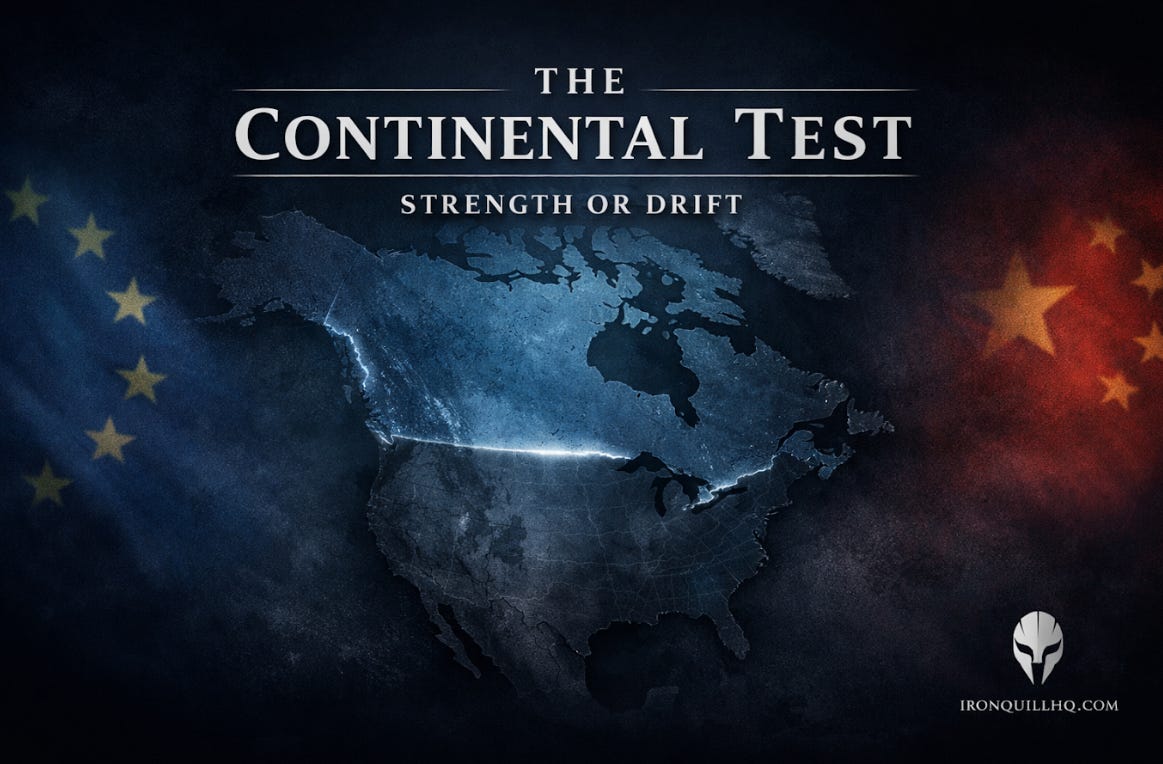
The Continental Test
Will Canada Negotiate From Strength or Drift?

The 2026 review of the
United States–Mexico–Canada Agreement
is not a bureaucratic check in.
It is a stress test.
Canada enters it at a moment of strategic ambiguity, with Ottawa signaling diversification through Europe’s SAFE defence framework while Washington signals a harder trade posture and North American supply chains tighten under industrial strain.
The illusion is that Canada can balance every direction indefinitely.
Geography does not bend to illusion.
Three quarters of our exports move south.
The United States runs on Canadian crude every single day.
Our defence perimeter is continental.
Vehicles assembled in Ontario cross the border multiple times before completion.
Trade relationships can diversify.
A landmass cannot.
The 2026 review will force clarity.
⸻
The Leverage Gap and the Leverage We Forget
Much of the commentary assumes Canada will simply absorb American demands.
That assumption ignores reality.
Canada supplies:
Oil and electricity that steady U.S. grids.
Nickel, uranium, potash and lithium central to industrial policy.
Agricultural production woven into continental food systems.
Arctic geography that will only grow in importance.
Steel mills.
Refineries.
Mines.
That is leverage.
The question is not whether Canada possesses it.
The question is whether Canada negotiates with it.
A country becomes a client state only when it behaves like one.
⸻
The Player Not at the Table
China will not sit in the review room.
But China will shape the review.
Washington negotiates in the shadow of economic rivalry with Beijing.
Autos are no longer simply autos. They are battery supply chains.
Minerals are no longer basic exports. They are industrial security.
Capital is no longer neutral. It is strategic exposure.
Expect tighter rules around:
Chinese components entering North America through Mexico.
Battery sourcing linked to Chinese firms.
Critical mineral coordination.
Investment screening alignment.
Washington is not just reviewing a trade agreement.
It is building a supply chain wall.
Every tightened rule of origin carries China in the background.
The review is continental in structure and geopolitical in substance.
Clarity on China will not be optional.
⸻
The SAFE Signal Diversification or Drift?
Canada’s participation in Europe’s SAFE framework is presented as diversification.
Diversification can be wise.
But diversification without industrial execution becomes drift.
If Washington reads SAFE as loosening continental alignment during a period of U.S. China decoupling, the squeeze will increase.
Not because Europe is adversarial.
Because alignment matters when bargaining heat rises.
In a fractured system, partners look for reliability.
Ambiguity invites escalation.
⸻
Washington Knows Our Pressure Points
Trade negotiations are not theoretical exercises.
The United States understands Canada’s internal structure:
Ontario’s auto industry.
Alberta’s energy exports.
Saskatchewan’s potash, uranium and grain.
Quebec’s supply management system.
Regional political divides that can be amplified.
For Alberta and Saskatchewan, this is not abstract geopolitics.
Oil.
Potash.
Uranium.
Grain.
These are bargaining chips.
Pressure, if applied, will not scatter randomly.
It will strike where economic dependence is highest.
Leverage works by finding seams.
Canada has them.
⸻
Can We Actually Build?
Diversification only works if you can build.
Can Canada approve pipelines, mines and processing facilities at speed?
Expand refinery and upgrading capacity?
Scale battery and mineral processing plants quickly?
Modernize procurement without procedural paralysis?
Or do announcements outpace execution?
Industrial strategy is not a press conference.
It is throughput.
If execution capacity is weak, hedging becomes theatre.
Theatre does not survive negotiation.
⸻
The Sunset Clause
The review mechanism embedded in USMCA was designed to prevent complacency.
It also creates leverage.
Uncertainty alone cools investment.
Capital hesitates.
Projects stall.
A credible withdrawal threat, even if never exercised, shifts bargaining behaviour.
The review is not administrative housekeeping.
It is pressure by design.
⸻
2026 Will Decide
This will not be polite recalibration.
It will be industrial.
Strategic.
Political.
The United States negotiates through escalation.
Ottawa negotiates through process.
That contrast will shape the outcome.
If Canada enters defensively, strain compounds.
If Canada enters with clarity, defined leverage and industrial seriousness, balance steadies.
⸻
The Iron Quill Question
This is not a choice between Europe and America.
It is a test of strategic clarity in a world reshaped by U.S. China rivalry.
Canada cannot treat geography as optional.
Continental integration is structural.
When the review comes, preference will matter less than preparedness.
In 2026, Canada will either negotiate as a continental power or learn very quickly what it feels like to be negotiated around.
—The Iron Quill
At this point, I'm convinced King Carney is deliberately sabotaging the USMCA with the intent to paint the Orange Man as BAD in the hopes of persuading the Elbowzo crowd to give him a majority & a mandate to "fix" the trading relationship.
If voters are that stupid, King Carney will take the majority, ignore the mandate and implement a CCP style "social credit system" complete with mandatory digital ID, CBDCs and constant surveillance.
The recent cozying up to China seems designed to create that drift you warn of