
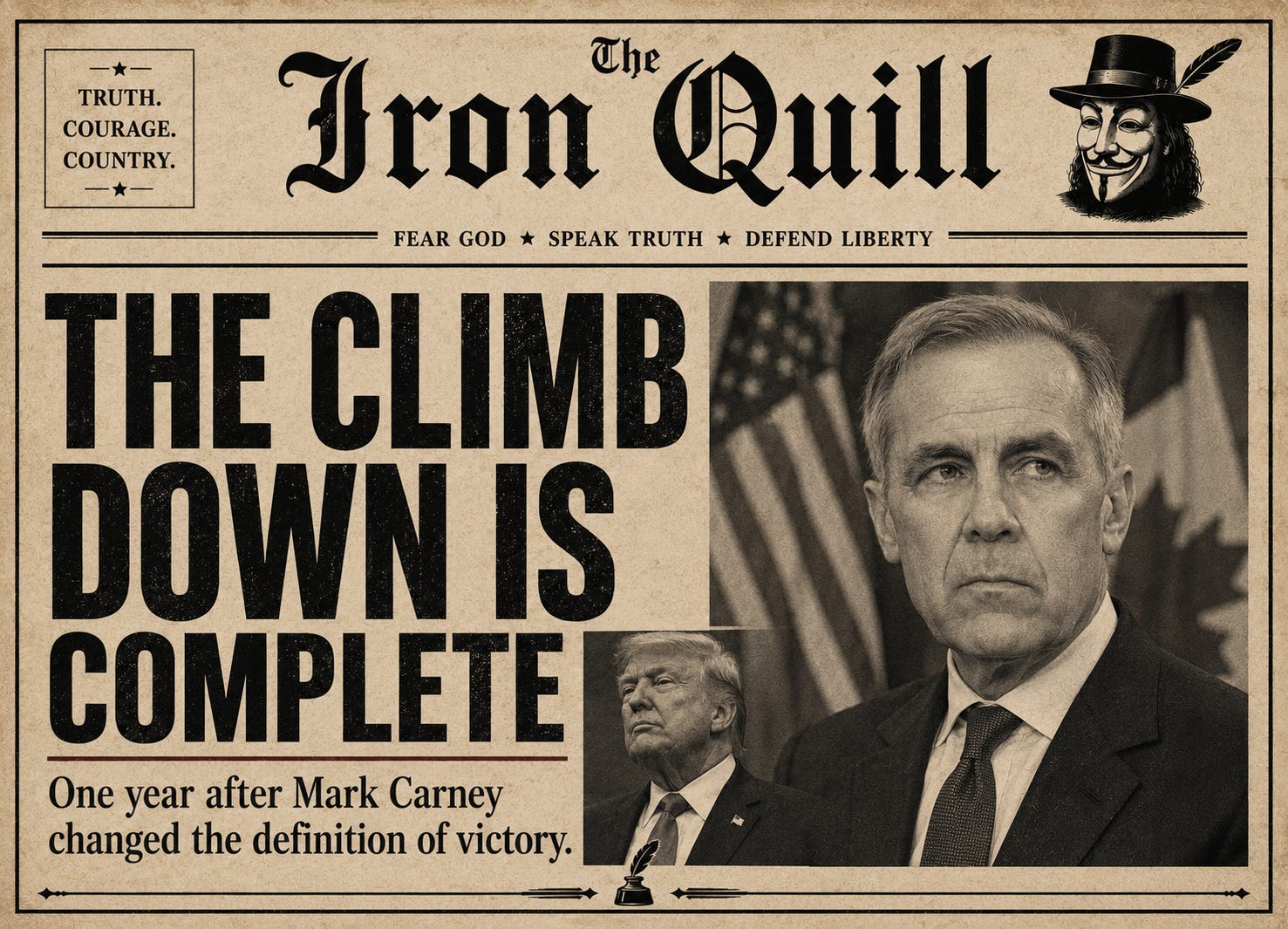
THE CLIMB DOWN IS COMPLETE
One Year After Mark Carney Changed the Definition of Victory

Some political moments arrive with sirens.
Others arrive in a sentence.
No emergency address.
No dramatic confrontation.
No admission that the promise has changed.
Just a sentence that quietly lowers the country’s expectations.
On July 15, 2025, Mark Carney acknowledged that any future trade agreement with the United States would likely include tariffs.
It was a realistic assessment.
It was also a long way from what Canadians had been encouraged to believe during the election campaign.
Carney was not presented merely as a competent administrator.
He was presented as the man uniquely equipped to handle Donald Trump.
He had led central banks.
He understood international markets.
He moved comfortably among governments, financial institutions and global elites.
Canadians were told that this was the résumé required for the moment.
The implication was clear.
They were expected to believe Mark Carney’s experience would give Canada greater leverage.
A year later, the country is discovering the difference between possessing impressive credentials and producing meaningful results.
Canada Elected a Résumé
Mark Carney’s education has never been the question.
Neither has his access to powerful institutions, financial markets or international decision-makers.
The question is whether any of it has translated into results.
That was the promise Canadians were sold.
Not simply that Carney understood the problem.
That he could do something about it.
A prime minister facing economic pressure from the United States should understand markets, trade and financial risk.
But technical knowledge alone does not create negotiating strength.
Nations negotiate from the position they built before arriving at the table.
Canada entered these talks heavily dependent on the American economy.
Our manufacturers rely on integrated American supply chains.
Our farmers rely on American buyers.
Our energy sector depends on infrastructure that overwhelmingly moves resources south.
A large share of Canadian exports still depends on access to one market.
Washington knows it.
Donald Trump knows it.
Mark Carney certainly knows it.
Understanding the imbalance is not the same as overcoming it.
The problem was never that Canada lacked someone capable of explaining why the country held a weak hand.
The problem was that Canadians were encouraged to believe Carney had the experience and ability to play that hand better than anyone else.
That claim must now be measured against the results.
A résumé may win an election.
A record determines whether the confidence placed in it was deserved.
The Definition of Victory Changed
The language surrounding the negotiations has steadily shifted.
At first, Canadians were told the relationship would be reset.
Then came the promise of a new economic and security partnership.
Then came the admission that tariff-free trade was probably no longer realistic.
Now the government points to the amount of trade that remains protected while major industries continue facing uncertainty and pressure.
That is how political expectations are lowered.
Not all at once.
One adjustment at a time.
The original question was whether Carney could defend the economic relationship Canada had.
The new question is how much of that relationship can be preserved.
Those are not the same test.
Sometimes a government truly does face bad options.
Sometimes preventing a larger loss is the most responsible outcome available.
But the public deserves honest language.
Containing damage is not victory.
Preserving part of what already existed is not a historic breakthrough.
When the promised result becomes impossible, governments often change the standard by which the result will be judged.
That is what has happened here.
The definition of success has been reduced until it fits the agreement Canada may eventually receive.
Trump Understands the Imbalance
Donald Trump’s approach to trade is built on a simple calculation.
The United States possesses the larger market.
It has more room to absorb disruption.
It can threaten tariffs knowing smaller trading partners will feel the pressure sooner.
Canada matters to the United States.
American industries rely on Canadian energy, minerals, agriculture and cross-border manufacturing.
But dependence is not equal.
Canada cannot casually walk away from the American market.
Trump negotiates knowing Ottawa needs continued access.
Carney negotiates knowing the same thing.
That difference shapes the entire conversation.
One side seeks better terms.
The other seeks to prevent the relationship from becoming significantly worse.
Carney may be more polished and predictable. He may understand the consequences better than almost anyone in Ottawa.
But understanding consequences does not change them.
Results do.
So far, Carney’s credentials have not altered the underlying balance of power.
Diplomacy matters, but diplomacy works best when it is backed by alternatives.
Canada has too few.
The Weakness Came Before Carney
Mark Carney did not create Canada’s vulnerability.
That distinction matters.
Successive federal governments failed to expand Canadian access to global markets with any urgency.
Major resource projects were delayed, cancelled or buried beneath years of regulatory uncertainty.
Pipelines that could have carried Canadian energy to tidewater became political battlegrounds.
Productivity weakened.
Investment left.
Governments spoke about diversification while allowing Canada’s economic dependence on the United States to deepen.
Carney inherited that position.
But he did not campaign as an ordinary caretaker inheriting an impossible problem.
He campaigned as the man best equipped to solve it.
That is why the standard is higher.
A leader cannot build his political identity around exceptional competence and then retreat behind the argument that no better result was possible.
Education alone does not build pipelines.
Experience alone does not secure stronger agreements.
Knowing why Canada is weak is not the same as making Canada stronger.
Perhaps the options were always limited.
But Canadians were told his experience would produce something better.
That promise cannot simply disappear now that the election is over.
Carney did not create Canada’s weak hand.
He campaigned as though he knew how to play it better than anyone else.
His record must now show whether he actually can.
Diversification Is Not a Press Release
The federal government now speaks constantly about finding new markets.
That is the correct goal.
Canada should trade more with Europe, Asia, the Middle East and other growing economies.
We should sell our energy, agriculture, minerals and manufactured goods to as many customers as possible.
But trade diversification cannot be announced into existence.
It requires ports, rail capacity, pipelines, processing facilities, competitive taxation and reliable regulation.
Above all, it requires the political willingness to approve projects before investors take their money elsewhere.
Canada has spent years talking about becoming less dependent on the United States while maintaining the policies that made dependence unavoidable.
A foreign trade mission does not replace infrastructure.
A memorandum does not replace a market.
A government announcement does not move one barrel of oil, one bushel of grain or one tonne of minerals.
Real diversification is built.
Canada mostly discussed it.
Now the consequences are arriving at the negotiating table.
This is where results matter.
Not in another speech about future markets.
Not in another announcement about opportunity.
In the pipelines approved, the ports expanded, the projects completed and the investment secured.
Governments do not create leverage by describing what they intend to build.
They create it by building.
Management Is Not Victory
Mark Carney may eventually secure the least damaging agreement available.
That may be the best outcome his government can now produce.
But Canadians should still be clear about what they are watching.
This is not the triumph they were promised.
It is the management of national weakness.
There may be skill involved in managing a retreat.
There may even be wisdom in recognizing when the original objective is no longer achievable.
But a retreat does not become a victory because it was conducted calmly.
The government must be judged by the agreement it delivers, the industries it protects, the concessions it makes and the strength it builds for the next confrontation.
Did Carney’s experience improve the outcome?
Did his international connections produce stronger terms?
Did his government build new leverage, or merely explain why Canada had so little?
Those are the questions his record must answer.
Not where he studied.
Not which institutions once employed him.
Not how impressive his résumé appeared during the campaign.
A résumé is a promise.
A record is the verdict.
The Climb Down Is Complete
Carney’s admission about tariffs did more than describe a trade negotiation.
It revealed Canada’s position.
The campaign had suggested that the right leader could stare down Trump.
Reality showed that no leader can negotiate from strength when the country has spent years refusing to build it.
But that cannot become a permanent excuse for Carney.
He sought the office by arguing that he was uniquely prepared for this moment.
He must therefore be judged by whether that preparation produces anything beyond a more polished explanation of retreat.
Canada needs more than an educated manager.
It needs a leader who can deliver.
It needs access to multiple markets.
It needs infrastructure that reaches both coasts.
It needs competitive industries, faster approvals and enough economic strength to say no when another country applies pressure.
Until those foundations exist, every Canadian prime minister will face the same limits.
The names and slogans will change.
The weakness will remain.
Mark Carney was elected because Canadians believed he could handle Donald Trump.
Perhaps he understands Trump perfectly.
Perhaps he understands the markets, the institutions and the negotiating table better than most.
But understanding the problem is not the same as solving it.
Credentials are not results.
And understanding why Canada must retreat does not turn the retreat into a victory.
The climb down did not happen in a single day.
It happened one lowered expectation at a time.
The climb down is complete.
The work of rebuilding Canadian strength has barely begun.

If today’s article challenged, informed, or encouraged you, I would ask you to consider standing with this work.
In the coming weeks, I have an opportunity to represent the concerns of everyday Canadians in an important conversation. Your support helps make that possible.
If you believe independent, faith-driven journalism still matters, please consider clicking the Stand With The Quill button below.
Thank you to everyone who has already stood behind this mission. Your support is making a difference.
I truly believe this is an intentional decline only benefiting carney and his global elites. They will come in with Brookfield and sweep up Canada for pennies on the dollar you will own nothing and be happy! Why has he not released his book “the hinge “? I truly feel as there are nefarious circumstances that are yet to befall us all. I do not trust our government they are so embedded with China. Our country is in perpetual turmoil. Immigration, asylum claims, temporary foreign workers, we are rapidly being replaced. Censorship bills are the government’s priority, we are closer to being Norrh Korea. I don’t understand how Canadians can’t see thru this. I feel one day I’ll be arrested for “wrong thinking” it’s absolutely unreal and you wonder why Alberta wants to leave.
Canada thinks it owns the arctic - it doesn't. The sparsely populated north shore of Canada does not qualify as ownership by international standards. In fact, if the US purchased Greenland, it could be argued that the NortWest Passage (NWP) is simply a US internal waterway between Alaska and Greenland. Then the NWP would be American, not Canadian.
The North West Passage is 4000 km shorter for shipping from the far East compared to the Panama Canal. Fees for the 2025 Panama Canal were reported as US$5.8B.
The size and scope of developing the (tundra/ permafrost) land adjacent to the NWP includes docks, ports, roads, landing strips, airports, Coast Guard, Ice Breakers, electrical generation and distribution, pre fab housing, pre fab mining process plants (sic: Little Cornwallis Island), communications, construction equipment...$ Trillions over the long run with payoffs in sovereinty, resources, transportation, technology, military, employment...Canada would be the Big Player in the Arctic.
Looking for some leader or party with a vision like this to bet on the future of Canada.