
THE CEASEFIRE IS OVER
When Peace Is Mistaken for Weakness

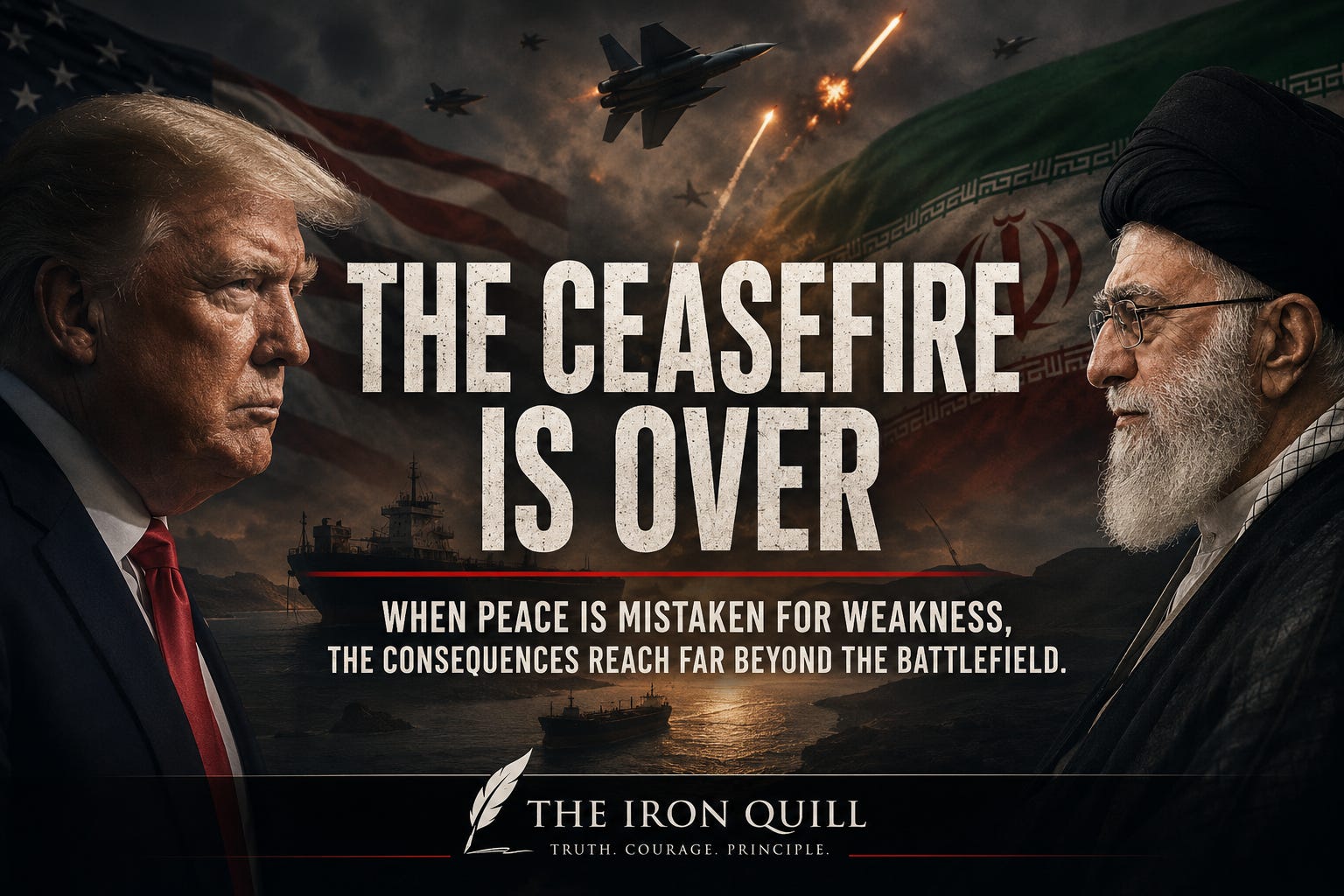
“To me, I think it’s over.”
With those words, President Donald Trump pronounced the apparent death of the fragile ceasefire between the United States and Iran.
The agreement was supposed to buy sixty days of breathing room. It gave negotiators time to pursue a permanent settlement, restore shipping through the Strait of Hormuz, reduce the danger to American forces, and offer Iran’s leadership one final chance to step away from a wider war.
It did not last.
Negotiations failed to produce a visible breakthrough. Commercial vessels were attacked in one of the world’s most important waterways. Washington restored pressure on Iranian oil sales and resumed military action. Iran answered with missiles and drones aimed at American military interests and Gulf states hosting U.S. forces.
The diplomats have not disappeared, but they are no longer setting the pace.
The battlefield is.
The ceasefire is over.
The illusion may be over with it.
A Ceasefire Is Not Peace
The modern world has developed a dangerous habit.
It hears the word ceasefire and assumes peace has arrived.
The guns grow quiet. Markets settle. Television panels congratulate the negotiators. Political leaders step before microphones and speak as though history has turned a corner.
Then the shooting begins again.
A ceasefire is not peace. It is an interruption.
It may stop the immediate exchange of fire, but it does not settle ambitions, dismantle weapons, rebuild trust, or change the character of the people holding power.
A ceasefire can open the door to peace.
It can also give an enemy time to reload.
That is the question every serious leader must ask when a hostile government agrees to stop fighting.
Is it seeking a settlement, or merely waiting for a better opportunity?
The agreement between Washington and Tehran was intended to create a negotiating window. Yet the talks produced no public evidence of a permanent settlement. Both governments accused the other of violations, the Strait of Hormuz remained unstable, and commercial shipping stayed under threat.
The agreement existed on paper.
Peace did not.
Trump Offered Iran an Exit
It matters what Iran was being offered.
The United States had already demonstrated that it was willing and able to strike Iranian targets. American forces were positioned throughout the region. Israel remained a direct military threat. Iran’s economy was under enormous pressure.
Tehran had every reason to understand that another round of fighting could be worse than the last.
Yet Washington did not immediately demand occupation or send an army marching toward Tehran. Negotiations continued. Iran’s leadership was given an opportunity to preserve what remained of its government, reduce economic pressure, restore movement through the Strait, and avoid a confrontation it could not fully control.
It was a final opportunity to avoid a wider war.
Trump had publicly claimed that an agreement would prevent Iran from obtaining a nuclear weapon. Whatever doubts surrounded the details, the message was unmistakable: Iran was being offered a route away from continued destruction.
But the negotiations stalled. Tankers were struck. Washington tightened pressure on Tehran, and American aircraft returned to Iranian skies. Trump then declared the interim ceasefire over and warned that the next response could be even harsher.
Iran was given a chance to step back.
Its rulers chose confrontation instead.
When Restraint Is Read as Weakness
Some governments understand restraint.
Others interpret it as hesitation and treat every concession as evidence that their opponent can be pushed farther.
That does not make diplomacy foolish. It means negotiations must be backed by something more than hope.
Peace cannot be built on the assumption that hostile regimes will eventually become reasonable simply because reasonable nations keep inviting them back to the table.
A country can desire peace.
It cannot force its enemy to desire the same thing.
Iran’s rulers may have calculated that Washington lacked the appetite for another prolonged Middle Eastern war. The American public is weary of open-ended military commitments, and Trump has repeatedly opposed conflicts that consume lives, money, and years without producing a clear victory.
Tehran may also have believed that rising oil prices, political pressure, market anxiety, and fear of regional escalation would eventually drive Washington back into negotiations.
But opposing endless war is not the same as refusing to fight.
The United States does not need to occupy Iran to destroy the military assets threatening American personnel, commercial shipping, or regional allies. It does not need to rebuild Tehran to make aggression painfully expensive.
Restraint is meaningful only when the other side understands that it is a choice backed by strength.
The Iranian regime appears to have misunderstood that distinction.
The Strait That Can Shake the World
For many Canadians, the Strait of Hormuz feels like a distant strip of water in a distant conflict.
It is not.
Roughly one-fifth of the world’s oil passes through that narrow waterway. When the Strait is threatened, the consequences reach far beyond the Persian Gulf.
Tanker traffic has again slowed dramatically as attacks, insurance concerns, and the danger of further military action frighten vessels away from the region. Only a small number of tankers were recorded passing through during the latest escalation, while other ships reportedly switched off tracking systems or reconsidered their routes.
When oil prices rise, transportation and shipping costs follow. Airlines pay more for fuel. Farmers pay more to operate equipment and move products. Manufacturers absorb higher costs for energy, materials, and freight.
Eventually, those increases reach households through gasoline, groceries, utilities, and nearly everything delivered by truck.
A missile fired in the Persian Gulf does not remain there.
Eventually, it appears on a receipt in Saskatchewan.
That is why attacks on commercial shipping cannot be dismissed as somebody else’s regional problem.
The Strait of Hormuz is a pressure point in the global economy, and Iran understands the leverage. It does not need to sink every tanker. Uncertainty alone can move markets, raise insurance costs, frighten shipping companies, and create political pressure throughout the West.
Iran may not be able to defeat the United States in a conventional war.
Its rulers may believe they do not have to.
If Tehran can make confrontation economically and politically uncomfortable enough, it may expect Western governments to begin searching for another compromise.
That is the gamble.
Iran’s Dangerous Calculation
The danger is that Iran may believe it can control the level of escalation.
Strike hard enough to create fear, but not hard enough to provoke an overwhelming response. Threaten shipping, launch missiles toward military facilities, and raise the economic cost until nervous governments demand negotiations.
The problem is that once missiles are moving, neither side controls every consequence.
Iran has claimed attacks against American military interests across the Gulf. Kuwait, Bahrain, Qatar, and other regional states have faced missiles or drones as the conflict has widened beyond Iran’s borders. Some incoming weapons were intercepted, and the full extent of the damage remains under assessment.
The direction, however, is unmistakable.
The conflict is spreading into countries that may not have expected to become active participants.
Each new target gives another government a reason to respond. Retaliation creates fresh opportunities for mistakes, and those mistakes narrow the path back to diplomacy.
Tehran may believe it can apply pressure without provoking decisive American action. Trump may believe he can restore deterrence without beginning another occupation or decade-long military commitment.
Those calculations may hold.
But in a conflict involving missiles, military bases, shipping lanes, allies, and nuclear facilities, one error can erase every assumption made before it.
The Most Dangerous Moment
Wars do not always expand because leaders planned a larger conflict.
They expand because events begin outrunning the people who started them.
A drone reaches a target air defences were expected to protect. A missile kills American personnel. A tanker sinks in a critical shipping lane. A strike lands too close to a nuclear facility. An ally decides it can no longer remain on the sidelines.
At that point, governments are no longer following the strategy they began with. They are responding to casualties, political pressure, military necessity, and public demands for retaliation.
That is why the collapse of the ceasefire matters.
Not because every broken agreement leads automatically to catastrophe, but because every agreement that fails removes another barrier between pressure and panic.
Washington and Tehran have entered a period in which both will attempt to prove they cannot be intimidated.
That is when restraint becomes most difficult.
It is also when wisdom matters most.
Peace Requires Consequences
Some will say the answer is simply more diplomacy.
Others will argue that diplomacy was always pointless.
Both positions are too easy.
Diplomacy matters because war is costly, unpredictable, and filled with innocent suffering. Strength matters because diplomacy without credibility is merely a request.
A responsible nation should always leave a path to peace.
But it cannot leave that path open forever while attacks continue.
A ceasefire cannot become permission to regroup, threaten international shipping, fire on military facilities, and then demand another round of negotiations whenever the response becomes uncomfortable.
Diplomacy works only when both sides believe the agreement means something.
Peace survives when the cost of breaking it becomes greater than the reward.
Peace and the Price of Miscalculation
Peace does not depend only on what leaders want.
It also depends on what they believe about one another.
Iran’s leadership seems convinced that the United States wants to avoid a prolonged war badly enough that economic pressure, attacks on shipping, and limited strikes against regional targets will eventually force Washington back to the negotiating table.
Trump appears to believe that a sharp display of overwhelming force can restore deterrence without pulling America into another occupation.
Both strategies depend on calculation.
Each side must correctly read the other’s limits, intentions, and tolerance for casualties.
That is what makes this moment so dangerous.
A government that mistakes restraint for fear may push too far. A government determined to prove its strength may respond harder than its opponent expected. Once that cycle begins, yesterday’s limits can disappear quickly.
Despite the military exchanges, diplomatic contacts have not completely ended. Regional governments continue pressing both sides to step back, and negotiations may yet resume. But the path is becoming narrower with every attack.
The road back to peace still exists.
Every missile makes it harder to reach.
The Illusion Is Gone
Every generation hopes it will be the one that finally outgrows war.
Every generation eventually learns that peace requires more than speeches, agreements, and carefully staged handshakes.
It requires hostile governments to believe the agreement will be enforced.
Trump gave Iran an exit.
Tehran appears to have mistaken that opportunity for hesitation.
Now American aircraft are striking again. Iranian missiles and drones are moving across the Gulf. Commercial shipping remains threatened, and diplomacy has been forced to the edge.
The question is no longer whether the ceasefire can be saved.
It is whether Iran’s rulers finally understand that some warnings are not negotiating tactics.
They are the final opportunity to avoid something far worse.
If today’s article challenged, informed, or encouraged you, I would ask you to consider standing with this work.
In the coming weeks, I have an opportunity to represent the concerns of everyday Canadians in an important conversation. Your support helps make that possible.
If you believe independent, faith-driven journalism still matters, please consider clicking the Stand With The Quill button below.
Thank you to everyone who has already stood behind this mission. Your support is making a difference.
Just another day with bullshit.
IceICE bebe!