
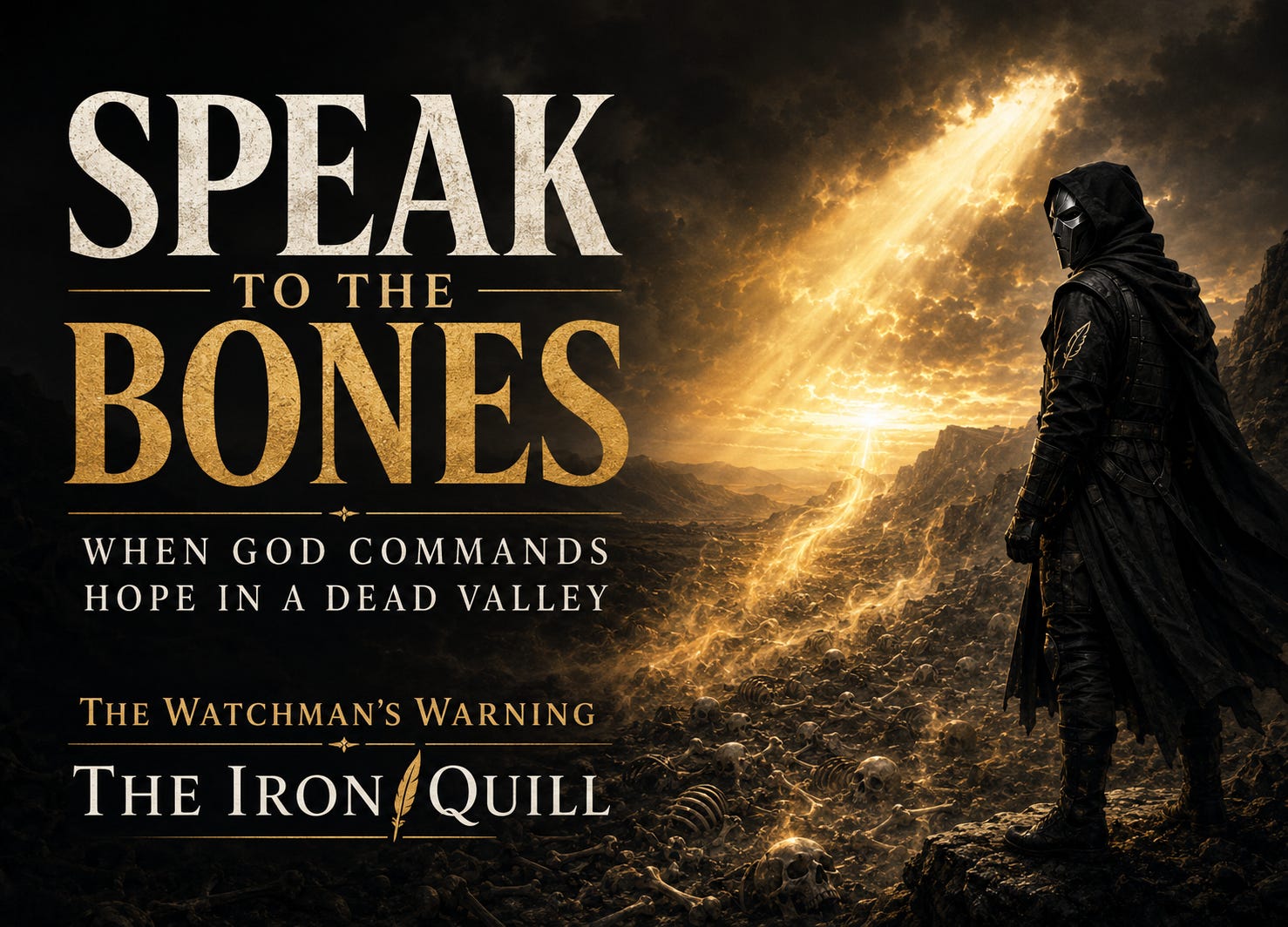
Speak to the Bones
When God Commands Hope in a Dead Valley

There are places in life that look beyond recovery.
A country can reach that point. So can a family. So can a church. So can the soul of a man who has carried too much for too long.
Dry. Scattered. Silent. Finished.
There are seasons when hope does not feel like a sunrise. It feels like a command given in a graveyard. It feels like standing in a valley full of bones while heaven asks the question no human strength can answer.
“Can these bones live?”
That is the question God asked Ezekiel.
Not in a garden. Not in a temple full of music. Not in a city celebrating victory. God brought the prophet into a valley of death and forced him to look at what was there.
The bones were not hidden. They were not softened. They were not explained away. Scripture says they were very dry.
That matters.
Biblical hope does not begin by pretending the valley is alive. It begins by admitting the bones are dry, then asking whether God is still God.
That is where many people are right now.
They are tired of being told everything is fine when they can see it is not. They are tired of watching institutions decay while leaders applaud themselves. They are tired of seeing families strained, churches weakened, children confused, money stretched, truth mocked, and courage treated like a dangerous thing.
They are not weak for noticing the valley.
They are not faithless because they can see the bones.
The question is not whether the valley is real.
The question is whether the valley gets the final word.
God Brought Him to the Valley
Ezekiel did not stumble into that valley by accident.
The hand of the Lord brought him there.
That detail matters because it means God was not surprised by the scene. He was not embarrassed by it. He was not trying to hide it from His servant. He led Ezekiel straight into the middle of it and made him walk around.
God sometimes does that.
He lets His people see what is broken. He lets them walk through the ruins. He lets them feel the weight of a place that has lost its breath.
Not because He wants them to worship despair.
Because He wants them to learn obedience when the situation looks impossible.
There is a false kind of faith that refuses to look at the valley. It calls blindness peace. It calls denial joy. It tells the grieving to smile faster, the exhausted to try harder, and the wounded to stop noticing the blood on the floor.
That is not biblical hope.
The Bible is not afraid of dry bones.
God does not need His people to lie about the condition of things in order to prove they trust Him. Faith does not require dishonesty. Hope does not require pretending. Courage does not come from closing your eyes and humming until the darkness goes away.
God brought Ezekiel to the valley and made him see it clearly.
The bones were many.
The bones were dry.
The death was real.
And then God spoke.
The Bones Were Very Dry
There is a difference between tired and dead.
There is a difference between wounded and dry.
The bones Ezekiel saw were not recently fallen. They were not moments from recovery. They were not bodies waiting for someone to shake them awake.
They were very dry.
That means the situation looked long finished. Whatever battle had happened there was over. Whatever life had once existed there had departed. Whatever strength had once moved through those bodies was gone.
That is the kind of image God chose for His message.
Not a bruised reed.
Not a sick tree.
Not a dim lamp.
Dry bones.
Because what looks too far gone to man is still within reach of the voice of God.
That is a word for the person whose prayer life feels dry.
That is a word for the man who feels like he has nothing left in the tank.
That is a word for the mother who keeps holding the house together while quietly wondering how much longer she can keep going.
That is a word for the believer who looks at the church and wonders where the fire went.
That is a word for the people who look at their country and feel like the old strength has been scattered across the valley.
God does not need fake strength from us.
He does not ask dry bones to pretend they are strong. He does not demand that the valley dress itself up before He enters it. He does not require the dead place to make itself presentable.
He speaks into it.
That is the hope.
Not that the bones are secretly fine.
Not that the valley is not really dead.
But that the God of heaven can stand in the middle of the dead place and still issue a command.
Can These Bones Live?
Then God asks Ezekiel the question.
“Can these bones live?”
It is one of the great questions in Scripture because it exposes the limits of human sight.
Ezekiel is standing in the valley. He can see the evidence. He can see the dryness. He can see the impossibility. If the answer depends on nature, the answer is no. If the answer depends on time, the answer is no. If the answer depends on human effort, organization, strategy, money, or motivation, the answer is no.
Dry bones do not rebuild themselves.
Dead things do not vote themselves alive.
Scattered remains do not hold a meeting and decide to rise.
But Ezekiel does not answer according to what he sees. He answers according to who is asking.
“O Lord God, you know.”
That is not evasion.
That is surrender.
There are moments when faith does not know the method. It only knows the Master.
Ezekiel does not pretend to understand how resurrection can happen in a valley full of bones. He does not manufacture a plan. He does not give God a speech about optimism. He does not say, “I believe in the bones.”
He says, in effect, “Lord, this is beyond me. But it is not beyond You.”
That is where real hope begins.
Not in confidence that circumstances are manageable.
Not in confidence that leaders will fix what they broke.
Not in confidence that people will suddenly wake up because the facts are obvious.
Real hope begins when human arrogance runs out of speeches and faith finally bows before God.
That is not weakness.
That is the place where breath can begin.
Speak Anyway
Then God gives Ezekiel a strange command.
Speak to the bones.
That sounds ridiculous.
Bones do not listen. Bones do not repent. Bones do not organize. Bones do not answer altar calls. Bones do not recognize the hour and decide to rise.
Yet God tells the prophet to speak.
This is where the passage stops being sentimental and becomes dangerous.
Because hope is not only something you feel. Hope is something you obey.
God did not tell Ezekiel to analyze the bones forever. He did not tell him to complain about the valley. He did not tell him to build a monument to what had been lost.
He told him to speak the word of the Lord.
That is a command for our time.
So speak truth when silence would be easier. Pray when the room feels empty. Open Scripture when the world calls it outdated. Teach your children while the age tries to disciple them first. Build what is right even when the valley gives you no applause.
Repent when pride offers you excuses.
Forgive when bitterness offers you a throne.
Stand when surrender would cost less.
A dead valley does not cancel obedience.
That may be the word someone needs tomorrow morning. You may not feel strong. You may not see results. You may not understand how things can come back to life. But if God has given you something to speak, something to build, something to repent of, something to repair, something to protect, then obedience is still on the table.
The bones are not responsible for making the command reasonable.
The servant is responsible for obeying.
Obedience is often the first sound heard in a dead valley.
Before the army stands, the prophet speaks.
Before the breath comes, the word goes forth.
Before the valley changes, one man obeys God in a place where obedience looks foolish.
That is faith.
The First Sign May Be a Rattle
Ezekiel speaks, and something happens.
There is a sound.
A rattling.
Not a song. Not a shout of victory. Not a polished revival meeting. A rattle.
Bone comes to bone. Structure begins to form. What was scattered begins to come together. Sinews appear. Flesh comes upon them. The scene begins to change.
But there is still no breath.
That is important.
God’s restoration often begins before life is fully visible.
Many people quit because the first sign of hope does not look like completion. They pray once and expect the whole valley to rise. They make one change and expect the whole life to be fixed. They speak truth once and expect the whole nation to wake up.
But restoration is often staged.
First there is sound.
Then structure.
Then covering.
Then breath.
Do not despise the rattle.
The rattle may be ugly. It may be awkward. It may be small. It may not impress anyone watching from a distance. But if God is moving, the first sound in the valley may not be beautiful. It may simply be evidence that what was scattered is no longer staying where death left it.
That matters.
A man who starts praying again may not look fully restored.
But there is a rattle.
A family that starts telling the truth again may not be healed overnight.
But there is a rattle.
A church that starts preaching Scripture with courage again may not be strong yet.
But there is a rattle.
A people who begin to reject lies, rebuild households, protect children, and return to God may not look like an army yet.
But there is a rattle.
The first sign of hope may not be a song.
It may be a rattle.
Breath Came Into Them
Then comes the moment structure is not enough.
The bodies are there, but they are not alive.
That is a warning.
A nation can have institutions without righteousness.
A church can have programs without the Spirit.
A family can have routine without love.
A man can have motion without life.
You can rebuild the appearance of strength and still lack breath.
This is where Scripture cuts deeper than politics, motivation, and public reform. God is not merely interested in arranging bones into a more respectable shape. He is not trying to make death look organized.
He brings breath.
The same God who breathed life into man in the beginning can breathe life into what looks finished now.
That is why structure alone cannot save us.
Build. Work. Organize. Repair what has been broken. Stand for truth. Teach your children. Strengthen your home. Speak in the valley.
But do not confuse movement with life.
Do not confuse noise with breath.
Do not confuse flesh with Spirit.
The dead need more than management.
They need resurrection.
And resurrection belongs to God.
That is why prayer is not a side issue. It is not decoration. It is not religious language sprinkled on top of a human plan. Prayer is the confession that without the breath of God, all our efforts remain incomplete.
We need the breath of God in our homes.
We need the breath of God in our churches.
We need the breath of God in weary hearts.
We need the breath of God in a generation that has been taught to mock Him while starving for meaning.
What the world calls recovery is still incomplete until the breath of God returns.
They Stood on Their Feet
The end of the vision is not survival.
It is standing.
The bones live. Breath enters them. They rise to their feet as an exceedingly great army.
Do not miss that.
God does not breathe life into His people so they can crawl forever.
He raises them to stand.
There is comfort in this passage, but there is also command. God restores the dead, but He does not restore them into passivity. He does not raise an army so it can admire itself. He does not bring breath into the valley so His people can go back to sleep.
He raises them for purpose.
That is the hope we need.
Not soft hope. Not decorative hope. Not the kind of hope that pats people on the head and tells them nothing is required.
We need the kind of hope that puts steel back into the spine.
The kind of hope that tells a tired father he can stand again.
The kind of hope that tells a weary mother her labour is not wasted.
The kind of hope that tells the lonely believer there are still others who have not bowed.
The kind of hope that tells the church to stop apologizing for being alive.
The kind of hope that tells a broken people that God can still raise what everyone else has written off.
The valley was full of bones.
Then it was full of an army.
That is the difference between a dead valley and the voice of God.
The Valley Does Not Get the Last Word
So speak to the bones.
Not because they look promising. Not because the valley feels hopeful. Not because you can explain how resurrection comes.
Speak because God still speaks.
Pray where others have quit. Stand where others have surrendered. Build where others only complain. Tell the truth where others have learned to survive by lying.
And when the rattle comes, do not despise it because it is not yet a trumpet.
When the breath comes, do not stay seated.
Rise.
The valley is real. The bones are dry. The grief is honest. The exhaustion is not imaginary.
But none of it outranks the voice of God.
The world may look at dry bones and call them finished.
God looks at them and asks, “Can these bones live?”
The answer is not found in the bones.
The answer is found in the One who speaks.
The valley was never the end.
It was the place where God taught dead bones to stand.
—The Iron Quill
The Iron Quill is reader-supported.
Most of this work remains free because truth should travel.
If you believe in the mission, become a paid supporter and help keep the signal alive.
This narrative from IQ shows there is still hope for this Country, if that Hope is found in God alone, and not in any politician or otherwise.