
Manna for Today

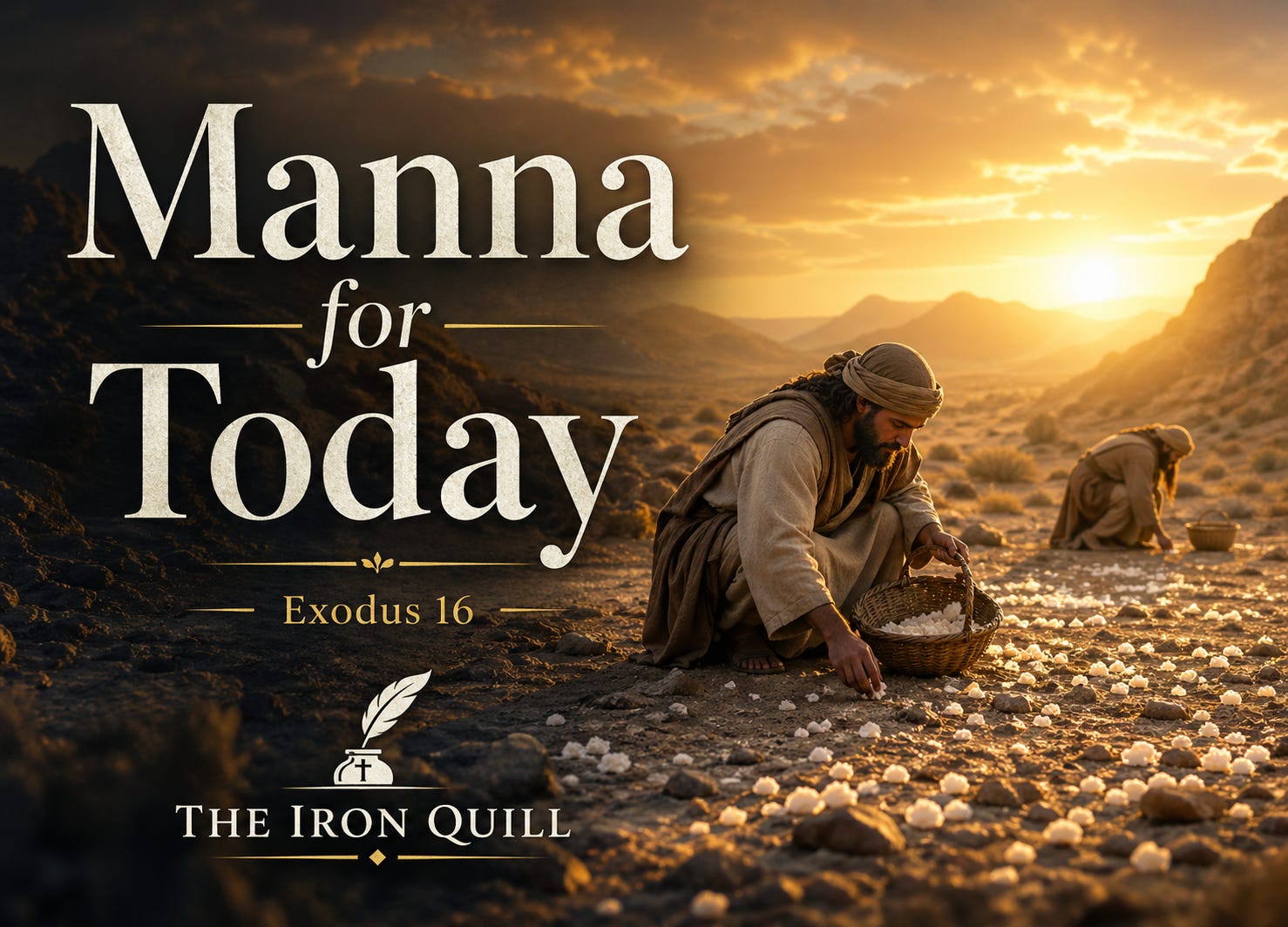
The wilderness has a way of exposing what Egypt trained into a man.
Israel had been delivered.
The plagues were behind them. Pharaoh’s grip had been broken. The Red Sea had opened, and the army that once terrified them had been swallowed beneath the waters. The chains were gone. The whip was gone. The brick pits were behind them.
And yet the hunger was real.
That is where the test began.
Not at the Red Sea, where the miracle was obvious. Not in Egypt, where the enemy was visible. But in the wilderness, where freedom no longer felt dramatic and provision was not yet stored in barns.
That is where Israel began to grumble.
Exodus tells us, “And the whole congregation of the people of Israel grumbled against Moses and Aaron in the wilderness.” Then they said something revealing: “Would that we had died by the hand of the Lord in the land of Egypt, when we sat by the meat pots and ate bread to the full” (Exodus 16:2–3, ESV).
There it was.
The sound of free men speaking like slaves.
They had been rescued from Egypt, but Egypt was still speaking inside them.
They remembered the meat pots.
They remembered the bread.
They remembered being full.
But fear had edited the memory.
They forgot the bondage. They forgot the cruelty. They forgot the murdered sons. They forgot the groaning. They forgot the brick quotas. They forgot what it meant to live under Pharaoh’s hand.
That is what fear does.
It makes the past look safer than it was. It makes bondage look stable. It makes slavery look predictable. It takes the worst place God delivered you from and paints it with softer colours because the road ahead looks uncertain.
The hungry heart can make a prison cafeteria look like a feast.
Freedom Does Not Always Feel Like Comfort
One of the hardest lessons for God’s people is this: deliverance does not always lead immediately into ease.
Sometimes deliverance leads into the wilderness.
That does not mean God made a mistake. It does not mean His hand was weak. It does not mean His promise failed. It means He is doing something deeper than merely changing the scenery around His people.
He is changing the slavery inside them.
Israel was out of Egypt, but Egypt was not yet out of Israel.
That was the real battle.
Pharaoh had lost legal claim over their bodies, but the habits of slavery still ruled their imagination. They knew how to obey a taskmaster. They knew how to survive under oppression. They knew how to measure safety by visible food, visible structures, visible systems, and visible power.
But they did not yet know how to walk with God.
So the Lord brought them into a place where the old supports were stripped away.
No Egyptian storehouses.
No familiar supply lines.
No Pharaoh to blame.
No old system to lean on.
Just the wilderness, the hunger, and the God who had already proven He could make a road through the sea.
This is where faith is tested.
Not when everything is obvious. Not when the pantry is full. Not when the path is comfortable. Faith is tested when God has delivered His people from what enslaved them, but has not yet shown them everything that comes next.
The wilderness is not always punishment.
Sometimes the wilderness is training.
Fear Edits the Past
The people said they had eaten bread to the full in Egypt.
That may have been true in moments.
But Egypt was not a place of blessing. It was a house of bondage. It was a system that used their bodies, crushed their spirit, and murdered their future.
Yet in the wilderness, their fear reached backward and polished the chains.
That is one of fear’s oldest tricks.
It does not tell the whole story. It selects the parts that serve panic. It reminds a man of the food, but not the whip. It reminds him of the roof, but not the prison. It reminds him of predictability, but not the cost of surrendering his soul.
This is why nostalgia can be dangerous when it is driven by unbelief.
There is a kind of remembering that strengthens faith. Scripture commands God’s people to remember His works, His covenant, His deliverance, His mercy, and His mighty hand.
But there is also a kind of remembering that leads back to Egypt.
That kind of memory does not honour the truth. It edits it.
It says, “At least we knew where the bread came from.”
But God did not lead Israel out of Egypt so Pharaoh could remain their provider.
He did not break chains so His people could spend the rest of their lives wishing for a better version of slavery.
He did not open the sea so they could stand on the other side and accuse Him of abandonment.
He brought them out to teach them a new way to live.
A free people must learn to trust differently than slaves.
Slaves trust the system that feeds them.
The people of God trust the Lord who commands the heavens.
Bread From Heaven
Then the Lord answered.
Not because Israel had earned it.
Not because their grumbling was noble.
Not because their fear was faithful.
But because God is merciful.
Exodus 16:4 says, “Then the Lord said to Moses, ‘Behold, I am about to rain bread from heaven for you.’”
Bread from heaven.
Not bread from Egypt.
Not bread from Pharaoh.
Not bread from the systems they had known.
Bread from above.
That is the line that matters.
God was teaching Israel that provision does not have to come from the place that once controlled you. It does not have to come through the hands that once owned you. It does not have to come from the institutions that trained you to fear life without them.
The Lord can feed His people in places where no natural supply appears.
He can set a table where there is no field.
He can rain bread where there is no bakery.
He can sustain His people in the wilderness because the wilderness is not outside His jurisdiction.
That is the great lie of fear.
Fear tells a man that God is powerful in Egypt, powerful at the Red Sea, powerful in the dramatic moment, but somehow absent in the daily need.
Fear believes in yesterday’s miracle but doubts today’s bread.
Israel had watched the sea split open.
Now they wondered if God could handle breakfast.
That sounds foolish until we see ourselves in it.
How often does the human heart do the same thing?
God has carried us before. God has answered before. God has opened doors before. God has sustained His people through trials that should have crushed them. And then, when the next need appears, flesh panics as if His faithfulness expired overnight.
But the God who opened the sea was also the God who sent the manna.
The God of the miracle is also the God of the morning.
Provision Was Also a Test
The manna was not only provision.
It was training.
The Lord said the people would go out and gather “a day’s portion every day” so that He might test them, “whether they will walk in my law or not” (Exodus 16:4, ESV).
That detail matters.
God could have given them a mountain of bread.
He could have filled their tents for the year.
He could have buried them under visible supplies so they never had to wonder where tomorrow’s meal would come from.
But He did not.
He gave them enough for the day.
God was not merely feeding stomachs. He was forming faith.
He was teaching His people the discipline of daily dependence.
That is a hard lesson for flesh and blood. We want the warehouse. We want the map. We want the guarantee. We want the visible proof that tomorrow has already been handled according to our preferred schedule.
But God often works differently.
He gives enough light for the next step.
Enough strength for the next act of obedience.
Enough bread for the day.
Not because He is cruel.
Because He is teaching us where life truly comes from.
God did not give them a warehouse because He was building faith, not storage capacity.
The issue was not whether God had enough.
The issue was whether Israel would trust Him again in the morning.
Hoarding Reveals Fear
Moses told the people not to leave any of the manna until morning.
Some listened.
Some did not.
Exodus says, “But they did not listen to Moses. Some left part of it till the morning, and it bred worms and stank” (Exodus 16:20, ESV).
That is a hard image.
Yesterday’s manna rotting in the tent.
A visible sign of invisible unbelief.
The issue was not wisdom. Scripture is not against preparation. Proverbs praises the ant that stores in summer. Joseph stored grain in Egypt before famine came. Prudence is not sin.
But this was different.
God had given a direct command. Gather for the day. Trust Me for tomorrow.
When some kept extra, they were not practicing wisdom. They were practicing fear.
They were saying, in effect, “God provided today, but we are not sure He will provide tomorrow.”
That is where unbelief often hides.
Not always in open rebellion.
Sometimes in anxious control.
Sometimes in the refusal to rest.
Sometimes in the desperate need to hold tomorrow in our own hands because we are not convinced the Father’s hands are enough.
Yesterday’s manna cannot carry tomorrow’s fear.
That is why it spoiled.
It was never meant to become an idol of security. It was meant to be received with gratitude, used in obedience, and trusted as evidence that the same God would still be God when the sun came up again.
The people had to learn that provision is not only about what sits in the tent.
It is about Who reigns in heaven.
Daily Bread Is Still the Prayer
The manna lesson did not end in Exodus.
Jesus carried it into the prayer life of His people.
When He taught His disciples to pray, He did not say, “Give us enough to never need faith again.”
He said, “Give us this day our daily bread” (Matthew 6:11, ESV).
Daily bread.
There it is again.
Not a lifetime supply.
Not full control.
Not every answer in advance.
Bread for the day.
And the bread in the wilderness pointed beyond itself. Christ would later call Himself the bread of life, the true bread from heaven.
This is not an excuse for laziness. It is not a rejection of work, planning, prudence, or responsibility. Scripture honours diligence. Scripture condemns sloth. A faithful man does not use trust as a mask for neglect.
But neither does he confuse anxiety with responsibility.
There is a kind of planning that is wise.
There is also a kind of planning that is worship of control.
Jesus cuts straight through that illusion.
In the same sermon, He says, “Therefore do not be anxious about tomorrow, for tomorrow will be anxious for itself. Sufficient for the day is its own trouble” (Matthew 6:34, ESV).
That is not weakness.
That is command.
Christ knows the human heart. He knows how quickly we leave today and start living inside fears that have not happened yet. He knows how easily tomorrow becomes a tyrant. He knows how anxiety drags future burdens into present obedience until a man is too weighed down to do what God has placed in front of him.
So He teaches us to pray differently.
Not as pagans who think they are alone.
Not as slaves who think Pharaoh controls the bread.
Not as orphans who think everything depends on their own grip.
But as children.
Father, give us bread for today.
And when tomorrow becomes today, give us bread again.
The Remnant Must Learn Daily Trust
This matters deeply in a shaking world.
Because the spirit of the age is anxiety.
The world teaches panic.
It teaches control.
It teaches hoarding.
It teaches outrage.
It teaches men to stare at every storm, every headline, every rumour, every market tremor, every institutional failure, and carry the weight of the whole future in their chest.
But God does not command His people to live like that.
The remnant must be clear-eyed, not frantic.
Prepared, not panicked.
Watchful, not consumed.
Faithful, not frozen by fear.
There is a difference.
The faithful man does not need to own tomorrow before he obeys God today.
He does not need every answer before he takes the next righteous step. He does not need to see the whole road before he walks by the light God has given. He does not need to understand every turn in the wilderness before he gathers the manna at his feet.
That is what daily trust looks like.
It is not dramatic.
It is not glamorous.
It is morning obedience.
It is receiving what God gives.
It is refusing to romanticize Egypt.
It is refusing to make fear the master.
It is refusing to call panic wisdom.
It is refusing to confuse control with faithfulness.
The wilderness generation struggled because they wanted the security of slavery without the chains. They wanted freedom to feel like Egypt with better conditions. They wanted God’s promise, but they also wanted Pharaoh’s predictability.
But God was not forming a people who would merely survive outside Egypt.
He was forming a people who would belong to Him.
That required daily bread.
Daily trust.
Daily obedience.
Daily surrender.
Enough for Today
There is something humbling about manna.
It could not be manufactured.
It could not be controlled.
It could not be stockpiled in disobedience.
It had to be received.
Every morning preached the same sermon: step out, receive what God has given, and trust Him again tomorrow.
That is not just ancient history.
That is the life of faith.
The proud man hates this because he wants to be self-sufficient.
The anxious man hates this because he wants to see every provision in advance.
The worldly man hates this because he wants a system he can control.
But the child of God learns to say, “My Father knows what I need.”
That is not passivity.
That is not denial.
That is not pretending the wilderness is easy.
It is confidence in the character of God.
The same God who delivered yesterday is not absent today.
The same God who opened the sea is not confused by the wilderness.
The same God who sent manna to Israel still teaches His people to pray for daily bread.
The wilderness was not proof that God had abandoned Israel.
It was proof that God was retraining them.
Egypt taught them dependence on Pharaoh.
The wilderness taught them dependence on God.
Egypt taught them to fear scarcity.
The manna taught them to trust the Father’s hand.
Egypt taught them to measure safety by what they could see.
God taught them to measure safety by Who had spoken.
And that lesson still stands.
God may not give His people a warehouse.
He may not show the whole road.
He may not explain every delay, every hunger, every uncertainty, or every wilderness season.
But He gives bread for the day.
And the people of God must learn to gather it with faith.
Not panic.
Not nostalgia.
Not fear.
Faith.
Because tomorrow belongs to God.
And today, He has not failed to provide.
The Watchman’s Warning is simple.
Do not let hunger make Egypt look holy.
Do not let uncertainty make bondage look safe.
Do not let fear rewrite the story of what God has already delivered you from.
Gather today’s manna.
Obey today’s command.
Pray today’s prayer.
Trust today’s God.
The Lord did not bring His people into the wilderness to starve them.
He brought them there to teach them the difference between visible security and living faith.
And once a man learns that lesson, Pharaoh’s voice loses its power.
The warehouse loses its throne.
Tomorrow loses its terror.
And daily bread becomes enough.
—The Iron Quill
The Iron Quill is reader-supported.
Most of this work remains free because truth should travel.
If you believe in the mission, become a paid supporter and help keep the signal alive.
.."give us this day our daily bread"...so THAT's where that phrase originated!!.. well, I learned my lesson for the day... .👍
I learned the lesson too. Thank you 🙏 ❤️