
The Northern Shield
Most people hear “Greenland” and picture ice.

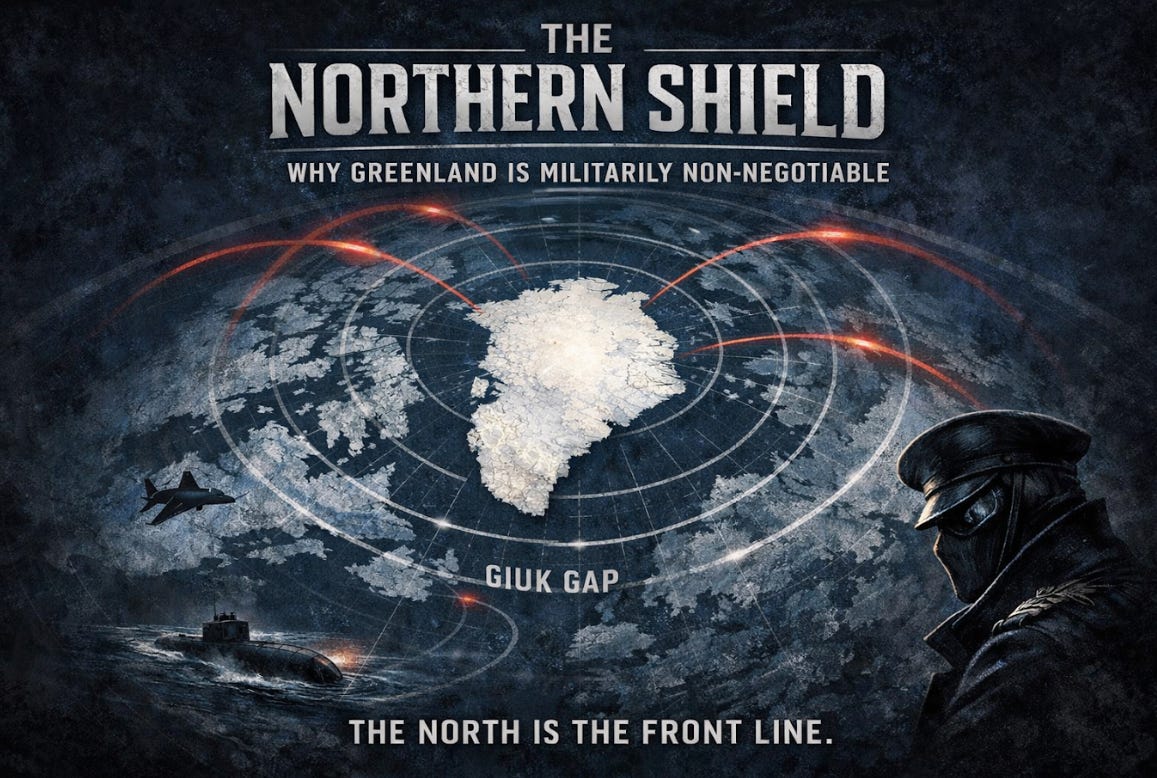
They think climate headlines, mineral maps, shipping lanes, and political theatre. They imagine a distant place that belongs in policy papers and documentaries, not in war rooms or command briefings.
That is the civilian lens.
The military lens is colder. It has to be.
Greenland is not a territory.
It is a system.
It is early warning time.
It is reaction margin.
It is the difference between knowing and guessing.
In modern warfare, the most decisive victories do not begin with explosions. They begin when one side controls detection, controls timing, and therefore controls the sequence of decisions that follow.
Greenland is where that sequence is either preserved or lost.
⸻
Greenland Is Not a Territory
It Is a Shield System
Stop thinking like a voter.
Start thinking like a commander.
Greenland does not matter because it is beautiful or remote. It matters because of where it sits, and what that position allows.
From a strategic standpoint, Greenland turns North America from a surprised target into a defended continent.
When military planners look at Greenland, they do not see a country. They see a platform.
A platform for sensors.
A platform for response.
A platform for denial.
And critically, a platform that cannot be moved out of the way.
As reaction time shrinks and ambiguity becomes lethal, fixed geography regains its old power. Greenland is one of the few places on Earth where geography still dictates outcomes.
⸻
Geography Is the First Weapon
The North Is the Real Front Door
Threats do not approach North America east to west.
They approach over the pole.
Strategic weapons follow the shortest path across the globe. On any serious defense map, those great-circle routes arc through the Arctic corridor whether politicians like it or not.
This is why serious North American defense planning begins at the pole, not at the coastline.
Ballistic missiles, long-range bombers, and advanced strike systems obey geometry. They are indifferent to borders, speeches, and diplomatic assurances.
The Arctic is not the edge of the map.
It is the front door.
And Greenland sits exactly where the lock belongs.
⸻
Greenland’s Role in Nuclear Deterrence
Seeing the Strike Before It Arrives
Every defense system rests on a basic truth.
You cannot stop what you cannot see.
Greenland hosts critical early-warning and surveillance infrastructure because the northern approach is where strategic threats appear first. That reality has shaped continental defense planning for decades. Facilities like Thule Air Base were not placed there by accident or symbolism.
In a nuclear or near-nuclear scenario, the difference between control and catastrophe is measured in minutes, sometimes less.
Detection must happen early.
Classification must happen fast.
Command authority must have time to verify before acting.
When warning time collapses, escalation becomes emotional instead of deliberate.
Greenland preserves the margin that keeps deterrence stable rather than brittle.
⸻
Hypersonics Changed the Equation
Why Greenland Matters More Now Than Ever
Ballistic missiles made Greenland important.
Hypersonic systems make it indispensable.
Hypersonic weapons fly lower, maneuver in flight, and compress decision time to the point where hesitation becomes fatal. Their defining feature is not speed alone. It is their ability to strip away choice.
Traditional radar networks struggle with this reality. Arctic-based forward sensors are no longer optional additions. They are foundational.
The north is where these threats emerge.
Greenland is where tracking improves.
Greenland is where classification happens sooner rather than too late.
Without Greenland, North America reacts behind the curve.
With it, decision-makers retain agency.
⸻
The Arctic Is Now a Military Theater
From Frozen Buffer to Contested Battlespace
The Arctic is no longer a quiet buffer zone.
Russia has heavily militarized its northern posture, operating airfields, radar sites, and submarine forces beneath permanent ice cover. China, meanwhile, seeks access through economic language, branding itself a “near-Arctic power” to normalize its presence.
Great-power competition does not leave territory neutral for long.
Greenland sits at the intersection of that competition, anchoring the Arctic to the North Atlantic and to North America. If the Arctic becomes a contested battlespace, Greenland becomes the command node by default.
⸻
The GIUK Gap
Why Greenland Locks the Atlantic
The GIUK Gap refers to the maritime chokepoint formed by Greenland, Iceland, and the United Kingdom.
For generations, it has been central to controlling submarine access to the Atlantic. Submarines are not merely naval assets. They are strategic weapons, carrying deterrence, surveillance, and escalation potential.
If Greenland is strong, the gap is monitored.
If Greenland weakens, the Atlantic opens.
An open Atlantic is not just a naval concern. It becomes an economic vulnerability, an infrastructure risk, and a homeland problem.
The north connects to everything.
⸻
Greenland as an Unsinkable Platform
Fixed Geography Beats Mobile Power
Aircraft carriers project power because they move.
Greenland controls space because it does not.
Mobile power shows presence.
Fixed power shapes the battlespace.
Greenland functions as an unsinkable platform for persistent surveillance, logistics, and deterrence. It provides continuity when everything else becomes contingent.
Great powers fight for fixed geography for a reason.
Greenland is continuity.
⸻
The China Factor
Influence Can Be as Dangerous as Occupation
Modern conquest rarely announces itself with troops.
It arrives quietly.
Investment.
Infrastructure.
Ports.
Telecommunications.
In a contested world, infrastructure is never neutral.
A port becomes leverage.
Leverage becomes access.
Access becomes compromise.
China does not need to invade Greenland to create strategic risk. Economic dependence and long-term positioning near sensitive sites are enough.
That is how influence works in the twenty-first century.
⸻
Shared Control Is a Strategic Risk
The Limits of Denmark and Alliance Assumptions
Greenland is politically tied to Denmark.
Militarily, Denmark cannot carry Greenland’s full strategic burden alone. That is not a criticism. It is arithmetic.
Arctic defense is expensive. Persistent surveillance, hardened infrastructure, rapid response, and modern sensor networks require resources that strain even large states.
Shared authority also slows decisions.
In a hypersonic age, slow becomes dangerous.
Hesitation creates gaps.
Gaps invite pressure.
⸻
Where Trump Fits
A Symptom, Not the Subject
Greenland was strategically decisive long before Donald Trump spoke about it.
Trump matters here only because he said aloud what defense planners already understood. He did not invent Greenland’s importance. He dragged it into public view.
Trump is the flare.
Greenland is the terrain.
⸻
The Canadian Implication
Greenland as Shield, Canada as Depth
If Greenland is the forward shield of North America, Canada is the depth behind it.
Depth matters.
As Arctic threats increase, Canada’s north becomes operational space. Radar coverage, air corridors, infrastructure choices, and investment policy all turn into strategic variables.
If Canada underfunds Arctic defense or treats sovereignty as symbolism, the United States will compensate out of necessity.
Not out of hostility.
Out of survival.
Weak depth becomes an operational problem whether Ottawa acknowledges it or not.
⸻
The General’s Assessment
What the Map Is Saying
Greenland is decisive because it preserves:
Early warning time
Deterrence stability
Arctic dominance
Atlantic control
Strategic continuity
This is not alarmism.
It is map reading.
Geography does not care about politics.
⸻
The North Is the Front Line
The Arctic is not coming.
It is already here.
Greenland is not symbolic.
It is structural.
Nations that understand this will prepare quietly.
Those that do not will learn through pressure, not persuasion.
This is not fear.
This is reality.
The north is the front line.
Greenland is the hinge.
And Canada is closer to the edge than it has admitted.
—The Iron Quill
Given how ten years have all but devastated our Canadian Armed Forces, the likelihood of Canada being able to defend the Arctic we claim is effectively nil.