
Death Outside Tim Hortons

Canada did not descend into darkness in one dramatic moment.
It arrived through policy, paperwork, clinical language, and enough bureaucratic fog to make moral collapse sound like administration.
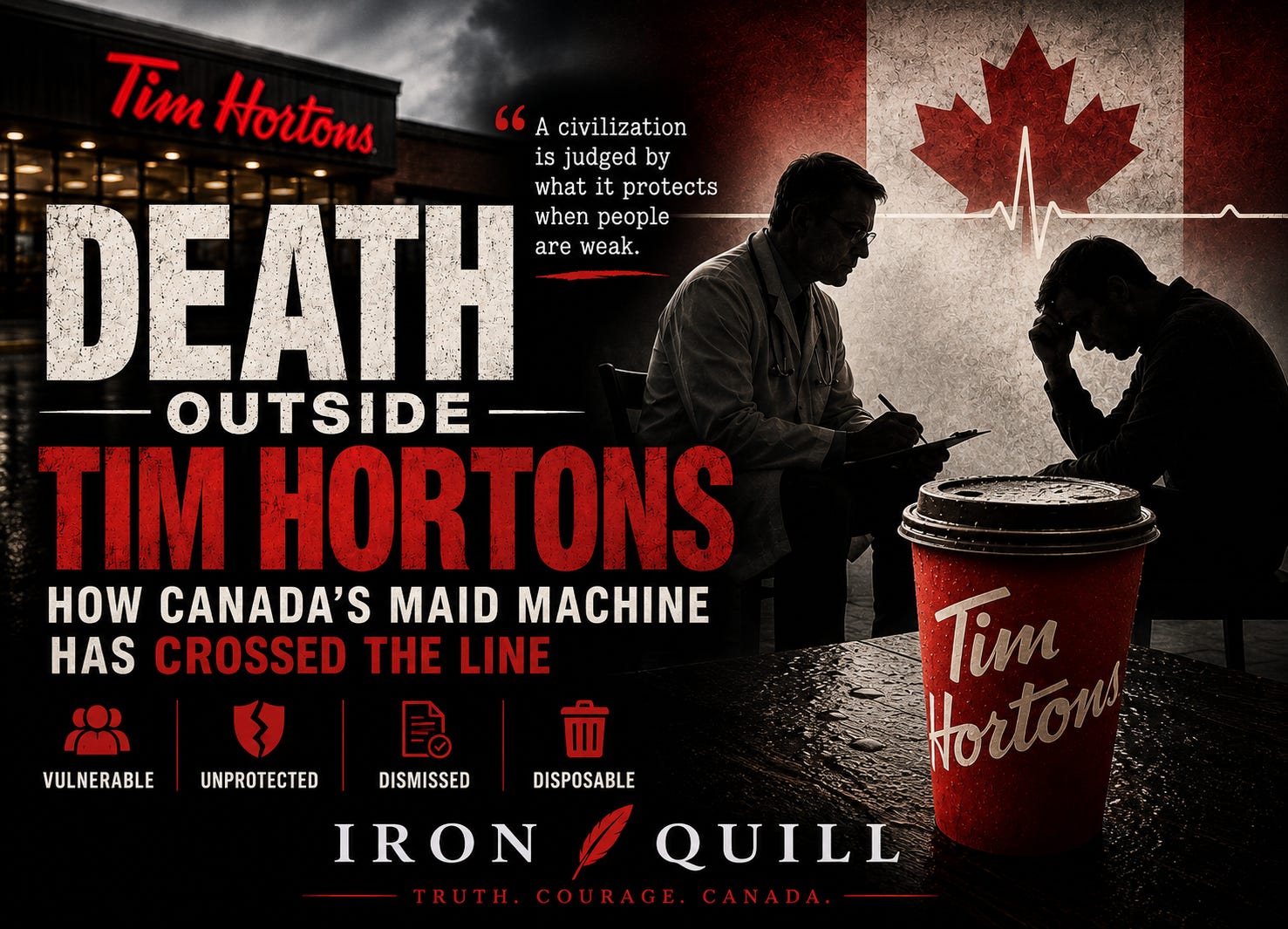
Now Canadians are staring at a headline that should stop the country cold: an Ontario man died through MAID after being assessed outside a Tim Hortons.
That sentence should not belong in a civilized nation.
According to the report, the case involved a London, Ontario doctor who assessed a man with inflammatory bowel disease and a history of mental health concerns in an informal public setting, then later drove him to the location where his life ended. The same report says the doctor agreed to at least six months of supervision after complaints reviewed by Ontario’s medical regulator.
This is not a small procedural matter.
This is the sound of a country losing its ability to blush.
The Image Canada Cannot Escape
Some details become symbols.
A Tim Hortons is ordinary Canadian life. It is shift workers, hockey parents, truck drivers, seniors, students, farmers, and tired people grabbing coffee before the day begins.
That is what makes this story so jarring.
A MAID assessment outside a Tim Hortons is not merely a question of setting. It is a national mirror.
It shows how casual the machinery can become once death is wrapped in official language long enough.
A society that still understands human dignity should recoil at that image. Not because suffering is fake. Not because pain is simple. Not because every case is the same.
Because death should never become casual.
From Compassion to Procedure
Canadians were told MAID would be rare.
They were told it would be controlled.
They were told it would be surrounded by safeguards, solemnity, caution, and restraint.
But the language has grown colder. The boundaries have moved. The public discomfort has been managed. The critics have been painted as cruel. Every new line is defended as if it had always been there.
That is how a nation is changed.
Not all at once.
Through normalization.
First the country accepts the exception. Then it builds a system around the exception. Then it trains professionals to administer the system. Then it tells ordinary people they are ignorant or hateful for noticing what the system has become.
The great danger of MAID was never only that some people would choose death.
The danger was that institutions would begin to see death as an answer.
The Vulnerable Were Supposed to Be Protected
The man at the centre of this case was reportedly in his forties, dealing with serious illness, isolation, dependence on family support, a history of mental illness, and substance-use issues. The report also raised concerns about family input and documentation.
That matters.
Because freedom is not always clean.
A person can be suffering and still need protection. A person can be exhausted and still need someone to stand between him and a permanent decision. A person can say yes from a place of despair, loneliness, pressure, fear, shame, or weariness.
That is why safeguards are supposed to matter.
That is why formality matters.
That is why family concerns matter.
That is why a society must move slowly around the vulnerable.
Because when the state gets this wrong, there is no appeal.
Oversight Without Teeth
The doctor was reportedly cautioned, placed under supervision, subject to chart reviews, and ordered into professional education.
Canadians have a right to ask whether that is enough.
When a doctor is found to have shown lack of judgment in multiple reviewed charts, when a MAID assessment is conducted in an informal public setting, when professional boundaries are questioned, and when a vulnerable man ends up dead, the answer cannot be hidden behind process language.
This is where the system reveals itself.
Bureaucracies are skilled at absorbing scandal. They convert moral failure into administration. They do not say a line was crossed. They say education was required. They do not say public trust has been damaged. They say monitoring requirements have been imposed.
They do not say the machine may be too dangerous for the vulnerable.
They say the matter has been addressed.
That is not accountability.
That is containment.
When Procedure Fails
The same reporting describes another case involving the same doctor where a patient reportedly resumed breathing after being pronounced dead.
That allegation does not need theatrics.
It needs answers.
Public trust depends on more than slogans about compassion. It depends on competence, seriousness, restraint, and a system that understands the gravity of what it is doing.
If that system fails, Canadians deserve more than professional development and committee language.
They deserve truth and accountability.
They deserve to know whether the safeguards they were promised are real, or whether they are paper shields around a machine already in motion.
Canada’s Moral Inversion
Official Canada loves to speak the language of compassion.
But compassion without moral limits becomes abandonment.
It becomes the soft voice of the institution telling the suffering person that their despair is reasonable, their burden is understandable, and their exit can be arranged.
That is not mercy.
Mercy sits with the suffering. Mercy fights for the lonely. Mercy brings treatment, family, prayer, patience, pain management, counselling, shelter, food, and hope.
Mercy does not meet despair outside a coffee shop and help move it toward death.
A country is not compassionate because it makes death available.
A country is compassionate when it makes life bearable.
That is the test Canada is failing.
The Quill’s Verdict
This story is not about mocking the suffering.
It is about defending them.
It is about saying the sick, the lonely, the mentally wounded, the addicted, the poor, the dependent, and the exhausted are not problems to be processed.
They are people to be carried.
Once a nation forgets that, the paperwork becomes a veil over something much darker.
Canada does not need better branding around MAID. It does not need colder language. It does not need another expert panel to explain why ordinary people should stop being disturbed.
Canada needs to remember that human life is not a service file.
A man reportedly assessed outside a Tim Hortons is now dead.
Another case reportedly went wrong in a way that should shake every regulator in the country.
And Canadians are expected to accept this as another administrative matter.
No.
A civilization is judged by what it protects when people are weak, sick, dependent, lonely, costly, afraid, and hard to carry.
That is where the truth comes out.
And Canada must decide what it is becoming.
Because when death can be assessed in the shadow of a coffee shop and explained afterward in the language of oversight, the scandal is not only what happened there.
The scandal is that a nation built a machine capable of making it seem normal.
—The Iron Quill
The Iron Quill is reader-supported.
Most of this work remains free because truth should travel.
If you believe in the mission, become a paid supporter and help keep the signal alive.
I see euthanasia (MAID) as being a natural extension of the satanic gubbermint's anti-human agenda. They make sacrifices to Moloch to ensure they remain in power.
Isn't this how it always happens from gays coming out of the closet to what we have now?
MAID for terminally ill people to what is happening now.
Canada's culture is a death culture. Whether canadians are guilty of worshiping death, accepting death so easily or not caring, our country revels in death.
From unrestricted abortions to MAID, Canada's culture is death. How can we ever expect God to bless a nation such as ours? We can't.
Thank goodness for a remnant who stand loyal to Gods Word, Gods Son Jesus and who proclaim ceaselessly Gods commandments.