
Daniel in Babylon
How to Stand Faithfully in a Culture That Has Forgotten God

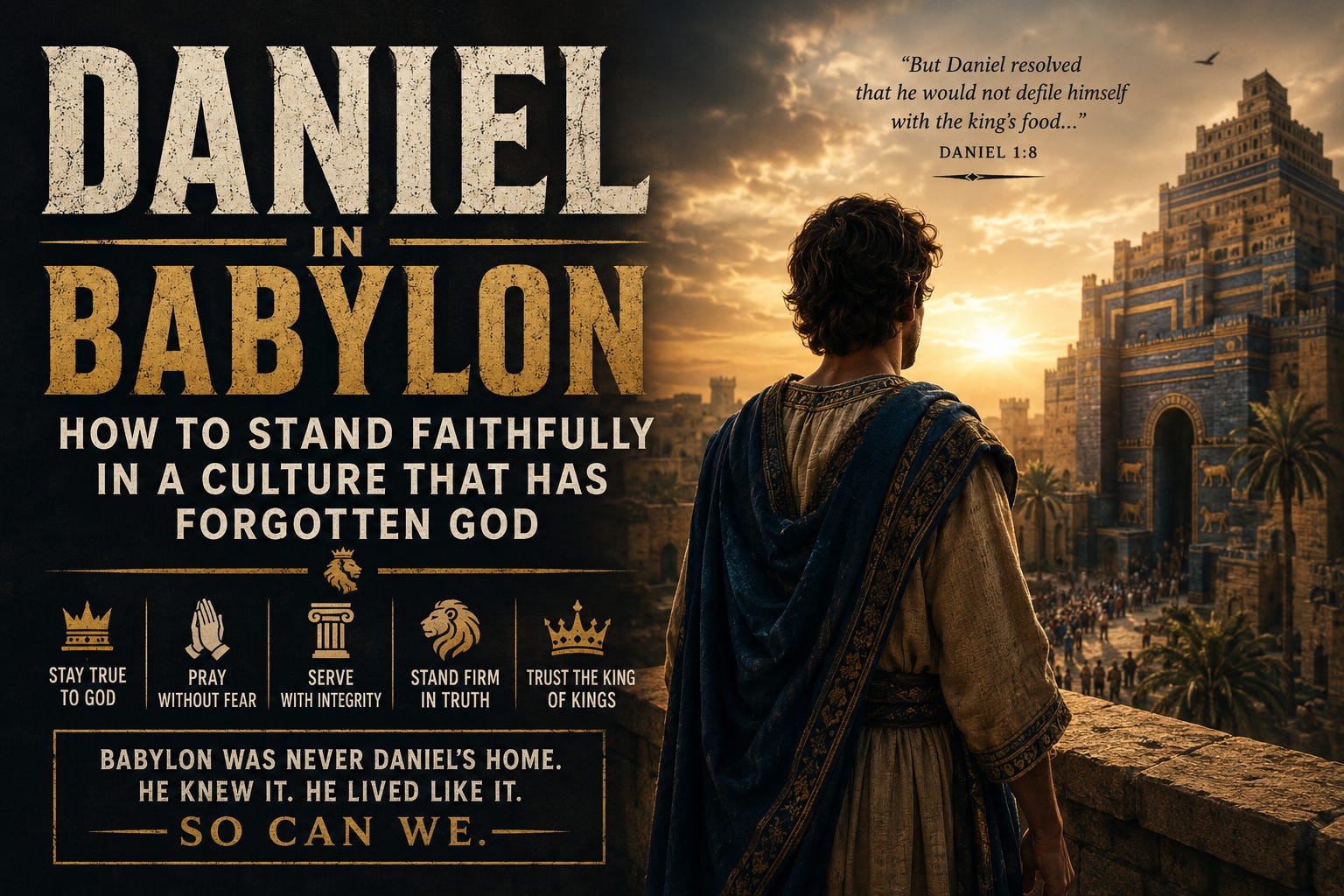
Many Christians today feel like strangers in their own country.
They look around and see a culture changing beneath their feet. Things once understood as basic truth are now treated as hateful. Convictions once considered normal are now treated as dangerous. Faith that once shaped public life is increasingly pushed into private corners, as though belief in God is acceptable only if it never speaks, never challenges, and never interferes with the direction of the age.
This feeling is not new.
God’s people have faced this before.
Long before our generation ever wrestled with secularism, compromise, political pressure, moral confusion, and cultural exile, a young man named Daniel was carried away into Babylon.
He was removed from his homeland.
Removed from the temple.
Removed from the culture that formed him.
Removed from the rhythms, customs, and public life of Judah.
Then the empire tried to remake him.
That is where the book of Daniel begins. Not with lions. Not with dreams. Not with statues. Not with fire falling from heaven.
It begins with exile.
Daniel was not living in a culture that supported his faith. He was living in a culture that wanted to absorb it, rename it, educate it, manage it, and eventually bend it.
That is why Daniel matters.
His story is not merely about surviving Babylon.
It is about refusing to let Babylon survive inside him.
Babylon Wanted Daniel’s Loyalty Before It Wanted His Worship
Daniel 1 opens with a devastating scene.
Judah has fallen. Jerusalem has been taken. The vessels of the house of God have been carried into the treasury of a pagan god. Young men from the royal family and nobility are selected for service in the king’s palace.
Daniel was among them.
Babylon did not begin by throwing Daniel into a lion’s den.
It began by enrolling him.
Teaching him.
Feeding him.
Renaming him.
Training him.
The empire understood something many modern people forget.
If you can reshape a person’s identity, you can often reshape their allegiance.
Daniel and his friends were taught the language and literature of the Chaldeans. Their Hebrew names, which carried meaning connected to the God of Israel, were replaced with Babylonian names connected to another culture and another system of worship.
This was not random.
It was formation.
Babylon was not merely trying to use Daniel’s abilities. It was trying to redefine the source of his identity.
That is how compromise often begins.
Not with a demand to bow.
Not with a threat of death.
Not with a public confrontation.
Often, it begins quietly.
A new language.
A new set of assumptions.
A new reward system.
A new definition of success.
A new name.
A new pressure to fit in.
The world does not always ask believers to deny God immediately. Sometimes it simply asks them to live as though God is no longer the centre.
That is more subtle.
And in many ways, more dangerous.
Daniel Drew the Line Early
One of the most important verses in the opening chapter is Daniel 1:8:
“But Daniel resolved that he would not defile himself with the king’s food, or with the wine that he drank.”
Daniel resolved.
Those two words carry weight.
He did not drift into faithfulness.
He did not wait until the pressure became unbearable.
He did not decide in the moment.
He resolved.
Before the lion’s den, before the visions, before the rise and fall of kings, before the dramatic moments everyone remembers, Daniel made a quiet decision about compromise.
He drew the line early.
This was not about vegetables being holier than meat. It was about allegiance. It was about remaining faithful in a system designed to absorb him. It was about refusing to let Babylon set the terms of his obedience to God.
That is where many believers lose the battle.
Not in the big public test.
In the small private surrender.
A little silence here.
A little compromise there.
A little reshaping of language.
A little embarrassment over Scripture.
A little willingness to laugh at what dishonours God.
A little fear of standing apart.
Then one day, the larger test comes, and the conviction has already been weakened.
Daniel’s strength in the lion’s den did not begin with lions.
It began at the table.
Faithfulness usually begins long before the crisis.
Daniel Served the Government Without Worshipping It
One of the most overlooked parts of Daniel’s life is that he served inside pagan governments.
He did not live in a Christian nation.
He did not serve under kings who shared his faith.
He did not have leaders who honoured the God of Israel.
Yet Daniel worked with excellence.
He served with integrity.
He became trusted.
He advised kings.
He interpreted dreams.
He held responsibility.
He did not use Babylon’s corruption as an excuse for laziness, bitterness, or rebellion.
That lesson is easy to miss.
Daniel did not worship the empire.
But he did serve faithfully where God placed him.
There is a difference.
Christians are not called to be careless citizens simply because the culture is compromised. We are not called to abandon excellence because the system is flawed. We are not called to become useless because the world is dark.
Daniel shows another path.
Work faithfully.
Serve honestly.
Speak truth when required.
Refuse idolatry.
Keep your allegiance clear.
That balance is desperately needed.
Some people compromise so deeply with the culture that no one can tell the difference between them and Babylon.
Others withdraw so completely that they no longer serve, witness, build, or influence anything at all.
Daniel did neither.
He stood in Babylon without becoming Babylonian.
He served kings without treating kings as God.
A Christian can honour authority without making authority ultimate.
A Christian can serve in a broken system without surrendering their soul to it.
A Christian can live in Babylon and still belong to the Kingdom of God.
The Lion’s Den Was Not About Lions
Most people know the story of Daniel and the lion’s den.
It is one of the most familiar accounts in Scripture.
But the lions are not the main point.
The miracle is powerful, but the real issue begins before Daniel ever sees the den.
Daniel’s enemies could find no corruption in him. They could not accuse him of dishonesty. They could not find negligence in his work. His integrity was so consistent that they realized the only way to trap him was through his faith.
That alone should make believers pause.
Could the same be said of us?
If the world wanted to accuse us, would they have to attack our faith because our conduct was otherwise faithful?
Daniel’s enemies convinced the king to sign a decree that no one could pray to any god or man except the king for thirty days.
This was the test.
A temporary compromise.
Just thirty days.
Daniel could have reasoned his way around it.
He could have prayed silently.
He could have closed the windows.
He could have changed his routine.
He could have told himself that God would understand.
He could have argued that he needed to protect his position so he could keep influencing Babylon from within.
But Daniel did what he had always done.
He went to his house.
He opened his windows toward Jerusalem.
He got down on his knees three times a day.
He prayed and gave thanks before his God, as he had done previously.
That final phrase matters.
As he had done previously.
Daniel did not create a public spectacle.
He did not perform courage for attention.
He simply refused to let a godless decree interrupt his obedience to God.
His public courage was built through private obedience.
That is why he was ready when the test came.
Many people want lion’s den courage without prayer-room faithfulness.
But Daniel’s courage was not manufactured in the crisis.
It was formed in the daily rhythm of devotion.
He knew who he served before the law changed.
He knew who ruled before the king signed the decree.
He knew where his allegiance belonged before the lions roared.
Babylon Eventually Fell
Babylon looked permanent.
Every empire does when it is at the height of its power.
Its walls seemed secure.
Its wealth seemed endless.
Its authority seemed unquestionable.
Its kings spoke as though history belonged to them.
But Babylon fell.
That truth runs through the book of Daniel.
Earthly kingdoms rise.
Earthly kingdoms boast.
Earthly kingdoms demand loyalty.
Earthly kingdoms build statues.
Earthly kingdoms issue decrees.
Earthly kingdoms threaten those who will not bow.
Then eventually, earthly kingdoms fall.
God remains.
One of the reasons Christians panic is because we forget how temporary human power really is. We look at governments, institutions, courts, corporations, media systems, and cultural movements as though they are eternal.
They are not.
They may be powerful.
They may be influential.
They may cause real damage.
They may pressure the faithful.
But they are not eternal.
Babylon was not eternal.
Rome was not eternal.
Every kingdom of man eventually discovers what Daniel already knew.
There is a King above kings.
There is a throne above thrones.
There is a kingdom that cannot be managed, manipulated, voted out, conquered, censored, or destroyed.
Daniel did not need Babylon to fall in order to be faithful.
His obedience was not dependent on immediate victory.
He served God while Babylon still stood.
He prayed while Babylon still ruled.
He remained faithful while wicked men still held power.
Christians need to remember that.
Faithfulness is not something we postpone until the culture improves.
We are called to obey God now.
In the confusion.
In the pressure.
In the exile.
In the Babylon of our own age.
What Babylon Looks Like Today
We should be careful not to flatten Scripture into a cheap comparison.
Babylon was a real empire.
Daniel was a real man.
The exile was a real judgment and a real historical moment in the life of God’s people.
But Babylon also represents something that appears again and again in human history.
Pride.
Idolatry.
Power without humility.
Wealth without repentance.
Knowledge without wisdom.
Government without God.
Culture that seeks to redefine identity.
Rulers who confuse authority with divinity.
Systems that tolerate faith only when faith stays silent.
That spirit did not disappear when ancient Babylon fell.
It appears wherever man tries to build a world without God and then demands that everyone else bow to it.
Modern Babylon does not always look like a golden statue.
Sometimes it looks like comfort.
Sometimes it looks like career advancement.
Sometimes it looks like social acceptance.
Sometimes it looks like fear of being mocked.
Sometimes it looks like a government asking people to place conscience beneath decree.
Sometimes it looks like a culture that tells Christians they can believe whatever they want privately, as long as they never speak publicly.
That is not tolerance.
It is containment.
Daniel’s life reminds us that faith cannot be contained that way.
Not because believers are trying to dominate the world.
Not because Christians should be reckless or arrogant.
But because God is not a private hobby.
He is Lord.
And if He is Lord, then our allegiance to Him cannot be confined to one hour on a weekend or one quiet corner of the heart.
It must shape how we live.
How we speak.
How we work.
How we refuse.
How we endure.
Daniel’s Greatest Legacy
Daniel is remembered for many things.
Wisdom.
Dreams.
Visions.
Prophecy.
The lion’s den.
Service under kings.
But perhaps his greatest legacy is simpler than all of that.
Babylon never got him.
It took him from his homeland, but it did not take his God.
It changed his name, but it did not change his allegiance.
It trained his mind, but it did not capture his worship.
It threatened his life, but it did not break his obedience.
That is victory.
Not the kind of victory the world always recognizes.
Daniel did not overthrow Babylon.
He did not reclaim Judah by force.
He did not build a movement around his own name.
He simply remained faithful.
Year after year.
King after king.
Pressure after pressure.
Test after test.
That kind of faithfulness is rare.
It is also powerful.
Many Christians want dramatic moments. We want clear victories, visible vindication, and immediate answers. But much of the Christian life is not dramatic. It is steady.
Pray.
Obey.
Work.
Refuse compromise.
Speak when called.
Repent when needed.
Endure when tested.
Trust God with the outcome.
That was Daniel’s life.
And it is still the calling of God’s people today.
We Are Called To Stand
Christians were never promised an easy culture.
Jesus did not tell His followers the world would always understand them. He did not promise that obedience would always be rewarded by society. He did not say faithfulness would guarantee comfort, influence, or applause.
He told His people to follow Him.
That remains the call.
In a world that wants to rename everything, we remember who we are.
In a culture that wants to redefine truth, we remain anchored in the Word of God.
In a system that wants private faith and public silence, we live with humble conviction.
In an age that treats compromise as wisdom, we draw the line where obedience requires it.
Daniel did not panic.
He did not compromise.
He did not hate Babylon.
He did not worship Babylon.
He served faithfully, prayed openly, spoke truthfully, and remembered that no earthly kingdom lasts forever.
The lesson is not fear.
It is faithfulness.
It is not rage.
It is resolve.
It is not retreat.
It is obedience.
Babylon was never Daniel’s home.
He knew it.
He lived like it.
And perhaps that is the lesson Christians need to remember now.
We may live in a culture that has forgotten God.
But we do not have to forget Him with it.

If today’s article challenged, informed, or encouraged you, I would ask you to consider standing with this work.
In the coming weeks, I have an opportunity to represent the concerns of everyday Canadians in an important conversation. Your support helps make that possible.
If you believe independent, faith-driven journalism still matters, please consider clicking the Stand With The Quill button below.
Thank you to everyone who has already stood behind this mission. Your support is making a difference.