
Consider Your Ways

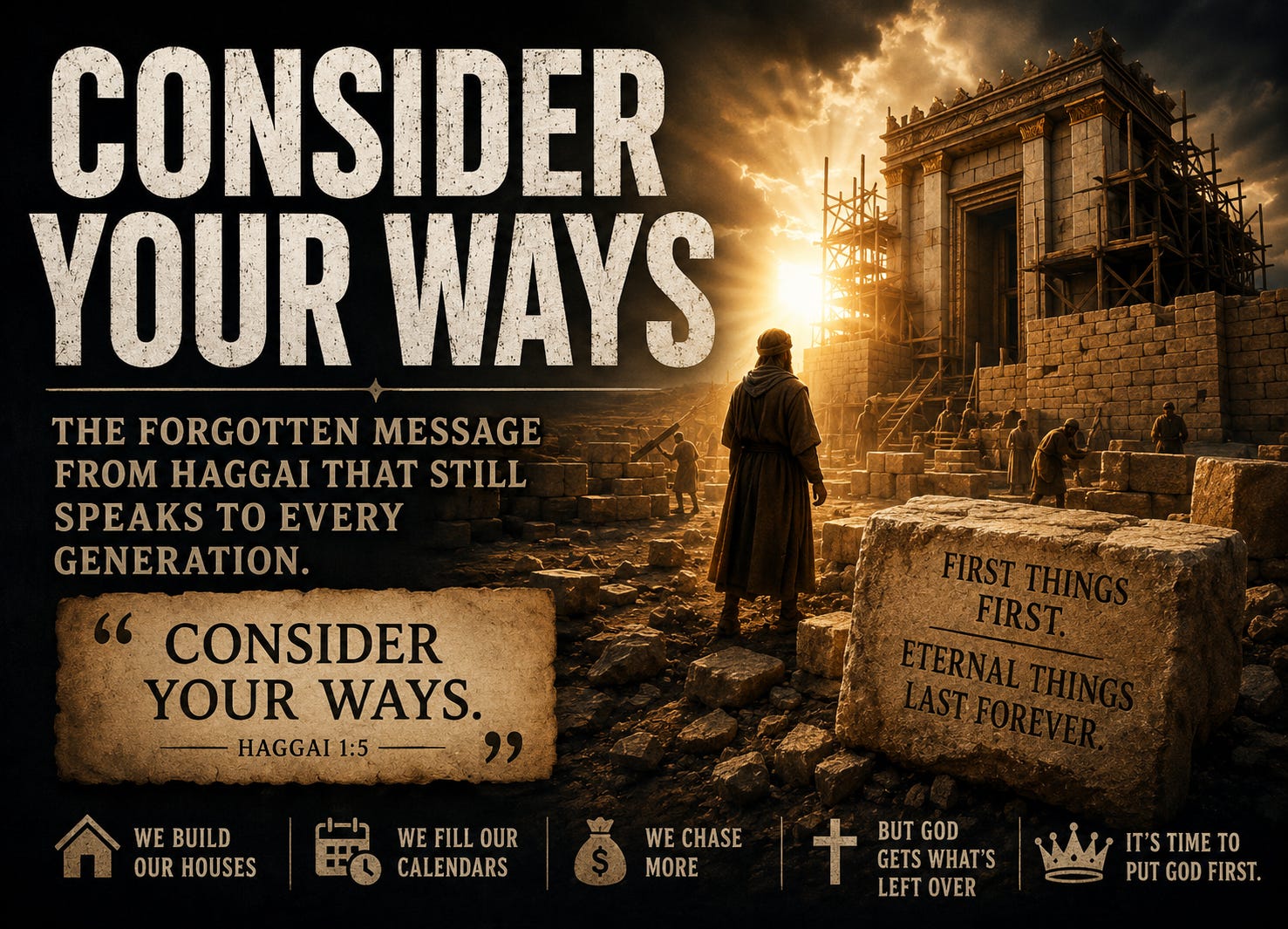
Some books of the Bible thunder from the mountain.
Others speak in a shorter voice.
Haggai is one of those books.
It is not long. It is not complicated. It does not require the reader to untangle generations of history before understanding the warning. It is direct, clear, and uncomfortable.
That may be why we avoid it.
Haggai speaks to people who had come home but had not returned to God with their whole heart. They had escaped exile. They had been given another chance. They had land, houses, work, opportunity, and time.
But something was wrong.
The people were busy building their own lives while the house of the Lord remained neglected.
They had not abandoned God with their mouths.
They had simply placed Him second with their lives.
That is a quieter kind of rebellion.
It is also a very common one.
A Forgotten Prophet With a Timeless Warning
Many Christians know Isaiah.
Many know Jeremiah.
Many know Daniel.
Few spend much time in Haggai.
Yet sometimes the shortest books carry the sharpest warnings.
Haggai spoke after the people of Judah returned from exile. They were no longer captives in Babylon. They had been allowed to go back to Jerusalem. The door had opened. The punishment of exile had not been the end of the story.
God had shown mercy.
But mercy was not meant to lead them back into comfortable neglect. It was meant to lead them back into obedience.
The temple was still unfinished. The work of God had stalled. The people had explanations. They had reasons. They had schedules, burdens, distractions, pressures, and practical concerns.
They said the time had not yet come to rebuild the Lord’s house.
But the Lord saw the truth beneath the excuse.
They had time for their own houses.
They had energy for their own comfort.
They had resources for their own priorities.
The problem was not that they had no time.
The problem was what came first.
The Question God Asked
Through Haggai, God gave them a simple command.
Consider your ways.
Not your enemies, politicians, economy, or excuses.
Your ways.
That is where biblical correction usually begins. Not with the crowd. Not with the culture. Not with the people we already think are wrong.
With us.
That is what makes Haggai so uncomfortable. It does not allow the reader to stay safely outside the warning. It reaches into the daily life of God’s people and asks what their choices are really saying.
What receives your first attention?
What gets your best effort?
What do you protect most fiercely?
What do you make time for no matter how busy you are?
What gets postponed?
What gets neglected?
What gets whatever is left over?
Those questions reveal more than our words ever could.
A man can say God is first while giving Him the scraps of his time.
A family can say faith matters while building every schedule around everything else.
A church can say Christ is Lord while becoming more concerned with comfort, branding, programs, and approval than obedience.
A nation can say God is part of its heritage while rejecting His authority in practice.
Haggai cuts through the language.
Consider your ways.
The Illusion of More
The people in Haggai’s day were not lazy.
They were working, planting, eating, drinking, and earning wages.
But nothing satisfied.
They planted much and harvested little. They ate but were not filled. They drank but were not satisfied. They earned wages only to put them into a bag with holes.
That image is painfully clear.
A bag with holes.
The more they placed into it, the more it slipped away.
There are generations that understand that image very well.
People work harder and feel further behind. They earn more and feel poorer. They consume more and feel emptier. They fill their houses and still lack peace. They chase comfort and become more anxious. They gain access to every distraction imaginable and lose the ability to be still before God.
This does not mean every financial hardship is direct punishment from God.
Scripture is not that shallow.
The righteous suffer. The faithful endure trials. The poor are not automatically guilty, and the wealthy are not automatically blessed.
But Haggai does show us a principle we would be foolish to ignore.
A life with disordered priorities will never be satisfied by more.
More money will not fix a soul that has placed God last.
More comfort will not heal a heart that has grown cold.
More entertainment will not quiet a conscience that needs repentance.
More success will not bring peace to a life built around self.
When God is pushed to the edge, the centre does not hold.
That is true for people, families, churches, and nations.
The Danger of Comfortable Neglect
The people were not bowing before some foreign idol in the streets.
They were not openly declaring war against God.
They were simply occupied.
That is what makes the warning so relevant.
Many people do not reject God dramatically. They drift from Him practically.
They still believe.
They still know the language.
They still approve of faith in theory.
But the calendar says something else.
The bank account says something else.
The habits say something else.
The priorities say something else.
They are not angry at God.
They are just too busy for Him.
That may be one of the great spiritual dangers of our age. Not open atheism. Not loud rebellion. Not even mockery from the world.
Distraction.
A comfortable, distracted life can do what persecution often cannot. It can make God’s people forget what matters without ever forcing them to deny it out loud.
The people in Haggai’s day had returned to the land, but their hearts still needed to return to the Lord.
That is a warning every believer should take seriously.
It is possible to be near the things of God while neglecting God Himself.
It is possible to have a Bible in the house and no hunger for the Word.
It is possible to attend church and still live with God pushed to the margins.
It is possible to speak Christian language while building a life where Christ is not truly first.
That is not a comfortable thought.
But it is a necessary one.
A Warning for the Church
It is easy to aim Haggai at the culture.
That is the safer application.
We can look around and say the nation has forgotten God. We can point to the corruption, confusion, pride, greed, lawlessness, and rebellion. We can say society has built its own houses while leaving the things of God in ruins.
There is truth in that.
But Haggai was not first spoken to Babylon.
It was spoken to God’s people.
That matters.
Before the church points at the world, it must consider its own ways.
Have we become more concerned with comfort than holiness?
Have we traded conviction for applause?
Have we built platforms while neglecting prayer?
Have we filled calendars while starving souls?
Have we softened truth because we wanted peace with a world that does not love God?
Have we become busy with religious activity while avoiding obedience?
These are not easy questions.
They are not meant to be.
The Word of God is not a decoration. It is a sword. It cuts. It exposes. It divides truth from excuse.
And sometimes the people most in need of correction are the ones most fluent in religious language.
That was true then.
It can be true now.
God Still Calls People Back
Haggai is not only a rebuke.
It is an invitation.
God was not finished with His people. He did not expose their priorities so He could crush them. He exposed their priorities so they could return.
The call to examine their ways was not a door closing.
It was a door opening.
That is the mercy of God.
He corrects because He is holy.
He calls because He is merciful.
He confronts because He is not content to leave His people asleep.
When the people responded, God stirred them to work. They obeyed. And then came one of the most beautiful promises in the book.
I am with you.
That is what the obedient heart needs most.
Not applause, comfort, popularity, or ease.
The presence of God.
The people had been chasing security through their own priorities, but true security was found in returning to the Lord.
That remains true.
A nation without God can build systems, but it cannot build peace.
A family without God can build a house, but it cannot build a foundation.
A man without God can build a career, but he cannot build a soul that stands when the storm comes.
We were not created to live with God as an accessory.
We were created to walk with Him.
The Message for Today
Haggai is not a newspaper.
It is not a codebook for modern headlines.
We do not need to force today’s events into the text to hear what God is saying through it.
The message is already clear.
Every generation faces the temptation to put urgent things ahead of eternal things.
Every generation finds excuses.
Every generation says the time has not yet come.
Not yet to repent, obey, forgive, pray, return, or put God first.
There is always another project. Another bill. Another crisis. Another distraction. Another reason to delay.
But delayed obedience eventually becomes disobedience.
That is one of the warnings of Haggai.
The people were not told that rebuilding their own houses was wrong. They were shown that building their own houses while neglecting God revealed a disordered heart.
That distinction matters.
Work, family provision, home building, and planning for the future are not wrong.
But when good things become first things, even good things can become idols.
That is where many lives go wrong.
Not because everything they pursue is evil.
But because everything is out of order.
Consider Your Ways
The words still stand.
Consider your ways.
Not as a slogan.
As a command.
Before we complain about what our nation has become, consider your ways.
Before we blame politicians, institutions, schools, media, churches, or culture, consider your ways.
Before we ask why everything feels empty, why more never satisfies, why peace seems so far away, consider your ways.
What has God been asking you to do that you keep delaying?
What has taken first place?
What have you built while neglecting Him?
What excuse has become comfortable?
What obedience has been postponed so long that it now feels normal?
These are the questions Haggai leaves with us.
And they are not meant for someone else.
They are meant for the reader.
They are meant for the church.
They are meant for anyone who still has ears to hear.
God does not call His people to examine themselves because He hates them.
He calls them because He is merciful.
He calls them because the bag has holes.
He calls them because the harvest is thin.
He calls them because the soul was never meant to survive on scraps while everything else receives the best.
The people of Haggai’s day had come home.
But God wanted more than their location.
He wanted their hearts.
That has not changed.
The question is not whether we can explain our busyness.
The question is whether we are willing to tell the truth about our priorities.
The Lord’s words remain as sharp now as they were then.
Consider your ways.

If today’s article challenged, informed, or encouraged you, I would ask you to consider standing with this work.
In the coming weeks, I have an opportunity to represent the concerns of everyday Canadians in an important conversation. Your support helps make that possible.
If you believe independent, faith-driven journalism still matters, please consider clicking the Stand With The Quill button below.
Thank you to everyone who has already stood behind this mission. Your support is making a difference.
Amen! We all too easily go through our days these ways. Lord, help us prioritize You first. In Jesus' Name!
I've never heard of Haggai before this article. What a fascinating rabbit hole! The shocking part is when Haggai spoke his prophecy, the people listened and took action.