
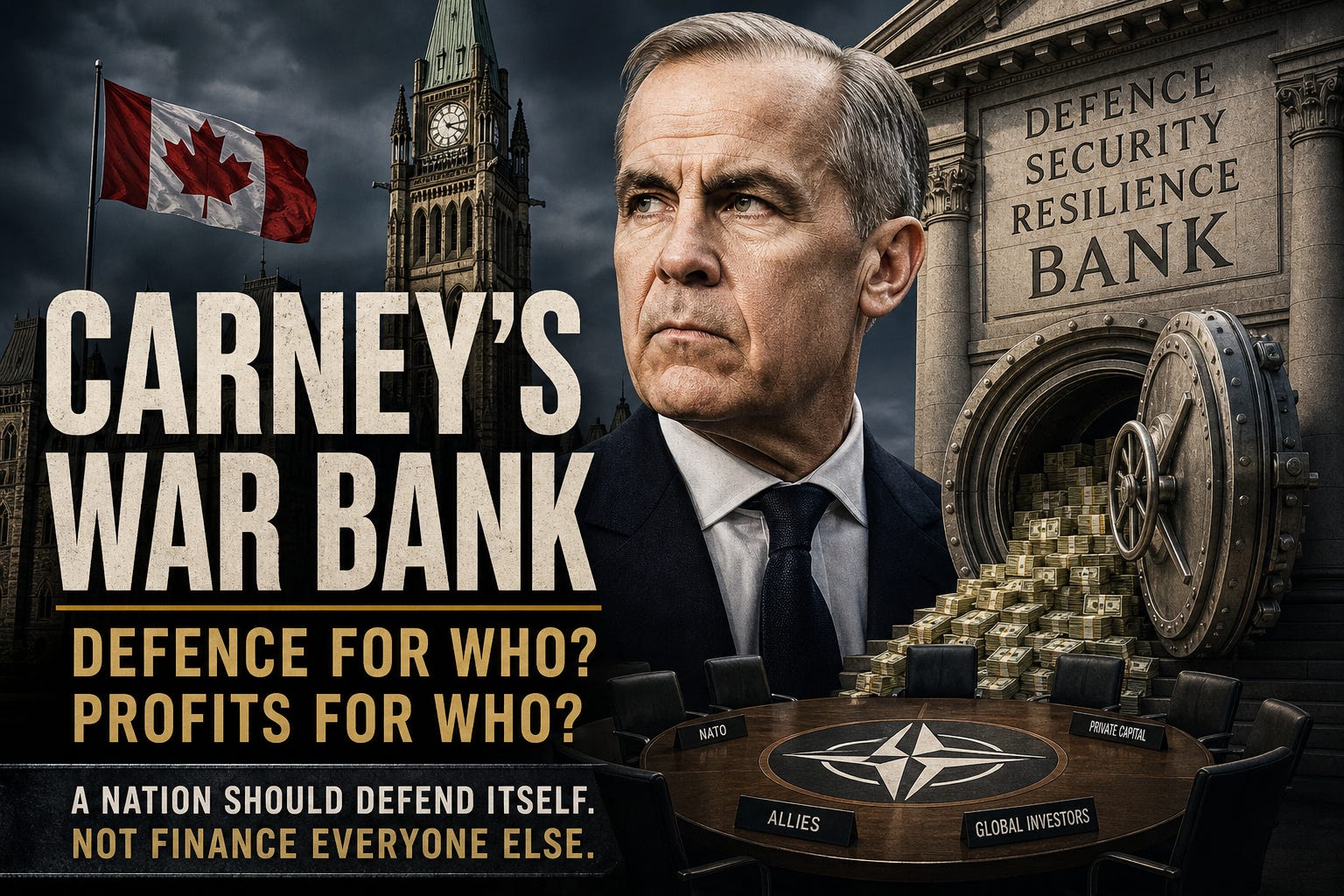
Carney’s War Bank

Canada was told Mark Carney would bring stability.
Instead, he is bringing the machinery of global finance into the centre of national defence.
Not a factory.
Not a shipyard.
Not a rebuilt military.
Not secured borders.
Not Arctic readiness.
A bank.
That is the part Canadians need to stop and look at.
Ottawa is now celebrating the fact that Canada will host the headquarters of a proposed NATO-linked defence financing institution called the Defence, Security and Resilience Bank.
The language sounds clean.
Defence.
Security.
Resilience.
Allied cooperation.
Shared values.
Preparedness for a dangerous world.
But buried beneath the polished words is something much more revealing.
Canada is not simply preparing to defend itself.
Canada is being positioned as the financial architecture for allied rearmament.
And under Mark Carney, that is not an accident.
It is the doctrine.
This is not just a defence story.
It is a Carney story.
It shows exactly how this government thinks. National strength is no longer built first through sovereign industry, domestic production, border control, energy security, military readiness, and loyalty to the people who live under the flag.
It is built through institutions.
Capital markets.
Debt structures.
Private financing.
Multinational coordination.
Global governance.
That is where Canadians should slow down.
Canada absolutely needs real defence: Arctic security, trained soldiers, functioning procurement, domestic production, ships, drones, radar, ammunition, and cyber capacity. Most of all, it needs the political will to use them.
The world is not safe. Hostile powers are not imaginary. Canada cannot drift through the next decade pretending geography, America, and good intentions will protect us forever.
But a sovereign nation does not rebuild itself by becoming the head office for a defence-financing bank while its own military remains hollowed out, its procurement system remains broken, its Arctic remains exposed, and its people remain financially crushed.
That is the contradiction.
And Canadians need to see it clearly.
What Ottawa Announced
Canada has announced that it will host the headquarters of the proposed Defence, Security and Resilience Bank.
The bank is being promoted as a multilateral financial institution meant to support defence, security, and resilience projects among allies.
That is the sales pitch.
It is supposed to help mobilize private capital. It is supposed to provide long-term, lower-cost financing. It is supposed to help defence production, supply chains, infrastructure, and military readiness across the allied world.
In plain English, the bank would use the credibility of allied governments to make defence-related borrowing cheaper and more attractive to private capital.
In plain language, this is a bank designed to help finance allied rearmament.
Not just Canadian rearmament.
Allied rearmament.
The proposed scale is massive. Reports have described the project as seeking to raise roughly £100 billion, or about $135 billion, with the goal of becoming a high-credit-rated financial institution for defence and resilience projects.
So let us be honest about what this is.
Canada is not merely supporting NATO.
Canada is positioning itself to host the financial machine.
Ottawa is not saying, “We are rebuilding the Canadian Armed Forces first.”
Ottawa is saying, “We are building the institution that finances the wider system.”
That distinction matters.
Because one is national defence.
The other is financial architecture.
And in the Carney era, architecture always comes before accountability.
The Word They Want You to Miss Is Bank
The branding is built around words Canadians are supposed to accept automatically.
Defence.
Security.
Resilience.
Allies.
Values.
Preparedness.
Those words are not meaningless. They matter. But they are not the most important word in this announcement.
The most important word is bank.
A bank does not defend a border.
A bank does not patrol the Arctic.
A bank does not train soldiers.
A bank does not fix procurement.
A bank does not put working equipment into the hands of Canadian troops.
A bank structures financing.
It moves capital.
It blends public purpose with private investment.
It turns geopolitical risk into an investable category.
That is the piece Canadians are supposed to glide past.
They want you to hear “defence” and stop asking questions.
But the Quill hears “bank” and starts asking the real ones.
Who governs it?
Who profits from it?
Who carries the risk?
Who decides what qualifies?
Who gets the contracts?
Who gets the financing?
Who underwrites the debt?
Who absorbs the losses if the grand vision fails?
Who benefits when crisis becomes a business model?
Asking those questions is not paranoia. It is what citizenship is supposed to look like.
Because the modern managerial class has become very skilled at wrapping financial machinery in moral language. They do not call it a transfer of power. They call it resilience. They do not call it financialization. They call it preparedness. They do not call it global institutional control. They call it cooperation.
But the mechanism remains the mechanism.
And this mechanism is a bank.
Canada Cannot Defend Itself, But Wants to Finance Everyone Else
Here is the part that should embarrass every serious person in Ottawa.
Canada has spent years failing to properly defend itself.
The Canadian Armed Forces have struggled with recruitment. They have struggled with retention. They have struggled with aging equipment, delayed procurement, shortage after shortage, and a political class that loves defence speeches more than defence spending.
Our Arctic remains exposed.
Our procurement system has become a national joke.
Our navy needs renewal.
Our air force has been delayed and debated into exhaustion.
Our soldiers are too often asked to do more with less while politicians stand in front of flags and pretend that rhetoric is readiness.
Canada has spent decades acting as though geography, America, and good intentions were a defence strategy.
Then suddenly Ottawa wants applause because Canada may host the headquarters of an international defence bank.
That is like a man with a collapsing house bragging that he has been asked to chair a construction committee.
Fix your own house first.
Before Canada becomes the banker of allied rearmament, Canada should become a country capable of defending its own land, waters, skies, people, and borders.
Before Ottawa helps finance the next generation of allied defence infrastructure, it should explain why Canada cannot build its own defence infrastructure properly.
Before Carney gives speeches about resilience, he should answer why Canada has become so fragile.
Because this is the pattern.
Ottawa fails at the basics, then reaches for the global stage.
It cannot secure the border, so it talks about international coordination.
It cannot fix procurement, so it talks about strategic financing.
It cannot build pipelines, so it talks about energy transition.
It cannot make life affordable, so it talks about investment frameworks.
It cannot restore national confidence, so it hides inside summit language.
That is not leadership.
That is escape.
This Is the Carney Doctrine
This announcement fits Mark Carney perfectly.
Not accidentally.
Perfectly.
Carney is not a builder in the old national sense.
He is not a farmer.
He is not an oilman.
He is not a soldier.
He is not a factory man.
He is a central banker.
His instincts are institutional.
His tools are financial.
His language is systems language.
His worldview is risk, capital, transition, resilience, governance, private-sector mobilization, and supranational coordination.
So when danger rises in the world, the Carney answer is not first to rebuild the nation from the ground up.
It is to build a financial mechanism from the top down.
That is why the Defence, Security and Resilience Bank matters.
It is not an isolated announcement.
It is a window into the governing mind.
Under Carney, Canada is not being restored as a sovereign country with hard borders, strong industry, cheap energy, food security, military readiness, and loyalty to its own citizens.
Canada is being repositioned as a platform.
A hub.
A facilitator.
A capital allocator.
A node in the global system.
In other words, Canada is being turned from a country into an operating platform.
This is not national revival.
This is managed repositioning.
And it is being sold to Canadians as strength.
But strength is not the same as access.
Strength is not the same as hosting.
Strength is not the same as being useful to powerful people in powerful rooms.
A nation can be useful to the global order while becoming weaker at home.
That should trouble every Canadian who still believes a country is more than a brand at a summit.
Defence Is Necessary. Financial Capture Is Not.
The Quill will say this clearly, because the dishonest people will try to twist the argument.
This is not an argument for weakness.
This is not an argument against defending Canada.
This is not an argument against allies.
This is not an argument for pretending the world is peaceful.
The world is dangerous.
Canada needs a serious military. Canada needs to support allies when our interests are aligned. Canada needs to deter hostile powers. Canada needs to defend the Arctic. Canada needs to rebuild domestic defence production.
But that is not the same as blindly accepting every global financing scheme wrapped in defence language.
Supporting national defence is not the same as supporting the financialization of war.
Supporting NATO is not the same as allowing Canada to become the administrative headquarters for a new military-credit machine.
Believing in strength is not the same as trusting bankers to define what strength means.
The issue is not whether Canada should have allies.
The issue is whether Canada is becoming more useful to allied institutions than it is accountable to its own people.
That line matters.
Because every time Canadians raise questions about these institutions, they are told they must be against the stated goal.
Question the climate financing machine and you are accused of hating the planet.
Question the pandemic bureaucracy and you are accused of hating health.
Question mass immigration policy and you are accused of hating immigrants.
Question a defence bank and you will be accused of hating defence.
No.
The Quill rejects the trap.
You can support defending Canada and still question who is building the machinery.
You can support strong allies and still ask who profits from the debt.
You can support military readiness and still oppose handing national strategy to bankers, asset managers, and global institutions.
That is not weakness.
That is sovereignty.
Who Profits From Resilience?
Canadians need to pay very close attention to the word resilience.
It sounds harmless.
It sounds responsible.
It sounds like something no decent person could oppose.
Who does not want resilience?
But in the managerial age, words like resilience are dangerous because they stretch.
They expand.
They absorb everything around them.
Defence is fairly clear.
Security is broader.
Resilience is almost limitless.
Resilience can mean ports.
It can mean roads.
It can mean rail.
It can mean energy systems.
It can mean critical minerals.
It can mean digital infrastructure.
It can mean cybersecurity.
It can mean supply chains.
It can mean surveillance tools.
It can mean industrial planning.
It can mean almost anything the system wants it to mean.
That should concern Canadians.
Because once a bank is created around a word with no clear fence, the word becomes the gate.
Who gets through the gate?
Who gets labelled resilient?
Who receives financing?
Which companies become strategic?
Which projects become essential?
Which industries become favoured?
Which political friends become partners?
Which risks become public?
Which profits become private?
This is where the real money moves.
Not in the press conference.
Not in the slogan.
Not in the patriotic language.
The real money moves in the definitions.
If the right people get to define resilience, the right people get to finance resilience.
And if the right people get to finance resilience, the right people get paid.
This is the world Carney understands best: not the battlefield, not the factory floor, not the border crossing, but the room where public necessity becomes private opportunity.
When a bank of this scale is created, the money does not float in the air.
It moves through institutions.
It moves through banks, pension funds, contractors, consultants, law firms, auditors, and politically connected intermediaries.
Canadians deserve to know who gets near the pipe before the pipe is built.
That is why Canadians should not be lulled to sleep by the language.
A country should be very careful when politicians create a bank around a word that can mean almost anything.
The Question Canadians Were Never Asked
Were Canadians asked whether they wanted their country to become the headquarters for a NATO-linked defence bank?
No.
Was there a serious national debate?
No.
Was there a clear democratic mandate?
No.
Was there a full public explanation of the risks?
No.
Was there an honest conversation about Canada’s role in future conflicts?
No.
Was there a serious discussion about whether public risk will be used to unlock private profit?
No.
Was there a clear line explaining where national defence ends and global financial engineering begins?
No.
It was announced.
That is how the modern system moves.
It does not usually ask the people to vote on the architecture.
It announces the architecture.
Then it tells the people the architecture is already too complex to question.
That is not democracy.
That is management.
And Canada is being managed into something Canadians did not vote for and may not even understand until it is already built.
That is the trick of the institutional class.
They do not need to abolish democracy.
They can simply move the important decisions into rooms where democracy cannot easily reach.
Boards.
Frameworks.
Banks.
Compacts.
Agreements.
Partnerships.
Mandates.
Advisory bodies.
International initiatives.
By the time the ordinary citizen realizes power has moved, the people moving it are already on to the next structure.
That is how countries are hollowed out without a single tank in the street.
Not by conquest.
By administration.
The Real Danger
The danger is not that Canada is preparing for a dangerous world.
Canada should prepare.
The danger is that Canada’s preparation is being outsourced into financial systems and global institutions before the Canadian people have even agreed on what we are defending, why we are defending it, and who gets to decide.
War, crisis, debt, private capital, and public guarantees are beginning to blur together.
Canada risks becoming useful to the global order while becoming weaker as a nation.
Ottawa may learn how to finance allied defence before it learns how to protect Canadian sovereignty.
A nation can sit at the table and still lose itself.
A nation can host the headquarters and still have no control.
A nation can be praised by allies while its own citizens are ignored.
A nation can become important to the system while becoming unrecognizable to its own people.
That is the warning.
Canada may be invited into the rooms where money moves.
But what good is a seat at the table if the country beneath the table is collapsing?
What good is prestige if the soldier is under-equipped?
What good is a defence bank if the Arctic remains vulnerable?
What good is global respect if Canadians cannot afford to live in their own country?
What good is resilience abroad if there is decay at home?
These are the questions Ottawa does not want asked.
So the Quill will ask them.
The Banker’s Version of Strength
Mark Carney’s version of strength is not the same as the old Canadian version of strength.
The old version was practical.
Build the road.
Drill the well.
Defend the border.
Feed the family.
Protect the town.
Stand with your neighbour.
Keep the promise.
Honour the soldier.
Tell the truth.
The new version is abstract.
Create the mechanism.
Mobilize the capital.
Leverage the partnership.
Coordinate the stakeholders.
De-risk the investment.
Align the mandate.
Scale the framework.
Host the institution.
That is the language of people who have confused management with nationhood.
Canada does not need to be managed into relevance.
Canada needs to be rebuilt into strength.
And strength does not begin with a bank.
It begins with the people.
It begins with territory.
It begins with energy.
It begins with food.
It begins with industry.
It begins with families.
It begins with borders.
It begins with soldiers who have what they need.
It begins with leaders who know whom they serve.
That is where national defence starts.
Not in a boardroom.
Not in a financing model.
Not in another international acronym.
Not in another announcement where the same people who broke the country tell us they have discovered resilience.
The Hammer
Canada needs defence, strength, and allies.
But Canada does not need another global institution built over the heads of its own people.
We do not need sovereignty by press release.
We do not need patriotism translated into debt instruments.
We do not need national defence handed to bankers, asset managers, and institutional architects who see every crisis as a financing opportunity.
Before Canada becomes the banker of NATO’s next rearmament cycle, Canada should become a country again.
A country with borders.
A country with industry.
A country with energy it is not ashamed to produce.
A country with soldiers who have what they need.
A country with leaders who answer to citizens before they answer to summits, markets, and multilateral boards.
Because the question is not whether Canada should be strong.
Canada should be strong.
The question is who gets to define strength.
The soldier?
The citizen?
The nation?
Or the banker?
And under Mark Carney, Canadians are starting to see the answer.
—The Iron Quill
The Iron Quill is reader-supported.
Most of this work remains free because truth should travel.
If you believe in the mission, become a paid supporter and help keep the signal alive.
Much like everything Carney touches he assuredly personally profits. He does not care a bit about Canada only his wallet.
Money laundering and gun running comes to mind 🤷🏼♀️🙄🤬