
Carney’s Pipeline Trap

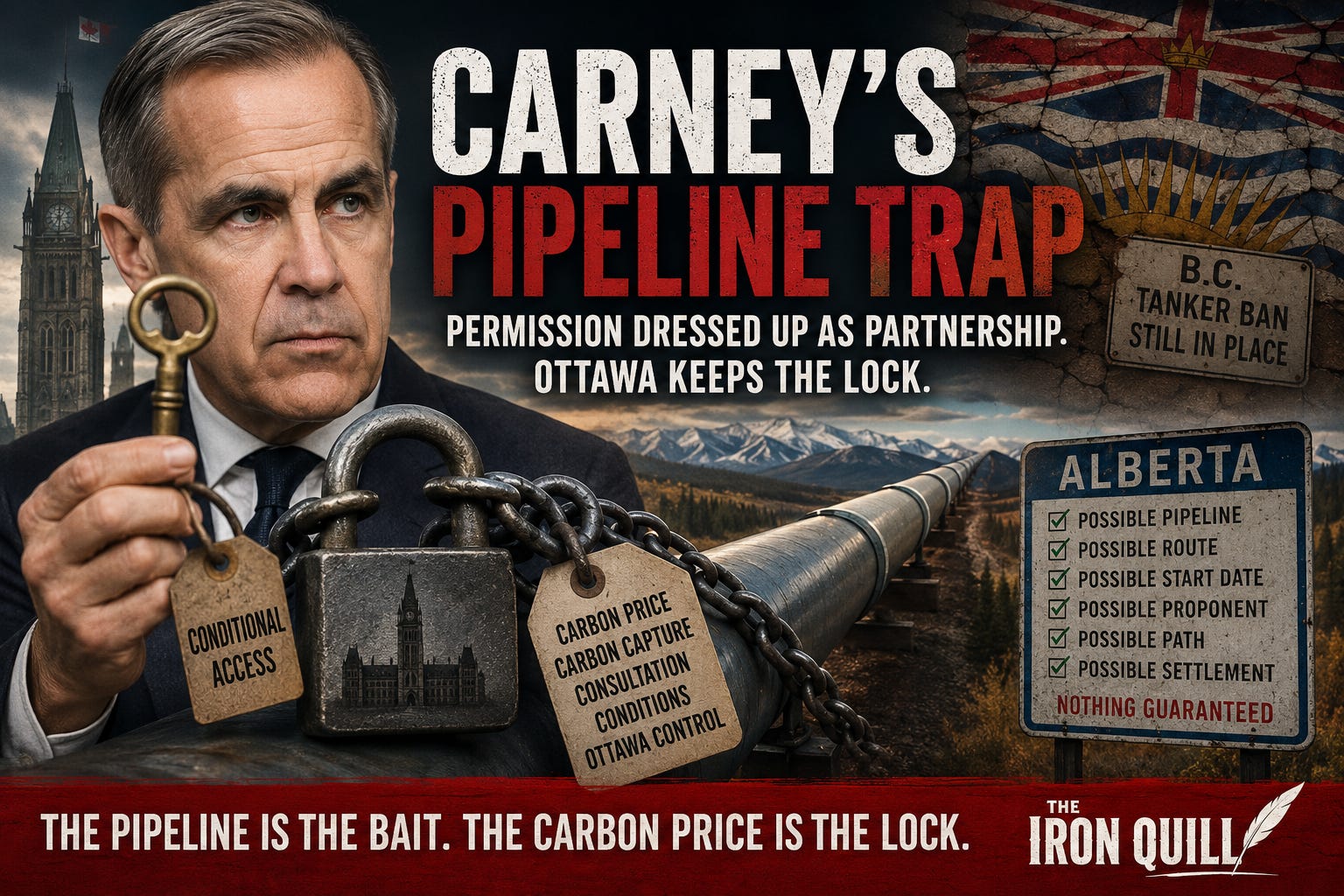
There are two ways to conquer the West. One is to stand at the gate and say no. The other is to open the gate halfway, attach a price meter to it, surround it with conditions, and call the whole thing partnership.
That is what Mark Carney has just done.
He did not walk into Alberta and tear down the gate. He walked in with a lock, offered the West a conditional key, and expected applause because the word “pipeline” was allowed back into polite conversation.
That is the trick.
The headline is cooperation. The sales pitch is energy security. The photo-op is Ottawa and Alberta standing together, pretending the adults have finally entered the room.
But the fine print tells a different story.
Ottawa is not freeing Alberta.
Ottawa is managing Alberta.
The Deal They Want You to See
Prime Minister Mark Carney and Alberta Premier Danielle Smith announced an agreement on industrial carbon pricing that is being sold as a step toward a possible new crude oil pipeline to British Columbia’s northwest coast. Reuters reported that the deal is tied to a proposed pipeline that could move up to one million barrels per day, with a target start date of September 2027, while also raising Alberta’s carbon credit price toward C$130 per tonne by 2040.
Ottawa wants Canadians to see a pipeline path, federal-provincial cooperation, and a serious government finally recognizing that Canada cannot build prosperity by strangling its own resource sector.
And yes, there is movement here. Alberta got Ottawa to say the word pipeline without spitting it out like a curse. That is not nothing. In a country where energy realism has been treated like a thought crime, even the admission that Canada needs to move oil to tidewater is significant.
But Westerners should not confuse movement with freedom.
A prisoner may be allowed to walk the yard. That does not mean he has been released.
The Pipeline Is the Bait
The pipeline is the shiny object.
It is what makes the deal sellable to Alberta, to industry, and to every Canadian who knows this country has been economically insane for years. A resource superpower that cannot move its own product to global markets is not a serious nation. It is a country choosing dependency while sitting on wealth.
So the promise matters.
But a promise is not a pipe in the ground.
This project is not built. It is not approved. Reuters reported that the project still lacks a private-sector proponent, remains conditional on Indigenous consultation, is tied to emissions-reduction technologies such as carbon capture, and still faces B.C. Premier David Eby’s opposition to lifting the tanker ban off the province’s northwest coast.
That is not certainty.
That is a maze.
Carney is not giving Alberta a pipeline. He is giving Alberta a conditional pathway through Ottawa’s machinery. Every serious obstacle remains in place: courts, consultation, B.C. opposition, the tanker-ban fight, carbon-capture demands, and the fact that no private builder has stepped forward.
And yet Alberta is expected to treat this as a breakthrough.
The West is being sold certainty by people who preserved every uncertainty that matters.
Carbon Pricing Is the Lock
The hard structure of this deal is not the pipeline.
It is the carbon price.
That is where Carney’s real power sits. Reuters reported the agreement pushes Alberta’s industrial carbon market toward a higher effective carbon cost, including a C$100-per-tonne floor beginning next year and a path to C$130 per tonne by 2040.
That is the lock. Ottawa is not saying, “Build.” Ottawa is saying, “You may build if you accept our pricing architecture.”
This is Carney’s style. It is not Trudeau’s style, and that matters.
Trudeau governed like an activist. He scolded. He sneered. He treated the West like a moral problem to be corrected by people who fly over the Prairies and call it national unity.
Carney is different.
He governs like a banker.
He does not need the sermon if he has the spreadsheet. He does not need theatrical contempt if he can build a system that makes compliance look like prudence. He does not need to shame Alberta into submission if he can price Alberta into the approved framework.
Trudeau tried to make the West feel guilty.
Carney is trying to make the West sign.
That may be more dangerous.
Because the cage does not always arrive with bars. Sometimes it arrives as a memorandum of understanding, a carbon floor, an emissions pathway, and a smiling press conference.
The Carbon Capture Clause
The carbon capture piece is the part Ottawa wants to sound technical enough that ordinary Canadians tune out.
But the principle is simple.
The oil may move, but only if the industry remodels itself around Ottawa-approved climate infrastructure.
Reuters reported that federal approval is connected to oil firms investing in emissions-reduction technologies like carbon capture, while industry leaders continue to raise concerns about cost and competitiveness, especially against the United States, which does not carry the same national carbon-pricing burden.
That is not energy freedom.
That is conditional permission.
The message is clear: you can develop, but only as an emissions-management project. You can produce, but only through the transition lens. You can move oil, but only if the carbon altar is fed first.
Canada keeps asking its energy sector to fight a global economic war while wearing ankle weights designed in Ottawa.
And then the same political class wonders why investment looks south.
The Americans understand something Ottawa keeps pretending not to know. A country that makes production easier wins. A country that turns every project into a moral audit loses.
The B.C. Wall Still Stands
Then there is British Columbia.
This is where the trap becomes obvious.
Alberta is being asked to absorb the carbon structure now for a pipeline that still has to survive the politics later. David Eby has already reaffirmed opposition to lifting the tanker ban off B.C.’s northwest coast, according to Reuters.
So what exactly has Alberta secured?
Alberta has a possible pipeline, a possible route, a possible start date, a possible proponent, a possible regulatory path, and a possible political settlement with B.C. But the carbon price is real, the compliance architecture is real, and the federal control is real.
That is the bargain.
Alberta gets a maybe. Ottawa gets a mechanism. And B.C. still gets a wall.
This is how the West gets managed. Not with a single no, but with conditional yeses tied to carbon prices, consultation, tanker-ban politics, carbon capture, industry costs, and Ottawa’s approval.
That is not nation-building.
That is permission dressed up as partnership.
Industry Can See the Problem
If this were pure liberation, industry would be celebrating without reservation.
It is not.
Reuters reported that oil executives fear the deal could hurt competitiveness against the United States, and that the Oil Sands Alliance opposes the carbon tax changes.
That matters.
The people who actually have to build, finance, operate, and compete under these rules can see what the political class wants voters to miss. This is not just a pipeline conversation. This is an industrial competitiveness conversation.
Canada is not operating in a vacuum.
Capital moves. Investment moves. Talent moves. Projects move. If Canada makes production too expensive, too slow, too political, and too conditional, the world does not stop and wait for us to find ourselves.
It goes somewhere else.
Ottawa can call that climate leadership if it wants. Capital will call it risk. The market will call it decline.
Danielle Smith’s Problem
Danielle Smith can argue she got movement.
Fair enough.
She can say she forced Ottawa to acknowledge the obvious: Canada needs pipelines, Alberta energy matters, and selling more product to global markets is in the national interest.
That argument has weight.
But Westerners should ask a colder question.
Did Alberta gain leverage, or did Ottawa turn Alberta’s hunger for a pipeline into acceptance of Carney’s carbon framework?
A starving man will call a locked pantry progress if someone finally lets him smell the bread.
That is the danger here.
Alberta has spent years fighting a federal order that tried to cap, tax, regulate, and morally downgrade its economic engine. Now Ottawa arrives with softer language and offers a pathway, but the pathway runs straight through the same climate architecture that helped create the problem.
This is not a reason to attack Smith personally.
It is a reason to read the fine print without emotion.
The West has been burned too many times by federal promises wrapped in national-interest language. Ottawa is very good at asking Alberta to compromise today in exchange for something that may happen tomorrow.
Tomorrow keeps moving.
The cost never does.
The Real Issue Is Sovereignty
This is bigger than one pipeline.
It is about who controls the economic destiny of the West.
The question is whether Alberta can develop its resources as a national engine, whether Saskatchewan and Alberta can build wealth outside Ottawa’s approved transition economy, and whether Canada can move energy to market without passing every serious project through ideological, regulatory, judicial, provincial, and activist veto corridors.
A country that cannot build a pipeline without a carbon confession is not serious about prosperity.
It is serious about control.
And control is what Carney understands.
He understands that modern power does not always need to ban something. It can price it, structure it, certify it, regulate it, de-risk it, reclassify it, and slowly make independence impossible.
That is why this deal matters.
It tells us what the Carney era may look like: less noise and more machinery, less open hostility and more institutional containment, less “you are wrong” and more “you may proceed under our terms.”
That is not freedom.
That is administrative rule with better manners.
The Hammer
Carney will sell this as balance.
Ottawa will call it cooperation.
The media will call it a breakthrough.
The political class will talk about certainty, investment, emissions, partnership, and national prosperity.
But the West should read the fine print.
The pipeline is not freedom if it comes with a leash. The timeline is not sovereignty if Ottawa still controls the gate. The deal is not liberation if Alberta must pay tribute through carbon pricing before it is allowed to move its own product.
Canada does not need another managed permission structure.
It needs the courage to build.
It needs a federal government that sees Western energy as a national asset, not a problem to be contained inside climate paperwork.
It needs leaders who understand that prosperity is not created by making every productive industry beg its way through a moral checkpoint.
Carney did not free the West. He made the cage more comfortable, gave Alberta the language of progress, and kept Ottawa’s hand on the lock.
That is not a pipeline victory. It is the oldest trick in Canadian politics: permission dressed up as partnership.
—The Iron Quill
The Iron Quill is reader-supported.
Most of this work remains free because truth should travel.
If you believe in the mission, become a paid supporter and help keep the signal alive.
He’s such a liar I can’t understand how Danielle doesn’t see the trap he’s setting up for her. He has no intentions of letting a pipeline go through BROOKFEILD has no way of making money off of it.
Full of Shite he is … lies beyond belief !