
Before They Left Ottawa

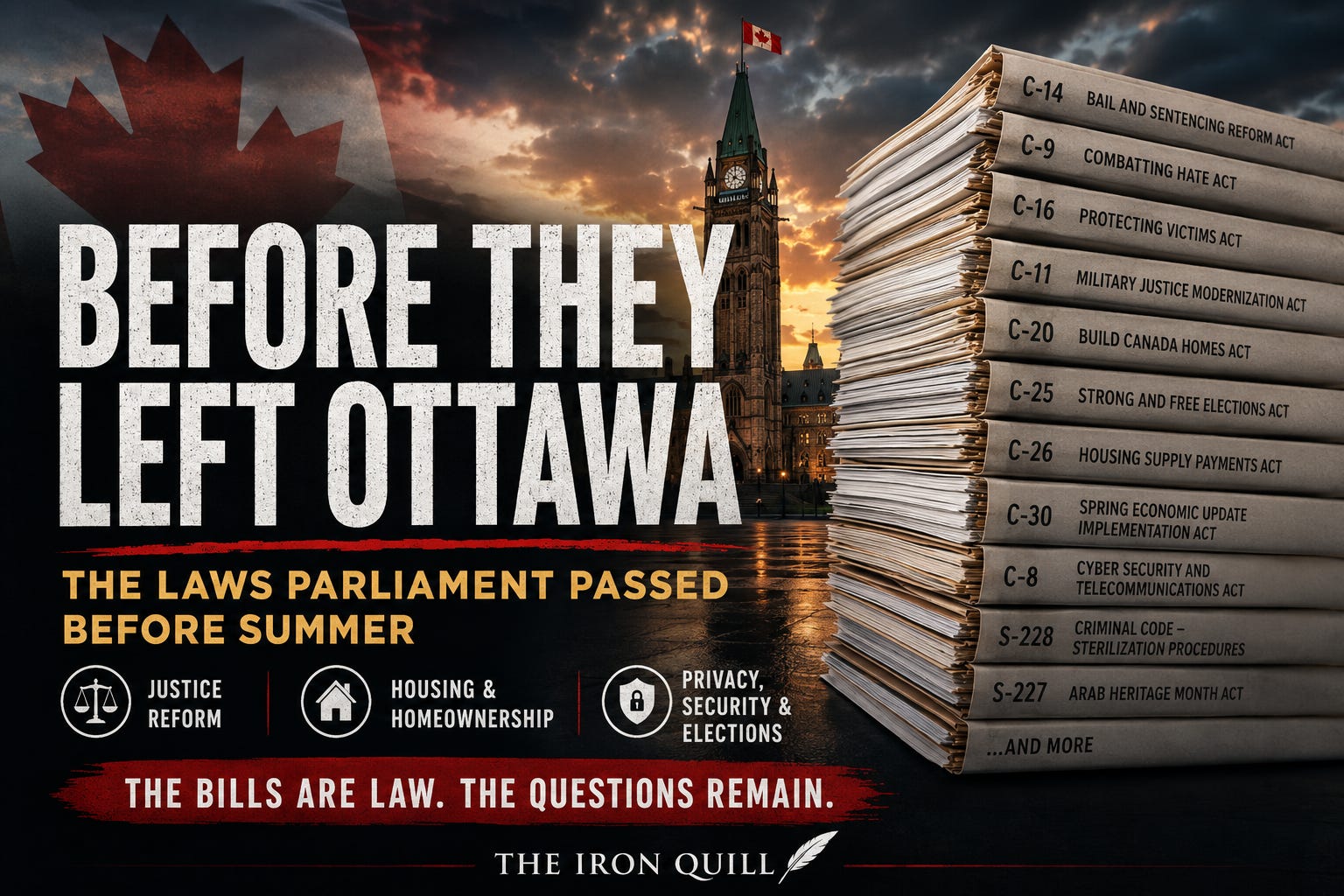
Parliament went home for the summer.
The lights dimmed.
The cameras turned away.
The daily theatre of Question Period went quiet.
And just before Ottawa emptied out, a flurry of bills crossed the finish line.
That is the part Canadians should not miss.
A country that does not watch its laws being made should not be surprised when it wakes up governed by things it never understood.
Government does not only act when the cameras are on. Sometimes the most important work happens in the final stretch, when everyone is tired, the calendar is closing, and the public is already looking somewhere else.
Not every bill in this stack is dangerous. Not every provision is a scandal. But every law deserves daylight before it becomes permanent.
This is not a small story.
The House of Commons passed 24 pieces of legislation during the sitting, with several receiving Royal Assent before Parliament adjourned for the summer. Some were technical. Some were symbolic. Some were serious. Some reached into criminal law, elections, housing, spending, military justice, privacy, and the power of the state.
That deserves attention.
Not panic.
Attention.
The End-of-Session Rush
Ottawa has a rhythm.
For months, bills crawl.
They are introduced. They are debated. They are sent to committee. They are amended. They wait. They stall. They get buried under speeches, scandals, travel, press conferences, and political theatre.
Then the calendar begins to close.
Suddenly everything matters.
Suddenly the government has urgent priorities.
Suddenly debate becomes delay.
Suddenly scrutiny becomes obstruction.
Suddenly MPs are asked to move quickly, vote quickly, agree quickly, and get it done before everyone heads home.
That is what happened again.
The government will say it was finishing its work.
The opposition will say debate was cut short.
Both things can be true in part.
But the citizen’s job is not to cheer for the government or the opposition.
The citizen’s job is to ask a better question.
What was passed?
How was it passed?
And what does it mean once Parliament is gone?
The Bills That Became Law
Before the break, a stack of legislation received Royal Assent.
Among them were bills dealing with bail and sentencing, hate crimes, criminal justice, sterilization procedures, military justice, housing, elections, government spending, cyber security, Arab Heritage Month, and other matters.
There was Bill C-14, the bail and sentencing reform bill.
There was Bill C-9, the Combatting Hate Act.
There was Bill C-16, the Protecting Victims Act.
There was Bill C-11, the Military Justice System Modernization Act.
There was Bill C-20, the Build Canada Homes Act.
There was Bill C-25, the Strong and Free Elections Act.
There was Bill C-26, which authorizes federal payments to provinces and territories for housing supply.
There was Bill C-30, the Spring Economic Update implementation bill.
There was Bill C-8, dealing with cyber security and telecommunications.
There was Bill C-225, a private member’s Criminal Code bill dealing with intimate partner murder.
There was Bill S-228, addressing sterilization procedures under the Criminal Code.
There was Bill S-227, creating Arab Heritage Month.
Some of these bills may be narrow.
Some may be widely supported.
Some may be sold under noble language.
But Canadians have learned to look past the label.
The name of a bill is not the same thing as the effect of a bill.
A good title does not guarantee good law.
The Justice Package
The government is calling this a criminal justice push.
Bill C-14 changes bail and sentencing rules. It makes it harder for certain accused persons to get bail, including in cases involving auto theft, extortion, violence, weapons, repeat violent charges, and certain organized crime related offences.
Canadians have been demanding bail reform for a long time.
They have watched stories of violent offenders released and reoffending. They have watched premiers call for action. They have watched police associations and victims’ families say the system is broken.
So yes, reform was needed.
But the question remains.
Will this law actually make communities safer?
Or will it become another Ottawa announcement that sounds strong on paper and weak in practice?
That is where Canadians have learned to be skeptical. They have heard promises before. They have watched governments announce safety while families still feel less safe. They have watched politicians claim victory before results arrive.
Then there is Bill C-16.
This bill deals with criminal and correctional matters, including child protection, gender-based violence, delays, coercive control, and deepfake intimate images.
Some parts of this bill address real problems in the modern world. Technology has created new forms of harm. Courts are slow. Victims often feel forgotten. Families often feel the system protects process more than people.
But again, Canadians should ask the basic question.
What exactly changed?
How will it be enforced?
Will victims actually see justice faster?
Or will another law be layered on top of a justice system already struggling under its own weight?
The Hate Crime Question
Bill C-9 may be one of the most important bills in the pile.
It amends the Criminal Code around hate propaganda, hate crime, and access to religious or cultural places.
The government says it is responding to a rise in hate and protecting vulnerable communities.
That matters.
Canadians should be able to worship, gather, speak, and live without intimidation. Synagogues, churches, mosques, temples, schools, and cultural centres should not become targets.
But when the state expands criminal law around speech, symbols, hatred, and access to public or religious places, Canadians must read carefully.
Canadians are capable of recognizing two truths at the same time.
Hatred is real.
Government overreach is also real.
Protecting people is necessary.
Protecting liberty is also necessary.
The danger is not in asking these questions.
The danger is in refusing to ask them.
Because criminal law does not stay inside press releases. It travels into courtrooms. It gives police and prosecutors new tools. It creates new boundaries. It changes the relationship between citizens and the state.
Canadians deserve more than slogans.
They deserve clarity.
Housing: More Supply or More Machinery?
Then came the housing bills.
Bill C-20 creates Build Canada Homes as a Crown corporation.
Bill C-26 authorizes payments to provinces and territories for the purpose of improving housing supply.
On paper, the message is simple.
Canada needs homes.
Everyone knows that.
Young families know it.
Renters know it.
Parents with adult children stuck at home know it.
Small towns know it.
Big cities know it.
The housing crisis is not theory.
It is kitchen-table reality.
But this is where Canadians should be careful.
A Crown corporation is not a house.
A federal payment is not a key in a young family’s hand.
A program is not a foundation.
An announcement is not a front door.
Canada does not need more housing speeches.
Canada needs actual housing.
The test is simple.
Do homes get built?
Do prices become reachable?
Do young Canadians see a path to ownership?
Do renters see relief?
Or does Ottawa create another machine, spend more money, hire more people, write more reports, and call it progress?
The Money Bill
Bill C-30 implemented parts of the spring economic update.
These bills matter because this is where governments often move money, policy, tax changes, program changes, and future obligations all at once.
Canadians may not read them.
Many MPs may not fully understand every line.
But the effects remain.
C-30 included measures tied to fuel excise tax, alcohol excise tax, Canada Pension Plan contributions, the Home Buyers’ Plan, and employee ownership trusts.
Some measures may be popular.
Some may be useful.
Some may be political positioning.
But the pattern matters.
Modern government increasingly operates through large implementation bills that carry many moving parts at once. That makes scrutiny harder. It makes public understanding harder. It makes accountability harder.
The bigger the bill, the easier it becomes to hide the ball.
That does not mean every provision is bad.
It means every provision deserves to be seen.
Elections and the Rules of the Game
Bill C-25 amended the Canada Elections Act and changed the names of certain electoral districts.
Election laws should always receive special attention.
Not because every change is sinister.
But because election law is the rulebook for democratic competition.
The people who benefit from the system should be very careful when changing the system.
That principle should apply to every party.
Liberal.
Conservative.
Bloc.
NDP.
Green.
Anyone.
When politicians adjust the machinery of elections, citizens should slow down and read the fine print.
The government may say the changes are technical.
Maybe some are.
But in a democracy, the rules of the game should never be treated like paperwork.
The Bill That Did Not Become Law Yet
There is also Bill C-22, the lawful access bill.
This one did not become law before the break. It passed the House of Commons and remains before the Senate.
That distinction matters.
But Canadians should not lose sight of it.
The bill has been criticized by privacy experts, civil liberties groups, tech voices, and opposition parties because it would expand state powers around digital information.
The government says law enforcement needs modern tools for modern crime.
That argument is not nonsense.
Crime has changed.
Technology has changed.
Police investigations have changed.
But so has the capacity of the state.
Digital access is not a small thing.
Metadata is not nothing.
Location patterns are not nothing.
Private communications are not nothing.
The lawful access debate is not finished.
It is waiting in the fall.
And Canadians should be waiting with it.
The Debate Over Debate
One of the biggest stories here is not only what passed.
It is how it passed.
Time allocation was used. Debate was limited. Bills moved quickly. Some passed on division, without recorded votes.
The government calls this getting work done.
The opposition calls it ramming legislation through.
The citizen should call it something else.
A warning sign.
Not because every delayed bill is good.
Not because every opposition tactic is noble.
Not because Parliament should talk forever.
But because laws deserve scrutiny.
When governments have power, they always discover reasons to move faster. There is always an emergency. Always a deadline. Always a crisis. Always a calendar. Always a reason why debate must end now and questions can wait until later.
But later rarely comes.
Once a bill becomes law, the press conference is over.
The MPs go home.
The machinery keeps moving.
And ordinary Canadians live under the result.
Where Was the Prime Minister?
Then there is the question of Mark Carney.
While Parliament was moving legislation through its final stretch, the prime minister spent part of the week outside the House attending the G7 summit and other events.
Supporters will say this is leadership.
They will say a prime minister must represent Canada internationally.
They will say global meetings matter.
Fine.
Representing Canada abroad matters.
But a prime minister cannot become a tourist of accountability, present for the world stage and absent from the Commons when his own government is moving law.
Question Period exists for a reason.
The House of Commons exists for a reason.
The prime minister is not only a global figure. He is the head of a government that answers to Parliament.
Canadians are not wrong to ask why the prime minister is so often elsewhere when questions are being asked at home.
This is bigger than Mark Carney.
It would matter if the prime minister were Conservative.
It would matter if the prime minister were Liberal.
It would matter if the prime minister were anyone.
Power should be present when accountability is scheduled.
That is not a partisan demand.
That is a democratic one.
Parliament Leaves. The Laws Stay.
Now the House is quiet.
The speeches are done.
The votes are recorded.
The bills are law.
MPs will return in September. Until then, many Canadians will enjoy summer, pay their bills, work their jobs, raise their kids, fight through the grocery aisle, watch gas prices, and try to keep their heads above water.
But the government does not stop.
The laws remain.
The spending continues.
The departments move.
The regulations develop.
The courts interpret.
The bureaucracy administers.
Parliament can take a recess.
Power does not.
The Real Lesson
The real story is not that MPs went home for the summer.
That is too easy.
The real story is what happened before they left.
A stack of bills moved.
Debate was limited.
Major areas of Canadian life were touched.
Justice.
Speech.
Housing.
Elections.
Military law.
Spending.
Digital privacy.
Public safety.
That is not background noise.
That is government.
And if citizens do not watch government while it works, they will only notice it when it reaches their doorstep.
Canada does not need more passive citizens.
It needs watchmen.
It needs people who read the bills after the slogans fade.
It needs people who ask what changed, who benefited, who gained power, who lost freedom, who paid the bill, and who was missing when the questions were asked.
Because speeches disappear.
Headlines fade.
Question Period clips vanish.
But laws remain.
And before Parliament left Ottawa, it left Canadians with plenty to read.
The only question is whether Canadians will.
—The Iron Quill
The Iron Quill is reader-supported.
Most of this work remains free because truth should travel.
If you believe in the mission, become a paid supporter and help keep the signal alive.
Welcome to Chinada. This is the biggest bunch of criminal politicians in the Histrionics of Canada. Arrest them all and charge them with treason !
An overly-long post, of critical importance. It reeks of ai, but the message is there, all the same. Our govt moves at a snail’s-pace, until summer recess approaches. Where is the outrage of the opposition? The filibuster? The hastily-passed Bills have enormous impact on Canadians’ Rights, under the Charter of Rights and Freedoms. I’m not appealing to the “elbows-up” boomers, I’m appealing to the opposition, who are supposed to keep the governing party accountable. Are you all so pathetically entitled, with your inflated salaries and gold plated pensions, that you have lost accountability to your constituents? How many more floor-crossers will be lured?
The MP’s are on their extended summer holidays, but legislation is cast in stone. Read the article. If you’re comfortable with what has transpired, then go to your summer cottages and enjoy your entitled life. If you’re uncomfortable with it, then voice your opinion, loud and clear.
Carney’s Canada is on a rapid, downward spiral. His agenda is not supportive of the people of Canada. Where is the opposition?